Jerusalem Bible 1966
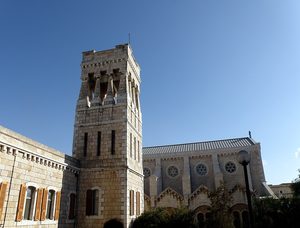

The Jerusalem Bible is a Catholic English Bible of 1966, built on the French La Bible de Jérusalem of the Dominican École Biblique and printed with that edition's introductions and notes. For about fifty years it supplied the Scripture readings at Mass in much of the English-speaking world outside North America, and its use of the divine name Yahweh lies behind a Vatican letter of 2008. Its text is under copyright and is described here, not quoted.
| Published | 1966 (London: Darton, Longman & Todd; New York: Doubleday); revised as the New Jerusalem Bible (1985) and the Revised New Jerusalem Bible (2019) |
|---|---|
| Translators | A team of Catholic scholars in Britain (about 27 named collaborators) under the general editor Alexander Jones; J. R. R. Tolkien translated Jonah. Based on La Bible de Jérusalem (1956), prepared at the Dominican École Biblique, Jerusalem |
| Language | English |
| Old Testament from | Hebrew and Aramaic (Masoretic Text), with the Septuagint and other ancient versions; the deuterocanonical books from the Greek |
| New Testament from | Greek, in a modern critical text |
| Books | 73 books: a 46-book Old Testament that includes the deuterocanonical books (Tobit, Judith, 1 and 2 Maccabees, Wisdom, Sirach, Baruch and the longer Esther and Daniel) in the Catholic order, and the 27-book New Testament |
| Approach | Between word-for-word and thought-for-thought: a literary English text carrying the French edition's notes (the 2019 revision describes itself as favoring accuracy over dynamic equivalence) |
| Copyright | Darton, Longman & Todd and Doubleday; in copyright |
| Used by | Catholic lectionaries in England and Wales (until Advent 2024), Ireland, Australia and New Zealand; listed by the Episcopal Church among translations approved for worship |
How it was made
In 1943 Pius XII's encyclical Divino afflante Spiritu encouraged Catholic scholars to translate from the Hebrew and Greek rather than from the Latin Vulgate that Jerome had made. In 1956 Dominican scholars of the École Biblique et Archéologique Française in Jerusalem published La Bible de Jérusalem, a French Bible with full introductions and notes. The English edition followed ten years later, edited by Alexander Jones of Christ's College, Liverpool; his Editor's Foreword is dated 1 June 1966. It was issued jointly by Darton, Longman & Todd in London and Doubleday in New York, and a shorter Reader's Edition with few notes appeared in 1968.
The relation of the English text to the French is itself part of the history. Jones's Foreword describes turning the annotated French edition into English while checking the Hebrew and Greek. Henry Wansbrough, who later edited the revision, wrote that Jones conceived the translation as "an underlay to the introduction and notes" and that some books were translated "almost entirely from the French." The 1985 preface says the 1966 edition had followed the French too closely.
J. R. R. Tolkien, a Catholic and an Oxford philologist, was among the collaborators and translated the Book of Jonah. Brendan Wolfe, writing in the Journal of Inklings Studies (2014), calls it the smallest portion any translator contributed; Tolkien's typescript survives in the Bodleian Library, and the published text includes changes by Jones and the other editors.
How it translates
The introductions and notes, translated from the French with revisions, follow modern critical scholarship; they date Daniel to the 160s B.C., for example, and treat 2 Peter as pseudonymous. The text is a readable literary English. In the Old Testament it follows the Masoretic Text but departs from it in many places, with the Septuagint and other ancient versions; the evangelical reviewer Gleason Archer criticized those departures in the Westminster Theological Journal (1971).
Its best-known choice is the divine name. Where the King James Version prints "the LORD" and the Douay-Rheims "the Lord," the Jerusalem Bible prints "Yahweh," the scholarly reconstruction of the Hebrew name, in more than 6,800 places. Jones's Foreword defends this, especially for the Psalms.
The Bible includes the deuterocanonical books within the Old Testament, so it prints 73 books, the Catholic canon; it does not print the further books in Orthodox Bibles, such as 3 Maccabees.
Reception and revisions
Catholic bishops' conferences adopted the 1966 text as the basis of the Sunday lectionary in much of the English-speaking world outside North America. For the New Jerusalem Bible (1985) Wansbrough, a Benedictine of Ampleforth, was given a free hand by Pierre Benoit, director of the École Biblique, and made at least a thousand changes to every book (Tyndale Society). The Psalms were translated afresh from the Hebrew and Greek, notes tied to the Catholic liturgy were removed, and inclusive language was used where possible. The NJB was translated directly from the original languages, with the French introductions and notes. The Revised New Jerusalem Bible (2019; Image in the United States) is Wansbrough's further revision of both earlier editions, with a Psalter based on the Revised Grail Psalms (2010).
On 29 June 2008 the Congregation for Divine Worship (Cardinal Francis Arinze, with Archbishop Albert Malcolm Ranjith) sent bishops' conferences a letter, issued by directive of the Holy Father, ruling that the name YHWH is "neither to be used or pronounced" in liturgical celebrations, songs and prayers. In liturgical translations it is to be rendered "God" where it stands with Adonai, which is rendered "Lord," following Liturgiam authenticam 41. The letter concerns worship; the Bible itself remained in print.
The England and Wales conference chose the English Standard Version Catholic Edition for a new lectionary, which came into use in England, Wales and Scotland on the First Sunday of Advent 2024; the previous lectionary used the Jerusalem Bible. The conferences of Ireland, Australia and New Zealand announced a joint lectionary project in December 2024 based on the Revised New Jerusalem Bible, which they describe as "sensitive to inclusivity" and faithful to the original texts. See also the New American Bible, the Catholic Bible used in the United States.
Where each church stands on the Jerusalem Bible
- Catholic:
The Church has not named one official English Bible; each bishops' conference approves versions for its lectionary, and the Jerusalem Bible was approved in several. Divino afflante Spiritu (1943) encouraged translation from the original languages, and Vatican II's Dei Verbum 22 asks that translations be made from the original texts, with Church approval and, where opportunity allows, in cooperation with other Christians. The letter of 29 June 2008 governs the divine name in worship. The conferences of Ireland, Australia and New Zealand base their new lectionary on the Revised New Jerusalem Bible; those of England, Wales and Scotland moved to the ESV Catholic Edition in 2024.
- Orthodox:
The Orthodox Church has made no statement about the Jerusalem Bible. Orthodox teaching on the Old Testament follows the Septuagint and includes the books Catholics call deuterocanonical, with others such as 3 Maccabees and the Prayer of Manasseh, which the Jerusalem Bible does not print (Confession of Dositheus, 1672, Question 3).
- Lutheran:
The Lutheran churches have made no statement about the Jerusalem Bible. The Lutheran Confessions name the prophetic and apostolic Scriptures as the norm but give no list of books; Luther's 1534 German Bible printed the Apocrypha apart, as "not held to be equal to Holy Scripture, but useful and good to read."
- Reformed:
The Reformed churches have made no statement about the Jerusalem Bible. The Westminster Confession (1.2-3) lists the 39 books of the Hebrew canon and says the Apocrypha are not inspired and have no more authority than other human writings; the Jerusalem Bible's Old Testament, which includes those books, therefore differs from the Reformed canon.
- Anglican:
Article VI of the Thirty-Nine Articles lists the Hebrew-canon books as Scripture and says the other books are read "for example of life and instruction of manners" but not to establish doctrine. The Episcopal Church lists the Jerusalem Bible, the New Jerusalem Bible (1987) and the Revised New Jerusalem Bible (2019) among the translations it has approved.
- Methodist:
Methodist churches have made no statement about the Jerusalem Bible. Article V of the Methodist Articles of Religion (1784) names the same Old Testament books as the Anglican Article VI and is silent on the Apocrypha; Methodists in practice use the 66-book canon.
- Baptist:
Baptist bodies have made no statement about the Jerusalem Bible. The Second London Confession (1689, 1.2-3) says the books called Apocrypha are "not being of divine inspiration" and are no part of the canon.
Sources
- Jerusalem Bible (1966), bible-researcher.com Jones's Foreword (1 June 1966), the French base, 1968 Reader's Edition, divine name, introductions
- Henry Wansbrough, "Editing the New Jerusalem Bible," Tyndale Society Journal the French base of 1966, the 1985 revision
- The New Jerusalem Bible (1985), Preface texts used; French base; revised 1973 French edition
- Brendan N. Wolfe, "Tolkien's Translation of Jonah," Journal of Inklings Studies 4.2 (2014) Tolkien's Jonah
- Congregation for Divine Worship, Letter to the Bishops' Conferences on the Name of God (29 June 2008, Prot. 213/08/L)
- Irish Catholic Bishops' Conference, Joint Lectionary Project (12 December 2024)
- Catholic Bishops' Conference of England and Wales, "Be patient and the beauty of the new lectionary will be revealed" (October 2024)
- Liturgy Office of England and Wales, Scripture versions
- Penguin Random House, The Revised New Jerusalem Bible (Image, 2019)
- Episcopal Church, approved translations of the Bible
- Pius XII, Divino afflante Spiritu (1943)
- Vatican II, Dei Verbum (1965), 22