Myrrh-streaming icons from 1982
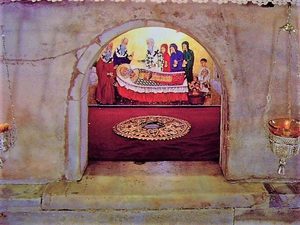

Myrrh-streaming icons are icons said to exude fragrant oil (Greek myron, Russian miro), reported mostly in Orthodox churches and usually read as a sign of the presence and prayer of the saint shown. This page follows the Montreal Iveron icon (1982–1997), the Hawaiian Iveron icon (from 2007) and the liquid gathered each year at the tomb of St Nicholas in Bari, with the investigations and the sceptics' findings. Each tradition's teaching on images and relics and on miraculous gifts shapes how it receives them.
| Date | Montreal icon: 24 November 1982 to 1997 (the icon has been missing since); Hawaiian icon: from October 2007; liquid at the tomb of St Nicholas: collected each 9 May |
|---|---|
| Place | Montreal, Canada, and wherever the icon traveled; Honolulu, Hawaii; the Basilica of St Nicholas, Bari, Italy |
| Claimed by | The Russian Orthodox Church Outside Russia (ROCOR) for the two icons; Orthodox and Catholic pilgrims at Bari, where the Dominicans keep the basilica |
| Type | Fragrant oil ("myrrh") on icons; the "manna" of the relics |
| Official status | Hawaiian icon recognized by ROCOR in June 2008; Montreal icon's travel blessed by ROCOR; no Catholic declaration about the manna; belief required by none of the seven churches |
| Investigations | No published laboratory report on either icon's myrrh found; University of Bari chemical analysis of the manna (1925); anatomical study of the relics (1953) |
What is claimed
According to its guardian, José Muñoz-Cortes, a Chilean-born iconographer who taught art in Montreal, the Montreal icon is a copy of the Iveron icon of Mount Athos, painted in 1981 at the Skete of the Nativity of Christ on Athos and given to him in summer 1982 by its abbot (OrthodoxWiki). In a 1983 interview with Archpriest Victor Potapov he said he found it covered with fragrant oil on 24 November 1982, and that it streamed almost without interruption, except in Holy Week, until it was lost; the account says oil flowed from the hands of the Mother of God and the Christ Child and later from the frame and glass (St John the Baptist Cathedral, Washington, via OrthoChristian). Muñoz-Cortes was killed in a hotel room in Athens on the night of 31 October 1997, a case that remains unsolved (OrthodoxWiki). The icon has not been seen since; a 2017 report says many of the faithful believe it returned to Athos.
The Hawaiian icon is a small printed copy of the Montreal icon, a gift in 1997 from Fr. Anatole Lyovin to Reader Nectarios of Holy Theotokos of Iveron Church (ROCOR) in Honolulu. Nectarios writes that on 6 October 2007 a bead of myrrh formed on a Cross icon in his home chapel and the mounted print was "completely wet"; Fr. Anatole revealed the icons to the parish on 14 October 2007 (Nectarios's letter, OrthoChristian).
At Bari the claim concerns a liquid gathered at the tomb of St Nicholas of Myra. Two early accounts, by Nicephorus and John the Archdeacon, say the relics lay in a sacred liquid when the men of Bari seized them in 1087; at the basilica the tomb is opened on the evening of 9 May and the liquid collected, about half a liter a year (St. Nicholas Center).
History and devotion
ROCOR recognized the Montreal icon and blessed its travels, and for fifteen years Muñoz-Cortes took it across North and South America, Australia and Europe (OrthodoxWiki). At the 35th anniversary liturgy in Washington (November 2017) Bishop Nicholas (Olhovsky) of Manhattan said, "It is a miracle of God" (RIA Novosti via OrthoChristian). The Hawaiian icon has traveled since June 2008: a 2011 update counted over 250 U.S. churches and an estimated 250,000 venerators (Nectarios, OrthoChristian).
At Bari the relics arrived on 9 May 1087, the day on which the Orthodox Church in America commemorates their translation (22 May on the Gregorian calendar for churches using the Julian). The Holy See entrusted the basilica to the Dominicans in 1951; the Archbishop of Bari celebrates the festival Masses of 7–9 May, and Orthodox guests are invited (St. Nicholas Center). The liquid is mixed with holy water and bottled for pilgrims.
Investigations and sceptical findings
For the Montreal icon, the account recorded at the Washington cathedral says only that a scientist in Miami found the back of the icon dry and a chip of its board ordinary pine; no published analysis of the myrrh appears in the sources found. Nectarios's letter describes no formal testing of the Hawaiian icon, and Bulgarian National Radio says ROCOR recognized it in 2008 after a "thorough ecclesiastical investigation" without describing it. Fr. Bill Olnhausen, an Orthodox priest, writes that no laboratory tests were done on the Cicero, Illinois, icon (1994) and that Orthodox people do not typically try to analyze myrrh; he reports that Bishop Basil first wiped away the myrrh and exorcised the icon in case it was a demonic counterfeit. In 2019 leaders of the Greek Orthodox Metropolis of Chicago asked that a weeping icon at Holy Trinity Church be removed from the sanctuary for authentication and urged that faith rests not on signs but on Christ crucified (ABC7 Chicago, 13 September 2019).
A Catholic monsignor, Jason Gray, says the first step in such cases is to look for a natural explanation (National Catholic Register, 2016). An encyclopedia entry on weeping statues says hoaxes have been uncovered, even among people of piety and honesty, and cites the sceptical investigator Joe Nickell's Looking for a Miracle. Metropolitan Hilarion (Alfeyev) called myrrh-streaming an "irrefutable, repeatedly recorded fact" (2005 conference, as reported).
At Bari the University of Bari's chemistry laboratory found the liquid in 1925 to be water "of particular purity." In 1953, during restoration, Luigi Martino, professor of human anatomy, studied the relics and found the skeleton in a shallow pool of liquid (Aleteia). The St. Nicholas Center's account says some see a miracle and others a natural process akin to condensation; Atlas Obscura, as reported by Aleteia, lists capillary action drawing water into the stone tomb among the theories.
Official status
ROCOR recognized the Hawaiian icon as miraculous in June 2008; accounts attribute the decision to Archbishop Kyrill of San Francisco or to the bishops as a body. No Orthodox church makes belief in any myrrh-streaming icon a condition of communion, and Hilarion, as reported, holds that canonical iconography, not miracles, is the test of an icon. At Bari the St. Nicholas Center's text says devotion to the water is not abolished, since it touched the saint's bones, but is not encouraged, lest personal faith be mistaken for something universal and required. The Catholic Church has no process for judging Orthodox icons; for claims in Catholic jurisdictions see the 2024 norms below.
Where each church stands
- Catholic:
The Dicastery for the Doctrine of the Faith's Norms for Proceeding in the Discernment of Alleged Supernatural Phenomena (17 May 2024) have the bishop examine such claims and, with the Dicastery's approval, reach one of six conclusions; the highest is a nihil obstat, and as a rule neither bishop nor Dicastery declares a phenomenon supernatural. Devotion under a nihil obstat is not obligatory. The Catechism (1674) lists the veneration of relics among forms of popular piety. Catholics keep the relics of St Nicholas at Bari, and the Archbishop of Bari presides at the May festival.
- Orthodox:
The Orthodox Church has no dogma on myrrh-streaming. ROCOR recognized the Hawaiian icon (2008) and blessed the Montreal icon's travels; Bishop Nicholas of Manhattan said of the latter, "It is a miracle of God." Metropolitan Philip of the Antiochian Archdiocese named the Cicero icon "the Miraculous Lady of Cicero"; the Metropolis of Chicago (2019) sought authentication and stressed that faith does not rest on signs. The Orthodox Church in America commemorates the translation of St Nicholas's relics on 9 May.
- Lutheran:
The Smalcald Articles (1537, II.2.22) call relics, with "so many falsehoods and tomfooleries," an abuse that should have been condemned long ago, since God has not commanded them. The Lutheran confessions make no statement about myrrh-streaming icons.
- Reformed:
The Westminster Confession (1647), 1.1, says "those former ways of God's revealing his will unto his people" are "now ceased"; many Reformed teachers hold that miraculous signs ceased with the apostles (spiritual gifts). The Reformed confessions make no statement about myrrh-streaming icons.
- Anglican:
Article XXII of the Thirty-Nine Articles rejects "the Romish Doctrine" of worshipping and adoring images and relics and of invoking saints, as having no warrant in Scripture. It has made no statement about myrrh-streaming icons.
- Methodist:
Article XIV of the Methodist Articles of Religion (1784) rejects the "Romish" worship and adoration of images and relics. Yet Wesley's Sermon 89 holds that the extraordinary gifts of the Spirit "almost totally ceased" after Constantine because "the love of many waxed cold," not because they were no longer needed. No Methodist body has made a statement about myrrh-streaming icons.
- Baptist:
The Second London Confession (1677; reissued 1689), 1.1, says "those former ways of Gods revealing his will unto his people" are "now ceased," and many Baptists hold that miracles ended with the apostolic age. Baptist bodies have made no statement about myrrh-streaming icons or relics.
Sources
- OrthoChristian, "The Montreal Iveron Myrrh-Streaming Icon of the Mother of God" (from St John the Baptist Cathedral, Washington)
- OrthodoxWiki, "José Muñoz-Cortes"
- OrthoChristian, "The Iveron Mother of God, and the Myrrh-Streaming Icons of Hawaii" (Reader Nectarios)
- OrthoChristian, "35th anniversary of myrrh-streaming Montreal Iveron Icon celebrated in DC" (RIA Novosti)
- Bulgarian National Radio, "Thousands in Sofia flock to see Hawaiian Myrrh-Streaming Icon"
- OrthoChristian, Nemychenkov on wonderworking reproductions (Hilarion Alfeyev)
- Fr. Bill Olnhausen, "Weeping Icons? Get Serious" (2018), on the Cicero icon
- National Catholic Register, "Myrrh Miracle? Thousands Flock to Illinois Icon" (2016)
- ABC7 Chicago, Holy Trinity Greek Orthodox Church icon (13 September 2019)
- Encyclopedia.com, "Weeping Statues"
- St. Nicholas Center, "The Manna of Saint Nicholas"
- St. Nicholas Center, Festival of the Translation of the Relics
- Aleteia, "The bones of St. Nicholas still exude a mysterious oil" (2017)
- Orthodox Church in America, Translation of the relics of St Nicholas to Bari (9 May)
- Vatican News, new norms on alleged supernatural phenomena (May 2024)
- Catechism of the Catholic Church 1674
- Smalcald Articles, Part II, Article 2 (Book of Concord)
- Westminster Confession of Faith, ch. 1 (OPC)
- Church of England, Articles of Religion
- Wesley, Sermon 89, "The More Excellent Way" (CCEL)
- Second London Baptist Confession (1689), ch. 1
- Tomb of Saint Nicolas, Bari, Wikimedia Commons (CC BY-SA 3.0)