Seraphim of Sarov 1754–1833
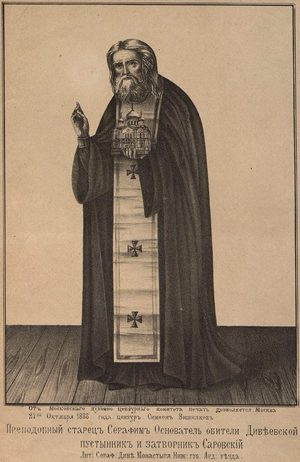

Seraphim of Sarov was a Russian monk who spent years as a hermit and in silence, then received pilgrims at Sarov monastery and guided the women's community at Diveyevo. The Russian Church declared him a saint in 1903 at the urging of Tsar Nicholas II, and his reported conversation on the acquisition of the Holy Spirit is among the best-known texts of modern Orthodox spirituality. Historians still ask how that text reached print and why the canonization went ahead as it did.
| Lived | 19 July 1754 (some sources give 1759), Kursk, to 2 January 1833 (Old Style), Sarov |
|---|---|
| Church | Russian Orthodox; monk of Sarov monastery, ordained priest in 1793 |
| Role | Hermit, then elder (starets) who received pilgrims; spiritual guide of the Diveyevo women's community |
| Influenced by | The elders Joseph and Pachomius at Sarov; the rule of the ancient monastic saint Pachomius and the example of Simeon the Stylite, as his Life records |
| Influenced | The Diveyevo community; Nicholas Motovilov, who recorded his conversation of 1831 |
| Writings | None cited as his own; his teaching is known from reports of his sayings and from the Conversation with Motovilov (recorded after November 1831, printed 1903) |
| Honored | Glorified by the Russian Church in 1903; feasts on 2 January (repose) and 19 July (uncovering of relics) in the Orthodox calendar; Commemoration on 2 January in the Church of England calendar |
Life
Prochorus Moshnin, a merchant's son from Kursk, arrived at Sarov monastery on 20 November 1778. He served the elder Joseph as cell attendant and worked in the bakery and carpenter's shop. According to the Orthodox Church in America (OCA) life of the saint, a three-year illness (dropsy) ended when the Virgin Mary appeared to him in a vision. He was tonsured Seraphim after eight years as a novice, became a hierodeacon, and in 1793 a priest. He then received permission to live alone in the forest about three and a half miles from the monastery, where he fasted strictly, read the New Testament through each week, and practiced the Jesus Prayer.
His Lives say he prayed there for a thousand days and nights on a large rock in the forest or a smaller stone in his cell, standing or kneeling with raised hands, in imitation of Simeon the Stylite. Three robbers beat him and left him for dead; he did not resist and later asked that they not be punished. He recovered, again by a vision of the Virgin according to the Life, but remained stooped for the rest of his life. He lived in silence, returned to the monastery in 1810 after fifteen years in the wilderness, and after five more years in his cell opened his door to the monks. On 25 November 1825, the Life says, the Virgin told him to end his seclusion; from then he received laypeople, greeting each with "Christ is Risen, my joy!" He also oversaw the women's community at Diveyevo, which the Sarov abbot Pachomius had blessed him to care for. On 2 January 1833 (Old Style) he was found dead, kneeling before an icon of the Virgin.
What he taught
The OCA life records the saying "Acquire the spirit of peace, and a thousand souls will be saved around you." His Lives present a path of ascetic labor: the Jesus Prayer, fasting, Scripture and the Fathers, and frequent Communion at the Liturgy. They also record visions, healings and clairvoyance, which the OCA life calls gifts of grace (see spiritual gifts).
His best-known teaching is the Conversation with Nicholas Motovilov, a layman he had healed, set in a forest near Sarov in November 1831. In the account, Seraphim says that the true aim of the Christian life is the acquisition of the Holy Spirit, and that prayer, vigil, fasting and almsgiving are "only means" to it. When Motovilov could not look at him, Seraphim told him, in the OCA's summary, that his own face too had become as bright, since he was "in the fulness of the Spirit of God." For the related Orthodox teaching on union with God (theosis) and the Lutheran answer from forensic justification, see theosis in Scripture and theosis or a courtroom verdict.
What historians say
The year of his birth is not settled: the OCA gives 19 July 1754, while other Orthodox sites such as Pravmir give 1759. The Motovilov text raises a larger question. The OCA life says Motovilov wrote it after the conversation of 1831, that the manuscript lay in an attic heap of rubbish for almost seventy years, and that the writer Sergei Nilus found it and printed it in 1903, calling it a "very precious contribution" to Orthodox spiritual literature. The Orthodox writer John Sanidopoulos argues that doubts about it center on Nilus rather than on Seraphim: Nilus's story of how he deciphered the damaged papers, his later publication of the Protocols of the Elders of Zion, and the mixing of the Conversation with prophecies from the Motovilov papers. He also notes that some scholars trace the text to Motovilov himself, and he compares its argument with John Cassian's Conferences.
The canonization has its own debate. The Pravoslavie.ru chronology reports that a commission under Metropolitan Vladimir (Bogoyavlensky) went to Sarov in January 1903 and found only bones, that almost all Synod members then opposed glorification, and that Metropolitan Anthony (Vadkovsky) wrote that incorruption of relics "is by no means considered a sign" of sanctity. After the Synod's report of 29 January 1903, Nicholas II wrote that he had read it "with a feeling of true joy and deep emotion." Richard Price's study in Studies in Church History 47 (2011) examines the "strange circumstances" of the canonization while stating that he does not question Seraphim's sanctity. Journalistic accounts, citing the memoirs of Sergei Witte, add that the tsar and tsarina hoped for a son, and name Konstantin Pobedonostsev, the Synod's lay head, as reluctant. The chronology reports that Anthony's statement held that Seraphim's sanctity rested on the faith of the people and not on the condition of his remains (images and relics).
His relics were opened by Soviet authorities in 1920, displayed in an atheist museum, and rediscovered in a Leningrad museum in 1990. They were handed to the Russian Church on 11 January 1991 and carried in procession to Diveyevo, where they were placed in Holy Trinity Cathedral on 30 July 1991 (Soviet control; the Orthodox record).
How the churches see Seraphim
- Catholic:
Rome has not canonized him. Fr. Hugh Barbour, O.Praem., answering for Catholic Answers (2022), says Catholics of the Russian Byzantine usage venerate him and that John Paul II called him a saint in Crossing the Threshold of Hope (1994). Metropolitan Hilarion delivered a relic of Seraphim from Patriarch Kirill to Pope Francis on 15 September 2016. On 30 May 2018 Francis told a Moscow Patriarchate delegation that the Patriarch had "sent me a relic of Saint Seraphim" and that "I venerate it and pray for our unity." On asking saints for prayer, see praying to saints.
- Orthodox:
The Holy Synod of the Russian Church glorified him: its act of 29 January 1903 was followed by the solemn uncovering of the relics at Sarov on 19 July (1 August) 1903. His feasts are 2 January (repose) and 19 July (uncovering of relics), Julian-calendar dates that fall on 15 January and 1 August on the civil calendar; the OCA's saints calendar lists them under 2 January and 19 July. The OCA life says he promised to intercede for those who remember his parents, Isidore and Agathia (intercession of saints).
- Lutheran:
The Lutheran confessions do not mention him. Article XXI of the Augsburg Confession (1530) says the memory of saints may be set before believers so that they may follow their faith and good works, but that "the Scripture teaches not the invocation of saints or to ask help of saints," since it sets Christ before us as Mediator and Intercessor.
- Reformed:
The Reformed churches have made no statement about Seraphim. The Westminster Confession (21.2) says religious worship is to be given to God "and to him alone," "not to angels, saints, or any other creature."
- Anglican:
The Church of England's calendar lists "Seraphim, Monk of Sarov, Spiritual Guide, 1833" on 2 January, printed in italics as a Commemoration. Article XXII of the Thirty-Nine Articles calls the Roman doctrine concerning "invocation of Saints" "a fond thing vainly invented."
- Methodist:
No Methodist body has made a statement about Seraphim. Article XIV of the Articles of Religion of the Methodist Church, from Wesley's revision of the Thirty-Nine Articles, calls the Roman doctrine of the invocation of saints "a fond thing," and the United Methodist Church says the Articles should be read in light of its 2008 Resolution of Intent: With a View to Unity.
- Baptist:
No Baptist body has made a statement about Seraphim. The Second London Confession (1689), which many Baptists hold, says in chapter 22 that religious worship is to be given to the Father, Son and Holy Spirit "and to him alone," not to angels, saints or any other creature.
Sources
- OCA, Repose of Venerable Seraphim, Wonderworker of Sarov (life) life, Motovilov conversation, 1903 printing
- OCA, Uncovering of the relics of Venerable Seraphim of Sarov (19 July)
- Pravmir, St Seraphim of Sarov birth year 1759
- Pravoslavie.ru, "2 / 15 января" and "19 июля / 1 августа" (calendar entries) Julian and civil dates of the feasts
- Pravoslavie.ru, "Благоухающие кости. Хронология канонизации преподобного Серафима Саровского" (2013) chronology of the 1903 canonization (in Russian)
- Price, "The Canonization of Serafim of Sarov: Piety, Prophecy and Politics in Late Imperial Russia," Studies in Church History 47 (2011)
- Russia Beyond (gw2ru), "Why Nicholas II insisted on canonizing Seraphim of Sarov" Witte and Pobedonostsev, as reported there
- Sanidopoulos, "The Authenticity of the Conversation Between St. Seraphim of Sarov and Nicholas Motovilov" (2020)
- Conversation of St Seraphim of Sarov with M. A. Motovilov on the purpose of the Christian life (English text)
- OrthoChristian, history of the relics, 1920 to 1991
- Catholic Answers, "Seraphim: saint or no saint?" (Fr. Hugh Barbour, 2022)
- Moscow Patriarchate, report of the gift of relics to Pope Francis (15 September 2016)
- Pope Francis, address to the delegation of the Moscow Patriarchate (30 May 2018)
- Augsburg Confession, Article XXI, Of the Worship of Saints (Book of Concord)
- Westminster Confession of Faith, chapter 21
- Church of England, The Calendar (Common Worship)
- Church of England, Articles of Religion
- United Methodist Church, The Articles of Religion of the Methodist Church
- Second London Baptist Confession (1689), chapter 22
- Lithograph of Seraphim of Sarov, 1888, Wikimedia Commons (public domain)