Dietrich Bonhoeffer 1906–1945
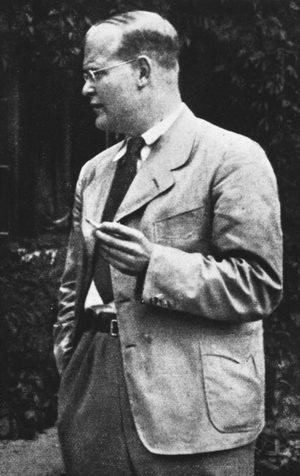

Dietrich Bonhoeffer was a Lutheran pastor and theologian who opposed the Nazi regime's control of the churches and its persecution of the Jews, joined the resistance circle in German military intelligence, and was hanged at Flossenbürg a month before the war in Europe ended. Several churches keep a day for him on 9 April, yet they differ on whether to call him a martyr and on how to read his late writings.
| Lived | 4 February 1906, Breslau, to 9 April 1945, Flossenbürg |
|---|---|
| Church | Lutheran pastor in the German Evangelical Church (ordained 15 November 1931); member of the Confessing Church |
| Role | Pastor of German-speaking congregations in London (1933–35); director of the Confessing Church's illegal seminary (1935–37); agent of the Abwehr, the German military intelligence office (from October 1940) |
| Influenced by | Karl Barth, whom he met in 1931; the worship and preaching of Abyssinian Baptist Church, Harlem (1930–31) |
| Influenced | Eberhard Bethge, his friend and editor; later Protestant, Catholic and Orthodox writers on the church in a secular age |
| Writings | Sanctorum Communio (dissertation, 1927); The Cost of Discipleship (1937); Life Together (1939); Ethics and Letters and Papers from Prison (published after his death) |
| Honored | 9 April in the Church of England calendar (Commemoration), the Episcopal Church calendar and the ELCA calendar; statue on the west front of Westminster Abbey (1998); recognized as a martyr by the United Methodist General Conference (2008) |
Life
Bonhoeffer wrote his doctoral dissertation, Sanctorum Communio, at Berlin (1927). In 1930–31 he studied at Union Theological Seminary in New York and attended Abyssinian Baptist Church in Harlem, where he taught Sunday school; he was ordained on 15 November 1931. In April 1933 he wrote "The Church and the Jewish Question," and he joined Martin Niemöller in founding the Pastors' Emergency League to protect pastors of Jewish origin. From September 1933 to April 1935 he served German-speaking congregations in London. The Confessing Church formed in May 1934, and in 1935 it asked him to direct an illegal seminary, which met first at Zingst and then at Finkenwalde until the Gestapo closed it in September 1937. He left for the United States on 2 June 1939 and returned to Germany that July.
Through his brother-in-law Hans von Dohnanyi and Hans Oster he was placed in the Abwehr (October 1940), which exempted him from military service; his journeys abroad served the resistance. In May 1942 he met Bishop George Bell of Chichester at Sigtuna, Sweden, and gave him news of the opposition inside Germany. He also took part in "Operation Seven," which moved Jews out of Germany. The Gestapo arrested him on 5 April 1943, after it uncovered the funds for that operation, and held him at Tegel prison in Berlin. After the failed attempt on Hitler of 20 July 1944 it moved against the remaining conspirators. He was hanged at Flossenbürg on 9 April 1945, with Wilhelm Canaris, Hans Oster and other conspirators.
What he taught
In Sanctorum Communio Bonhoeffer treated the church as a community in which Christ is present; in his Ethics he calls it a section of humanity in which Christ has taken form, not a religious society beside him. The Cost of Discipleship, drawn from his Finkenwalde lectures, set "costly grace" against "cheap grace" and called for obedience to Christ's command. Life Together (1939) records the seminarians' common life of prayer, Scripture and confession. In the Ethics and the essay "After Ten Years" (Christmas 1942) he wrote of responsible action in a corrupt world, in which a Christian may take on guilt for the sake of others.
In letters to Bethge from Tegel (30 April 1944 and after) he asked what Christianity could mean for a world that was becoming "religionless," and he criticized his teacher Barth's "positivism of revelation" as a revelation delivered without showing its meaning for worldly life. Andreas Pangritz argues that this criticism has been overemphasized and did not mark a real breach between them.
What historians say
Accounts differ on his part in the plot. The Christian History Institute describes him as a secret courier whose chief aim was to seek terms from the Allies; an Associated Press report of 2024 summarizes historians as saying he knew of and supported the plan to kill Hitler but was not active in its operations, and never morally justified it, though he saw no alternative. Craig Slane's Bonhoeffer as Martyr (Brazos, 2004) argues that his death counts as a Christian martyrdom, because it followed from a life of responsible obedience. The Lutheran pastor Brian Bennett writes that martyrs are killed for being Christian and that Bonhoeffer was arrested after he "got wrapped up in a plot" against Hitler, so he would not use the word (Living Lutheran, 2013).
The late letters are also disputed. The historian Richard Weikart (Christian Research Journal, 2012) admires Bonhoeffer's courage and acknowledges his insistence on the authority of Scripture, but holds that his neo-orthodox view of Scripture should make evangelical admirers wary. Mark Nation, Anthony Siegrist and Daniel Umbel, in Bonhoeffer the Assassin? (2013), challenge the picture of him as an assassin and stress his call to peacemaking. Eric Metaxas's Bonhoeffer: Pastor, Martyr, Prophet, Spy (Thomas Nelson, 2010) was widely praised in the popular press; scholars of the Dietrich Bonhoeffer Works criticized it. Clifford Green did so in "Hijacking Bonhoeffer" (Christian Century, 19 October 2010), Victoria Barnett called its grasp of the period's history shaky, and Ferdinand Schlingensiepen wrote that it made him "a likeable arch-conservative." In October 2024 more than eighty descendants of his siblings, and leaders of the International Bonhoeffer Society, protested against the use of his name by political movements.
His church's record is part of the discussion. Historians note that most Confessing Church leaders defended the church's own freedom more than the persecuted Jews, while German Protestants point to Barmen and to the pastors who were arrested or killed (the German Protestant churches under National Socialism; the Lutheran record).
How the churches see Bonhoeffer
- Catholic:
No Catholic calendar entry or Vatican act naming Bonhoeffer was found. The Vatican's Jubilee 2000 magazine published an excerpt of his writing on the church that was read at the ecumenical celebration at St. Paul outside the Walls. Cardinal Gerhard Ludwig Müller, former Prefect of the Congregation for the Doctrine of the Faith, called him a martyr "of all Christendom" (Jüdische Allgemeine, 2025). For the Catholic Church's own record in the period, see the Nazi era.
- Orthodox:
No statement about Bonhoeffer by an Orthodox church was found. Michel Evdokimov, an Orthodox priest, sets him beside the Russian Orthodox priest Alexander Men in Two Martyrs in a Godless World (New City Press, 2021); a reviewer says the book presents both as accepting secularization and seeing the church as a servant, not a privileged power (Englewood Review of Books).
- Lutheran:
The ELCA calendar keeps 9 April for him, but Evangelical Lutheran Worship calls him "theologian" and the Lutheran Book of Worship "teacher," without "martyr" (Bennett, Living Lutheran). Concordia Publishing House's list of commemorations for the Missouri Synod's Lutheran Service Book does not include him. David Scaer writes that Bonhoeffer's views "remain a point of contention, especially in the LCMS," and that Hermann Sasse disagreed with him over Barmen (Concordia Theological Quarterly, 2013); Uwe Simon-Netto, cited there, reads his resistance as a matter of the "left hand" of the two kingdoms.
- Reformed:
No Reformed church was found to name Bonhoeffer in a calendar or confession. Karl Barth, who helped draft the Barmen Declaration of May 1934, met him in 1931 and in 1933 urged him by letter to leave London and return to Germany. Bonhoeffer's own late criticism of Barth's "positivism of revelation" is a standing subject in Reformed theology (Pangritz).
- Anglican:
The Church of England's calendar has a Commemoration on 9 April for "Dietrich Bonhoeffer, Lutheran Pastor, Martyr, 1945," and the Episcopal Church's calendar remembers him as "Theologian and Martyr." His statue by Tim Crawley stands with nine other twentieth-century martyrs above the west door of Westminster Abbey (1998). Bishop George Bell took his message to Anthony Eden in 1942; Eden refused to reply, writing that the German opposition had "done little to prove its existence."
- Methodist:
The 2008 General Conference of the United Methodist Church (Fort Worth, 23 April to 2 May) adopted a resolution from Charles Sigman, citing the Church of England and the Church of Wales, that "we, as United Methodists, should also recognize Dietrich Bonhoeffer as a modern day martyr for the cause of Christ." United Methodist News Service called him the first martyr the church had officially recognized.
- Baptist:
No Baptist convention was found to have made a statement on Bonhoeffer. His year in Harlem was spent at Abyssinian Baptist Church under Adam Clayton Powell Sr.; the church is affiliated with the National Baptist Convention, USA and American Baptist Churches USA. Bonhoeffer later said that in New York he "turned from phraseology to reality" (David Ford, The Modern Theologians).
Sources
- United States Holocaust Memorial Museum, "Dietrich Bonhoeffer" birth, Union, London, Finkenwalde, Abwehr, arrest, execution, 1933 essay
- Christian History Institute, "The Life and Death of a Modern Martyr" ordination, Finkenwalde, Life Together, 1939 trip, Abwehr, Bell, Operation Seven
- Christian History Institute, "Barth and Bonhoeffer"
- Christian History, "You Are There" (issue 65), Barth's letter of 1933
- Wikipedia, "Dietrich Bonhoeffer" (pointer to the doctorate, Sunday school, Westminster Abbey and Methodist items) used only to locate facts
- Oremus, Common Worship calendar, 9 April: Commemoration of Dietrich Bonhoeffer
- Forward Movement, "The Church Remembers": Dietrich Bonhoeffer, Theologian and Martyr, 1945
- Bennett, "Theologian, yes. Pastor, yes. Martyr, ehhh," Living Lutheran, 11 April 2013
- Concordia Publishing House, Lutheran Service Book commemorations
- Scaer, "Abortion, Incarnation, and the Place of Children in the Church," Concordia Theological Quarterly 77 (2013)
- Byassee, review of Slane, Bonhoeffer as Martyr, Christian Century, 21 September 2004
- Weikart, "The Troubling Truth About Bonhoeffer's Theology," Christian Research Journal 35:6 (2012)
- Contemporary Church History Quarterly, notes on Metaxas, Green, Barnett and Schlingensiepen
- Associated Press, "What would Bonhoeffer do?" (October 2024)
- Pangritz, Karl Barth in the Theology of Dietrich Bonhoeffer (review, Themelios)
- Westminster Abbey, Dietrich Bonhoeffer (Modern Martyrs)
- Ecumenical News International, letters of Bishop Bell and Anthony Eden (2006)
- United Methodist News Service, "Bonhoeffer achieves martyr status with United Methodists" (17 June 2008) reposted copy
- Vatican, Jubilee 2000 magazine, excerpt from Bonhoeffer read at St. Paul outside the Walls
- Jüdische Allgemeine, "Dietrich Bonhoeffer: vor 80 Jahren hingerichtet, bis heute verehrt" (2025)
- Englewood Review of Books, review of Evdokimov, Two Martyrs in a Godless World
- Wikipedia, "Abyssinian Baptist Church" (pointer to affiliations and Bonhoeffer's Sunday school) used only to locate facts
- Bundesarchiv photograph, Wikimedia Commons (CC BY-SA 3.0 de)