Bernard of Clairvaux 1090–1153
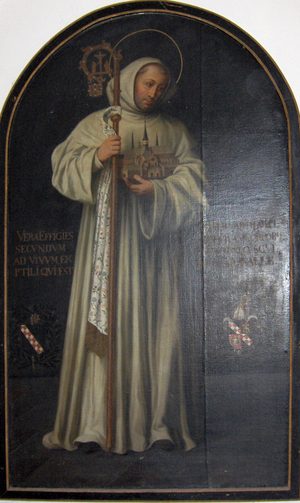

Bernard was the abbot of Clairvaux who made the Cistercian order a power in Europe, wrote the sermons on the Song of Songs that shaped medieval devotion to Christ, and at the pope's command preached the Second Crusade. His name is attached to a famous victory over Peter Abelard and a famous failure in the East, to a hymn that may not be his, and to the defense of Jews from a massacre. Catholics honor him as a Doctor of the Church; Protestants of several traditions quote him as a witness to grace.
| Lived | c. 1090, Fontaine-lès-Dijon, Burgundy, to 20 August 1153, Clairvaux |
|---|---|
| Church | Cistercian monk (entered Cîteaux c. 1113); first abbot of Clairvaux (1115) |
| Role | Abbot; adviser to popes; preacher of the Second Crusade (1146) |
| Influenced by | Augustine; the Rule of Benedict; the Cistercian reform begun at Cîteaux |
| Influenced | Cistercian spirituality; Luther and Calvin, who both quoted him; the later tradition of Christ-centered devotion |
| Writings | Homilies on Missus est (c. 1120); In Praise of the New Knighthood (c. 1129); On Grace and Free Choice; On Loving God; 86 sermons on the Song of Songs; On Consideration, for Pope Eugenius III; about 530 letters |
| Honored | Canonized 18 January 1174 by Alexander III; declared Doctor of the Church by Pius VIII (1830); Roman Catholic memorial 20 August; Church of England Lesser Festival and Episcopal Church commemoration 20 August; Lutheran Church–Missouri Synod commemoration 19 August |
Life
Bernard was born about 1090 at Fontaine-lès-Dijon into a noble family. About 1113 he entered the Cistercian house of Cîteaux with some thirty young Burgundian nobles, and on 25 June 1115 he founded the abbey of Clairvaux and became its abbot. The Catholic Encyclopedia says he founded 163 monasteries, and that 343 existed at his death. At the Council of Troyes (1128) he served as secretary, and he wrote In Praise of the New Knighthood (c. 1129) for the Knights Templar. In 1141 he brought charges against Peter Abelard at the Council of Sens.
On Easter, 31 March 1146, he preached the Second Crusade at Vézelay before King Louis VII; according to the Catholic Encyclopedia he cut up his own habit to make crosses for the crowd. He then went to Germany, where Conrad III took the cross at Speyer. The crusade failed in 1148, and Bernard answered the criticism in the second book of On Consideration, written for Pope Eugenius III. He died at Clairvaux on 20 August 1153 (the Catholic Encyclopedia gives 21 August) and was canonized by Alexander III on 18 January 1174, the first Cistercian on the calendar of saints.
What he taught
Bernard's best-known theme is the love of God. In On Loving God he writes that "the reason for loving God is God; the measure of this love is to love without measure," and he describes four degrees of love, from love of self for self's sake to love of self for God's sake. His eighty-six sermons on the Song of Songs, which he never finished (they stop at the third chapter), read the poem as the soul's marriage to Christ. In Sermon 15 he says the name of Jesus is "honey in the mouth, melody in the ear, joy in the heart," in Calvin's rendering.
On Grace and Free Choice holds that the will is free by nature, bound by sin, and set right by grace alone; Calvin summarizes him as saying that "to will well is the part of grace." He wrote warmly of the Virgin Mary in his homilies on Missus est; Pius XII quotes him as saying God willed that "we should have nothing which has not passed through the hands of Mary" (Mary and the saints). Yet in a letter to the canons of Lyons (Letter 174) he objected to their new feast of Mary's Conception, because they had set it up without consulting the Holy See and it was foreign to the Church's tradition. The Catholic Encyclopedia reads him as having had only the active conception in mind, not the doctrine later defined as the Immaculate Conception.
What historians say
On Abelard, Pius XII's encyclical Doctor Mellifluus (1953) says that in Abelard's thought human reason "usurps for itself everything, leaving nothing for faith." The Stanford Encyclopedia of Philosophy tells the affair differently: Abelard asked for a public debate, and Bernard turned it into an inquiry into his writings, after lobbying at the papal court. Sens itself was long dated to 1140; Constant Mews argued in 2002 that it met in 1141, and the Catholic Encyclopedia gives 1141. The council condemned propositions from Abelard's works, and Pope Innocent II confirmed the sentence of silence; Abelard died on 21 April 1142.
The Second Crusade is the other debate. Bernard held that he had acted on the pope's orders and blamed the crusaders' sins; he asked, "How could they make progress when they were always looking backward as they walked?" (James Brundage's translation). Pius XII wrote that if the crusade "was not brought to a successful conclusion, the fault was surely not his." Other writers stress the consequences: the failure turned many in the West against crusading and strained relations with Byzantium (the Crusades).
In 1146 a monk named Radulf preached against Jews along the Rhine, and massacres followed in several cities. According to the Encyclopaedia Judaica, Bernard opposed him in speech and in writing and went to Germany to stop him; Jewish chroniclers stressed his disinterested defense. The same entry notes that he drew a line between Jews, whom he forbade the crusaders to attack, and Muslims, against whom he thought war just, and that he asked only that interest on loans Jews had made to crusaders be cancelled.
How the churches see Bernard
- Catholic:
Alexander III canonized Bernard on 18 January 1174. Pius VIII named him a Doctor of the Church (1830), and in Doctor Mellifluus (24 May 1953) Pius XII called him "the last of the Fathers, but certainly not inferior to the earlier ones." His memorial is kept on 20 August. The Catholic Encyclopedia reads his letter to the Lyons canons as concerned with the active conception only, not the doctrine of the Immaculate Conception as later defined.
- Orthodox:
The Orthodox Church has made no statement about Bernard that could be found, and he is not among the Western saints OrthodoxWiki lists from before the 1054 schism (which it notes is not an official list). He lived after that separation (the Great Schism). The Orthodox Church in America's church history, in describing the Second Crusade he preached, says that the crusaders "further alienated the Byzantines."
- Lutheran:
The Apology of the Augsburg Confession (Article XII, paras. 73–74), part of the Book of Concord, quotes Bernard that forgiveness must be believed to come "through Him," and says these words "shed a wonderful light upon our cause" of justification by faith. Lutheran Service Book lists "Bernard of Clairvaux, Hymnwriter and Theologian" on 19 August. Luther said, according to the Table Talk, that Bernard's sermons surpass all other teachers, even Augustine, yet in 1533 he rejected the Missus est homilies for spending the whole sermon praising Mary.
- Reformed:
Calvin cites Bernard in the Institutes as a witness on sin, the bondage of the will and the name of Jesus (2.1.4; 2.3.5; 2.16.1), saying of the last that his remark "well deserves to be remembered." W. Stanford Reid reports that Calvin cited him favorably more often than any other medieval author, but not uncritically: he rejected Bernard's purgatory, allegorical exegesis and monasticism.
- Anglican:
The Church of England keeps 20 August as a Lesser Festival, "Bernard, Abbot of Clairvaux, Teacher of the Faith, 1153" (as listed on the Church of England website, and Wikipedia's index to it). The Episcopal Church's Lesser Feasts and Fasts also commemorates him on 20 August. Anglican hymnals such as Hymns Ancient and Modern and the New English Hymnal print "Jesus, the very thought of thee" (Hymnary.org), a hymn commonly credited to him.
- Methodist:
No Methodist statement about Bernard was found. The United Methodist Hymnal (no. 175) prints "Jesus, the Very Thought of Thee," credited to him and translated by Edward Caswall (1849). The Latin poem Jesu dulcis memoria is now widely held to be anonymous: Helen Deeming writes that all that can be said with confidence is that its author knew Cistercian theology.
- Baptist:
No statement about Bernard by a Baptist confession was found. The Southern Baptist Baptist Hymnal (1991, no. 225) prints "Jesus, the Very Thought of Thee," attributed to him, and Hymnary.org notes that some scholars hold it to be his and others place it in Britain at the end of the twelfth century.
Sources
- Catholic Encyclopedia (1913), "St. Bernard of Clairvaux" life, works, canonization; gives 21 August for his death
- Pius XII, Doctor Mellifluus (24 May 1953)
- Wikipedia, "Bernard of Clairvaux" (pointer for 20 August 1153 and the 1830 Doctor title)
- Catholic Encyclopedia (1913), "Immaculate Conception" (Bernard's Epistle 174)
- Catholic Encyclopedia (1913), "Councils of Sens"
- Mews, "The Council of Sens (1141): Abelard, Bernard, and the Fear of Social Upheaval," Speculum 77 (2002) cited via the Wikipedia article
- Stanford Encyclopedia of Philosophy, "Peter Abelard"
- Schaff, History of the Christian Church, vol. 5 (Bernard and the Second Crusade)
- Bernard, De consideratione, Book II (Brundage translation), Internet Medieval Sourcebook
- Encyclopaedia Judaica, "Bernard of Clairvaux" (encyclopedia.com)
- Apology of the Augsburg Confession, Article XII (Concordia Publishing House)
- Luther's reception of Bernard of Clairvaux (Concordia Theological Seminary, Fort Wayne)
- Concordia Publishing House, Lutheran Service Book commemorations
- Calvin, Institutes (Beveridge), Book 2, chs. 1, 3 and 16 (CCEL)
- Reid, "The Reformer Saint and the Saintly Reformer," Christian History 24 (1989)
- Church of England, Lesser Festivals (Common Worship)
- Wikipedia, "Lesser Festival (Anglicanism)" (list citing the Church of England page)
- Episcopal Church, Lesser Feasts and Fasts (Bernard, 20 August), via Kansas City Cathedral Noonday Prayer
- Hymnary.org, "Jesus, the Very Thought of Thee"
- Deeming, "Jesu dulcis memoria" (Royal Holloway)
- Orthodox Church in America, church history, twelfth century: the West
- OrthodoxWiki, Western Saints before the AD 1054 Schism
- Portrait photograph, Wikimedia Commons (public domain)