Charles Wesley 1707–1788
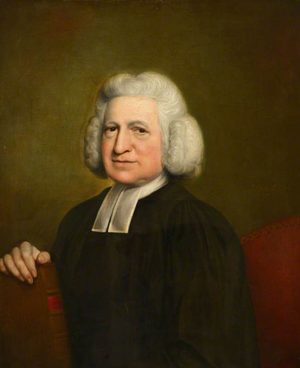

Charles Wesley was an Oxford-trained priest of the Church of England, a founder with his brother John of the Methodist movement, and the author of thousands of hymns, among them "Hark! the herald angels sing" and "Love divine, all loves excelling." Methodists treat his hymns as a body of teaching; many other churches sing them.
| Lived | 18 December 1707, Epworth, Lincolnshire, to 29 March 1788, London |
|---|---|
| Church | Priest of the Church of England (ordained deacon and priest, 1735); never left it |
| Role | Founder-member of the Oxford Holy Club; secretary to James Oglethorpe in Georgia; itinerant preacher; hymn writer; in later years a Methodist leader in Bristol and London |
| Influenced by | His parents Samuel and Susanna Wesley; his brother John; the Holy Club; the Moravians |
| Influenced | Methodist worship and hymnody; the English-language hymn tradition in many churches |
| Writings | Hymns and Sacred Poems (1739); Hymns on the Lord's Supper (1745, with John); Hymns for Those That Seek, and Those That Have Redemption (1747); most of the hymns in A Collection of Hymns for the Use of the People Called Methodists (1780) |
| Honored | 24 May with John (Lesser Festival) in the Church of England calendar; 3 March with John, as priests, in the Episcopal Church calendar; Wesley Day, 24 May, in the Methodist Church in Britain's lectionary |
Life
Charles Wesley was born at Epworth on 18 December 1707, the eighteenth of the nineteen children of the rector Samuel Wesley and Susanna Wesley. He entered Westminster School in April 1716 and Christ Church, Oxford, in June 1726, taking his B.A. in 1730 and M.A. in 1733. In 1729 he and a few friends began the group nicknamed "Methodists" for its methodical devotion; his brother John later took it over and made it a society.
In 1735 Charles was ordained deacon and priest, and sailed to Georgia with John and the colony's founder, James Oglethorpe, serving as Oglethorpe's secretary and as chaplain at Fort Frederica. The Georgia Encyclopedia says his strictness in religious matters caused difficulties there. He returned to England on 26 July 1736. On 21 May 1738, Whitsunday, he experienced the conversion from which he afterwards dated his faith, and, according to Hymnary, wrote "And can it be" in the days after; his brother John had his own experience at Aldersgate Street three days later, on 24 May.
For some eighteen years he preached as an itinerant, visiting Ireland twice, and with John he founded the societies in Bristol and London. In 1749 he married Sarah (Sally) Gwynne, and they had eight children. In 1771 he moved his family to London, where he continued to serve the Methodist societies until his death on 29 March 1788. He was buried in the churchyard of Marylebone parish church.
What he taught
Charles Wesley's teaching is found chiefly in verse. His hymns tell of redemption, of the sinner's release and of holiness. "And can it be" marvels, "Amazing love! how can it be, / That thou, my God, shouldst die for me!" and says of the soul set free, "My chains fell off, my heart was free, / I rose, went forth, and followed thee." "Love divine, all loves excelling," first printed in Hymns for Those That Seek, and Those That Have Redemption (1747), asks that believers be "Changed from glory into glory." The Wesleyan doctrine of perfect love, to which Methodists often relate that hymn, is argued over in Fifty questions for Methodists.
John Wesley's preface to A Collection of Hymns for the Use of the People Called Methodists (dated 20 October 1779; published 1780) calls the book "a little body of experimental and practical divinity" and says that "but a small part" of the hymns are his own; most are Charles's. Hymns on the Lord's Supper (1745) has 166 hymns, with an opening extract from Daniel Brevint's treatise supplied by John; its Part IV is headed "The Holy Eucharist as it Implies a Sacrifice." The Catholic-Methodist commission's report Encountering Christ the Saviour (2011) cites one of Charles's baptismal hymns for Wesley's distinction between the outward sign of baptism and the inward grace it signifies (para. 52). For the Lord's Supper see the readings below.
Charles held that Methodism belonged within the Church of England. According to Encyclopedia.com, he regarded the societies as wholly within the Church and was angered by John's ordination of ministers for America in 1784, which he saw as defiance of it. The questions this raised are set out in Wesley ordained without a bishop and Wesley and the bishops.
What historians say
Estimates of his output vary with the method of counting. Encyclopedia.com counts 4,430 published hymns and 2,840 more in manuscript, about 7,300 in all; Hymnary lists 2,475 texts by him that appear in hymnals. "Hark! the herald angels sing" has a history of its own: it was first printed in 1739, in Hymns and Sacred Poems, as a "Hymn for Christmas Day" beginning "Hark, how all the welkin rings," and George Whitefield changed the opening lines in his 1753 Collection, giving the version now sung (Hymnary).
Biographers differ on how he stands beside John. Gary Best (Charles Wesley: A Biography, Epworth, 2006), formerly headmaster of Kingswood School, wrote to bring Charles out from his brother's shadow; a reviewer in Reviews in Religion and Theology says he takes Charles's side and that the book is not an intellectual biography. Gareth Lloyd (Charles Wesley and the Struggle for Methodist Identity, Oxford, 2007) argues that Charles's "Church-Methodist" position had as great an influence on Methodism as the opinions of his opponents; a reviewer for Evangelicals Now adds that Lloyd sees the long struggle over separation as owing as much to the personal contest between the brothers as to principle, and Charles's reputation as a casualty of the hero-worship of John. For the divisions of the Methodist churches after the Wesleys, see the Methodist record.
How the churches see Charles Wesley
- Catholic:
The Catholic Church has made no declaration about Charles Wesley. The joint report of the Catholic-Methodist commission Encountering Christ the Saviour (2011) calls the 1745 Hymns on the Lord's Supper "a deep well-spring of truth" for common reflection, while noting that "not all Methodists will adhere in full" to their teaching and that Catholics "will not find in them the fullness of their doctrine on the Eucharist" (para. 75). It adds that the hymns' language of Christ's one sacrifice gives "a firm foundation" for further agreement on the sacrificial nature of the Eucharist (para. 131).
- Orthodox:
The Orthodox Church has made no statement about Charles Wesley.
- Lutheran:
No Lutheran church has made a statement about Charles Wesley. The Lutheran Church-Missouri Synod's Lutheran Service Book (2006) prints "Hark! The Herald Angels Sing" (no. 380), crediting him with the text, marked as altered.
- Reformed:
No Reformed body has made a statement about Charles Wesley. The Trinity Hymnal (revised edition, 1990), published for the Orthodox Presbyterian Church and the Presbyterian Church in America, includes his "O for a thousand tongues to sing" (no. 164) and "Love divine, all loves excelling" (no. 529). On election the Reformed confessions and the Methodist tradition differ: the Westminster Confession (3.3) says that "some men and angels are predestinated unto everlasting life" (see Predestination and free will). Churches that sing only the psalms do not sing his hymns (only psalms in worship).
- Anglican:
The Church of England's Common Worship calendar (2000) lists "John and Charles Wesley, Evangelists, Hymn writers" on 24 May as a Lesser Festival, with a collect asking God to give "a heart ever to rejoice in singing your praises." The Episcopal Church's calendar lists "John and Charles Wesley, Priests, 1791, 1788" on 3 March. Charles died a priest of the Church of England and was buried in the churchyard of a parish church.
- Methodist:
Methodists value Charles Wesley's hymns as teaching as well as praise. The Methodist Church in Britain's lectionary provides readings for Wesley Day (24 May), and John Wesley's 1780 preface calls the hymnbook "a little body of experimental and practical divinity." The United Methodist statement This Holy Mystery calls the Hymns on the Lord's Supper "our richest resource for study," as the Catholic-Methodist report quotes it (para. 75). The Methodist Church in Britain's doctrinal standards name John Wesley's Notes and Sermons rather than the hymns (how binding are the Standard Sermons).
- Baptist:
Baptist churches have made no statement about Charles Wesley. The Baptist Hymnal (2008), published by LifeWay for Southern Baptist churches, prints "And can it be that I should gain" (no. 250). Baptists differ from Methodists on baptism, reserving it for believers (Baptism).
Sources
- Encyclopedia.com, "Wesley, Charles" dates, schooling, marriage, hymn counts, stance on 1784
- Georgia Encyclopedia, "Charles Wesley (1707-1788)"
- Hymnary.org, Charles Wesley (birth, death, burial, number of texts)
- Hymnary.org, "And Can It Be, That I Should Gain?"
- Hymnary.org, "Hark! The Herald Angels Sing"
- Hymnary.org, "Love Divine, All Loves Excelling"
- Wesley, Preface to A Collection of Hymns for the Use of the People Called Methodists (1779), Wesley Center Online
- Hymns on the Lord's Supper (1745), Duke Divinity School edition
- Catholic-Methodist commission, Encountering Christ the Saviour: Church and Sacraments (Durban, 2011)
- Gareth Lloyd, Charles Wesley and the Struggle for Methodist Identity (Oxford, 2007), publisher's page
- Evangelicals Now, review of Lloyd, "Family politics"
- Reviews in Religion and Theology 14 (4), review of Best, Charles Wesley
- Metrevive, review of Gary Best, Charles Wesley (Epworth, 2006)
- Exciting Holiness, 24 May: John and Charles Wesley (Common Worship)
- Episcopal Church, Calendar of the Church Year
- Methodist Church in Britain, lectionary for 24 May
- Hymnary.org, Lutheran Service Book 380
- Hymnary.org, Trinity Hymnal (Rev. ed.), 164
- Hymnary.org, Trinity Hymnal (Rev. ed.), publisher and denominations
- Hymnary.org, Baptist Hymnal 2008, 250
- Westminster Confession of Faith, ch. 3
- Portrait of Charles Wesley by John Russell (1771), Wikimedia Commons (public domain)