William Tyndale c. 1494–1536
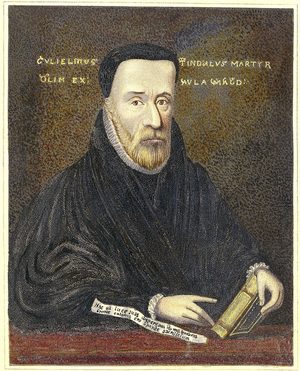

William Tyndale was an English priest who printed the first English New Testament translated from the Greek (1526) and was strangled and burned for heresy ten years later, before he could finish the Old Testament. His wording lies behind much of the King James Version, and every tradition's view of him is tied to its view of the Bible in the people's language.
| Lived | c. 1494, Gloucestershire, to 6 October 1536, Vilvoorde, near Brussels |
|---|---|
| Church | Roman Catholic priest (ordained 1515); condemned for heresy and executed by the imperial authorities (1536) |
| Role | Translator of the Bible; chaplain or tutor in the household of Sir John Walsh at Little Sodbury; exile on the Continent from 1524 |
| Influenced by | Erasmus's Greek New Testament (1516); Luther's prefaces and German New Testament |
| Influenced | John Rogers and Miles Coverdale, whose Bibles built on his work; the Great Bible (1539); the King James Version (1611) |
| Writings | New Testament (1526; revised 1534); The Obedience of a Christian Man (1528); Pentateuch (1530); The Practice of Prelates (1530); Answer unto Sir Thomas More's Dialogue (1531) |
| Honored | 6 October: Lesser Festival in the Church of England calendar; 6 October in the Episcopal Church's calendar |
Life
Tyndale was probably born in Gloucestershire between 1493 and 1495. He studied at Magdalen Hall, Oxford (B.A. 1512), and probably at Cambridge, and was ordained priest in 1515. From about 1521 he lived in the household of Sir John Walsh at Little Sodbury, where he was summoned before the chancellor of the diocese of Worcester on a charge of heresy. In 1523 he asked Cuthbert Tunstall, Bishop of London, for a place to translate the New Testament and was refused; he wrote later that there was "no place to do it in all England." He left in 1524 and reached Hamburg.
Printing of his New Testament began at Cologne in 1525 but was stopped by the city authorities. At Worms, Peter Schoeffer printed it in 1526, from Erasmus's Greek text. Copies were smuggled into England; Tunstall denounced them, and they were burned at St Paul's in October 1526. Tyndale revised the New Testament in 1534. He printed the Pentateuch from the Hebrew (1530) and wrote The Obedience of a Christian Man (1528) and The Practice of Prelates (1530), which opposed Henry VIII's divorce.
In spring 1535 Henry Phillips betrayed him at Antwerp, and he was held in the castle of Vilvoorde for about eighteen months. He was tried by Roman Catholic inquisitors, condemned as a heretic and degraded from the priesthood in August 1536, and on 6 October 1536 he was strangled and burned. According to John Foxe, his last words were "Lord, open the King of England's eyes." He left in manuscript a translation of the Old Testament from Joshua to 2 Chronicles.
What he taught
Tyndale held that Scripture, not the church, is the final authority for faith (Scripture alone), and that ordinary people must have it in their own language. To a cleric he is reported to have said that, if God spared his life, he would make "a boy that driveth a plow" know more of Scripture than the cleric did. He agreed with Luther that sinners are justified by faith alone. On the Lord's Supper, Timothy George writes, he came closer to the Swiss reformers than to Luther, and recent scholarship has found the theme of covenant central to his thought.
His translation changed the church's vocabulary. He rendered ekklesia as "congregation" rather than "church," presbyteros as "elder" (at first "senior") rather than "priest," agape as "love" rather than "charity," and wrote "repent" where earlier versions had "do penance." He defended these choices by the Greek text and by the example of Erasmus, and wrote: "I never altered one syllable of God's Word against my conscience." He also held that rulers rule by divine ordinance and are owed obedience.
What historians say
Luther. Thomas More called Tyndale a "confederate with Luther." Tyndale's prologue to Romans is largely a translation of Luther's preface of 1522. L. J. Trinterud argued in 1962 that the debt has been overstated: Tyndale took Luther's writings and name but not his distinctive positions, and owed more to Christian humanism and the Swiss reformers. Donald Smeeton finds Luther the most widely felt influence yet notes that Tyndale often expanded or reversed him. Whether Tyndale visited Wittenberg is also uncertain: George thinks a stay there likely, and Smeeton accepts a visit but says a meeting with Luther cannot be clearly established.
The King James Version. David Daniell, Tyndale's biographer, wrote that the New Testament of the KJV is "83% pure Tyndale." George cites about 90 percent of what Tyndale completed. Such figures depend on how a share is counted, and they vary from study to study.
More and Tyndale. Eamon Duffy writes that More aimed most of his English polemic (1529–33) at Tyndale, whose New Testament he saw as the source of errors spreading among ordinary readers. More charged that the changes of "church," "priest" and "charity" served Lutheran teaching; Tyndale replied in 1531 on linguistic grounds, appealing to the Greek and to Erasmus. More also described Tyndale as "a man of right good living, studious, and well learned in Scripture" (as quoted by George).
His death. Tyndale was condemned under the heresy law of the Empire, in the years when other reformers and Anabaptists were executed (Executing reformers and Anabaptists). Who arranged and paid for the betrayal is unknown, and the account of the arrest rests on Foxe, who had it from Thomas Poyntz, Tyndale's host at Antwerp. The Tyndale Society gives the execution only as autumn 1536; 6 October is the date usually given.
How the churches see Tyndale
- Catholic:
Tunstall, Bishop of London, denounced the English New Testaments in 1526 and had them burned, and More answered them in his Dialogue Concerning Heresies (1529) and Confutation (1532–33). The Catholic Encyclopedia (1913) records that the book was prohibited in England. Tyndale was condemned for heresy by the imperial authorities after examination by Catholic inquisitors. The Catholic answer to such executions is that they followed heresy laws common to Christendom (the Catholic record). Vatican II, in Dei Verbum 22, asks that easy access to Scripture be provided for all the faithful and encourages translations. No Catholic statement about Tyndale by name is known.
- Orthodox:
No official Orthodox statement about Tyndale is known. Orthodox teaching on reading Scripture is that of the Synod of Jerusalem (1672), which says every Orthodox Christian may hear it but forbids the unprepared to read some parts, especially of the Old Testament. Orthodox Christians point to Cyril and Methodius, who translated Scripture into Slavonic in 863, as precedent for Scripture in the people's language (the Bible and the people).
- Lutheran:
Tyndale is not among the commemorations in the Lutheran Service Book. The Missouri Synod's Reformation site (Deaconess Betsy Karkan, 2017) calls him "the Father of the English Bible" and says that Luther's work had "a significant influence" on his, shown in his adoption of Luther's order of the New Testament books. Article XXIV of the Augsburg Confession defends worship in a language the people understand. Scholars differ over how far Tyndale was a Lutheran: he agreed with Luther on justification but not on the Supper.
- Reformed:
No Reformed confession names Tyndale. The Westminster Confession (1.8) holds that Scripture is to be "translated into the vulgar language of every nation," and its Larger Catechism (Q 156) binds all to read it privately and with their families. Ligonier Ministries (Todd Rester, 2026) says Tyndale agreed with Luther on faith and justification, and lists the charges at his trial: justification by faith alone, human traditions not binding conscience, and no invocation of Mary and the saints. George notes that Tyndale's view of the Supper and of sanctification lay closer to the Swiss and South German Reformed leaders than to Luther.
- Anglican:
The Church of England keeps 6 October as a Lesser Festival of William Tyndale, translator of the Scriptures and martyr; the Episcopal Church's calendar lists "William Tyndale, Priest, 1536" on the same day. Henry VIII's injunction of 1538 ordered an English Bible placed in every parish, and the Great Bible (1539) was based on the Matthew's Bible, which the Catholic Encyclopedia calls a compilation of Tyndale's and Coverdale's renderings. Article XXIV of the Thirty-Nine Articles requires worship in a tongue the people understand. Rowan Williams, as quoted by George, calls Tyndale's thought "not Lutheran or Calvinistic or Zwinglian, but distinctive."
- Methodist:
The United Methodist Church has no official Bible translation, and no Methodist body is known to have made a statement about Tyndale. Wesley wrote his Explanatory Notes upon the New Testament (1754) for "plain unlettered men" and set down the common English translation of his day, the King James Version, whose New Testament Daniell traced largely to Tyndale. United Methodist News (Heather Hahn, 2017) names Tyndale among the reformers who "likewise wanted to produce a Bible in his people's language." Articles of Religion V and XV set out Scripture's sufficiency and worship in the people's tongue.
- Baptist:
Baptists do not claim Tyndale as a founder. Timothy George of Beeson Divinity School writes in the Southern Baptist Journal of Theology (2011) that he "established no church, founded no school," and gave his life to translating Scripture. Baptists hold that the Reformation restored the Bible to ordinary people (the Bible and the people), and Baptist writers honor Tyndale in that story: Baptist Press profiles him as the first to translate the Bible into English from the original languages. Bristol Baptist College held a copy of his 1526 New Testament, left to it by the Baptist minister Andrew Gifford (d. 1784), until it was sold to the British Library in 1994.
Sources
- Hertford College, Oxford, "William Tyndale (1494-1536)" chaplaincy, Tunstall, Cologne and Worms, Practice of Prelates, Vilvoorde
- Tyndale Society, early life and timeline birth, Oxford B.A. 1512, Little Sodbury
- Christian History Institute, "A Man for All People" Tunstall, More dispute, Phillips, execution, last words
- Christian History Institute, "What the English Bible Cost One Man" trial, degradation, execution; uncertainties of the sources
- Tyndale Society, "Tyndale's Betrayal and Death" arrest, Foxe's source Poyntz
- George, "Tyndale's One Thing," Southern Baptist Journal of Theology 15.4 (2011): 30-37
- Daniell, Gloucester Cathedral Lecture, 2003 (Tyndale Society Journal 27) Greek source; 83% of the KJV New Testament
- Smeeton, "Where Did Tyndale Get His Theology?" Christian History 16 (1987)
- Trinterud, "A Reappraisal of William Tyndale's Debt to Martin Luther," Church History 31 (1962): 24-45
- Tyndale's Prologue to Romans (1534 text), bible-researcher.com largely a translation of Luther's preface
- Tyndale Society, "Sir Thomas More's Dialogue" (Anne O'Donnell, S.N.D.) More's objections to word choices; Tyndale's reply
- More, Dialogue Concerning Heresies, Books III-IV, summarized by R. I. Lakowski
- Duffy, "Thomas More's Confutation: A Literary Failure?" Studies in Church History 48 (2012): 134-155
- Catholic Encyclopedia (1913), "Versions of the Bible"
- Catholic Encyclopedia (1913), "England (Before the Reformation)"
- Vatican II, Dei Verbum 22
- Synod of Jerusalem (Confession of Dositheus) 1672, Question 1
- Lutheran Service Book commemorations (Concordia Publishing House)
- Karkan, "The Cradle of Christ in Every Home: Reformation Translations of the Bible," lutheranreformation.org (2017)
- Augsburg Confession, Article XXIV (Book of Concord)
- Westminster Confession of Faith 1.8 (OPC)
- Westminster Larger Catechism Q 156 (OPC)
- Rester, "Who Was William Tyndale?" Ligonier Ministries (2026)
- Church of England, Lesser Festivals (Common Worship)
- Episcopal Church, Calendar of the Church Year
- Church of England, Articles of Religion
- Britannica, "Great Bible" and "John Rogers" Matthew's Bible, Great Bible
- UMC, "Does the UMC have an official Bible translation?"
- Hahn, "6 ways the Reformation affects our world," United Methodist News (2017)
- Wesley, Preface to Explanatory Notes upon the New Testament (1754)
- Baptist Press, "Labor Day: 4 who exemplify laboring for the Lord"
- West, "The Bristol 1526 Tyndale Testament," Tyndale Society
- Portrait, Wikimedia Commons (public domain)