Bolsena and Orvieto 1263
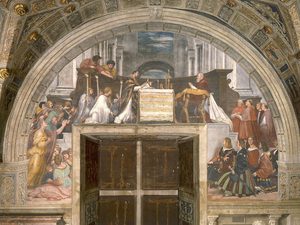

The Miracle of Bolsena is the Eucharistic miracle Catholic tradition places in 1263 in the church of Santa Cristina at Bolsena in Lazio, where a consecrated Host is said to have bled onto the linen corporal. The corporal is kept at Orvieto, where Urban IV was then living and in 1264 issued the bull establishing the feast of Corpus Christi. Every tradition has a view on the feast, the procession of the Sacrament and the doctrine of the real presence behind it, and historians discuss how far the miracle and the feast are connected.
| Date | 1263, as tradition dates it (sources also give 1264); no day is recorded |
|---|---|
| Place | Church of Santa Cristina, Bolsena (Lazio); the corporal is kept at Orvieto Cathedral (Umbria) |
| Claimed by | The Catholic Church, through the local tradition of Bolsena and Orvieto |
| Type | Eucharistic miracle: a consecrated Host said to bleed onto a corporal |
| Official status | No papal or conciliar definition found. The bull Transiturus (1264), which established Corpus Christi, does not mention the miracle. Paul VI spoke of it at Orvieto in 1964 as a story handed down |
| Investigations | No church commission or laboratory test of the corporal reported in the sources consulted; the written sources have been examined by historians (Catholic Encyclopedia, 1913) |
What is claimed
According to the tradition of Bolsena and Orvieto, a priest said Mass at the church of Santa Cristina in Bolsena in 1263. The tradition names him Peter of Prague, a German or Bohemian priest on pilgrimage to Rome, and Paul VI used that name at Orvieto in 1964. The story says he was troubled by doubt whether Christ is truly present in the consecrated bread, and that at the breaking of the Host blood flowed from it and soaked the corporal, the linen cloth on which the Host and chalice rest.
According to the same tradition the stained corporal was taken to Orvieto, where Pope Urban IV was residing, and the miracle moved him to establish the feast of the Body of Christ. The tradition thus joins two things: the event at Bolsena, and the universal feast of Corpus Christi, kept on the Thursday after Trinity Sunday.
History and devotion
The feast has an older history. Juliana of Mont Cornillon near Liège (c. 1193–1258) held that the Church lacked a solemnity of the Sacrament, and Bishop Robert of Liège ordered the feast for his diocese at a synod in 1246, seventeen years before the date given for Bolsena. Jacques Pantaléon, who had been archdeacon of Liège and had heard Juliana's ideas, became pope as Urban IV (elected 29 August 1261). His bull Transiturus extended the feast to the whole Church on the Thursday after Trinity Sunday and granted indulgences for attending its Mass and Office. Paul VI dates the bull 11 August 1264, from Orvieto; the Catholic Encyclopedia gives 8 September. Urban died on 2 October 1264. Clement V renewed the feast at the Council of Vienne (1311) and John XXII urged its observance. Neither decree mentions a procession; processions with the Sacrament existed in some places and later received indulgences from Martin V and Eugene IV (Catholic Encyclopedia, "Feast of Corpus Christi").
The Office of the feast, including the sequence Lauda Sion, is attributed to Thomas Aquinas, who was then at Orvieto (Paul VI). The Catholic Encyclopedia says he composed it at the pope's request; Encyclopedia.com says Urban replaced earlier texts with new ones assembled by Aquinas, who "may have composed" some of them.
At Orvieto the bishop, Bertrand dei Monaldeschi, ordered a reliquary for the corporal from the Sienese goldsmith Ugolino di Vieri in 1337; its enamel scenes show the miracle and the Passion, and frescoes of 1357–64 in the cathedral also depict it (Catholic Encyclopedia, "Orvieto"). The corporal is still carried through Orvieto in the Corpus Domini procession. On 11 August 1964, the seventh centenary of the bull, Paul VI went to Orvieto on an Eucharistic pilgrimage. Raphael painted The Mass at Bolsena in the Stanza di Eliodoro (c. 1512), with Pope Julius II kneeling at the right.
Investigations
The Catholic Encyclopedia (1913) states that the miracle "is not supported by strong historical evidence." It reports that the oldest record is the enamel scenes of the reliquary (1337–39), some seventy years after the date given. It also notes that Urban IV's bull "makes no mention of it," that his biographers are silent, and that Thierricus Vallicoloris's verse life of Urban describes his stay at Orvieto in detail without alluding to the miracle. It adds that Antoninus of Florence (fifteenth century) says only that a few drops fell on the corporal, without a doubting priest. The Catholic Encyclopedia article on the feast does not mention Bolsena.
Marc Venard (Tabularia, 2009) asks whether devotion to blood relics and bleeding Hosts in the twelfth and thirteenth centuries was linked to the Latin Church's ending of communion from the chalice for the laity.
A natural explanation has been proposed for reports of bleeding bread in general. The pharmacist Bartolomeo Bizio identified the red-pigmented bacterium now called Serratia marcescens in blood-red polenta at Padua in 1819 (his letter was published in 1823 and translated in the Journal of Bacteriology, 1924). Asimov Press, summarizing the work of Christian Ehrenberg (1848), reports his conclusion that it was probably behind many cases of "miraculous blood," and says a host "bled" with it at Bolsena; it presents that link as a belief that is difficult to verify. None of the sources consulted reports a test of the Orvieto corporal.
Official status
The Catholic Church keeps Corpus Christi (now the Solemnity of the Most Holy Body and Blood of Christ) on the Thursday after Trinity Sunday, or in some countries on the Sunday after. The feast rests on the bull Transiturus and the doctrine of the real presence, taught by the Council of Trent (Session 13, 1551), not on the Bolsena account. No pope or council in the sources consulted has defined that the miracle happened as a matter of faith. At Orvieto in 1964 Paul VI called it "il racconto del miracolo di Bolsena" (the story of the miracle of Bolsena), recalled it as a medieval tale and did not retell it, turning instead to the bull and to Aquinas's Office. See Transubstantiation and the Lord's Supper.
Where each church stands
- Catholic:
Pope Urban IV's bull Transiturus (1264) established Corpus Christi for the Latin Church, and Clement V confirmed it at Vienne (1311). The Council of Trent (Session 13, ch. 5) taught that the worship of latria is due to the Sacrament, and its canon 6 condemns those who deny that it may be honored with a festival, carried in procession and set before the people for adoration. Paul VI went to Orvieto in 1964 for the seventh centenary and spoke of the Bolsena miracle as a story told since the Middle Ages. No official text in the sources consulted requires belief in the Bolsena event itself.
- Orthodox:
The sources consulted show no Orthodox synodal statement on Bolsena or on Corpus Christi, a feast of the Latin West that arose two centuries after the separation of 1054. The Confession of Dositheus (Jerusalem, 1672), Decree 17, teaches that the bread and wine are changed (metousiosis) into the Body and Blood of Christ, and the Longer Catechism of Philaret of Moscow says they are "changed, or transubstantiated."
- Lutheran:
Lutherans confess Christ's true body and blood in the Supper (Augsburg Confession, art. X) but hold, in the Solid Declaration of the Formula of Concord, that nothing has the nature of a sacrament apart from the use instituted by Christ. It says bread "enclosed, borne about, and exhibited for adoration" is not a sacrament (VII.85–87). No Lutheran confession mentions Bolsena.
- Reformed:
The Heidelberg Catechism (1563), Q&A 80, calls the Mass "an accursed idolatry" because it teaches that Christ is bodily present in the bread and to be worshipped there, a line some Reformed churches have since bracketed (the CRC in 2006). The Westminster Confession (29.4) says worshipping the elements or "carrying them about for adoration" is contrary to Christ's institution, and 29.6 calls transubstantiation "repugnant" to Scripture and reason. The Reformed confessions do not mention Bolsena.
- Anglican:
Article XXVIII of the Thirty-Nine Articles says that transubstantiation "cannot be proved by Holy Writ" and that the Sacrament was not by Christ's ordinance "reserved, carried about, lifted up, or worshipped." Common Worship of the Church of England nevertheless lists the Thursday after Trinity Sunday as the Day of Thanksgiving for the Institution of Holy Communion (Corpus Christi). The Church of England has made no statement on Bolsena.
- Methodist:
Article XVIII of the Methodist Articles of Religion, taken from the Anglican Articles, says that transubstantiation cannot be proved by Holy Writ and that the Lord's Supper was not by Christ's ordinance "reserved, carried about, lifted up, or worshiped." No Methodist statement on Bolsena has been found in the sources consulted.
- Baptist:
The Second London Baptist Confession (1689), 30.4, says that worshipping the elements, "the lifting them up, or carrying them about for adoration," is contrary to Christ's institution. Baptist confessions do not mention Bolsena.
Sources
- Catholic Encyclopedia (1908), "Feast of Corpus Christi" Juliana, 1246 synod, Transiturus, Aquinas, Vienne, procession
- Catholic Encyclopedia (1913), "Orvieto" the corporal, the reliquary, the evidence for the miracle
- Paul VI, address at Orvieto on the seventh centenary of Transiturus, 11 August 1964 Italian; Bolsena as a story, the date of the bull
- Encyclopedia.com, "Corpus et Sanguis Christi, Solemnity of" Urban IV, Transiturus (11 August 1264), the Office
- Marc Venard, "Le Sang du Christ : sang eucharistique ou sang relique ?", Tabularia (2009)
- C. P. Merlino, translation of Bizio's letter on the red polenta, Journal of Bacteriology 9 (1924)
- Asimov Press, "A Brief History of the Miracle Bacterium" popular summary; cited for Ehrenberg (1848) and the Bolsena suggestion only
- Council of Trent, Session 13 (1551), ch. 5 and canon 6
- Formula of Concord, Solid Declaration VII; Heidelberg Catechism, Q&A 80; Westminster Confession 29.4 and 29.6; Thirty-Nine Articles, art. XXVIII; Methodist Articles of Religion, art. XVIII; Second London Baptist Confession 30.4; Confession of Dositheus, Decree 17
- Raphael, The Mass at Bolsena, Wikimedia Commons