Pope John Paul II 1920–2005
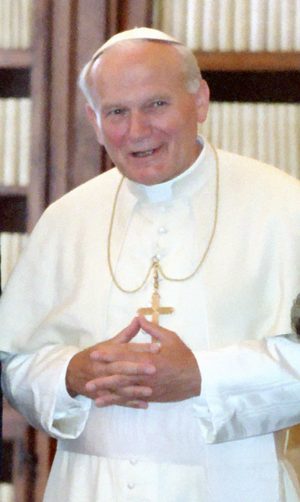

Karol Wojtyła, Archbishop of Kraków, became in 1978 the first Polish pope and led the Catholic Church for almost twenty-seven years. He issued the Catechism of the Catholic Church, asked other Christians to discuss how the papacy might serve unity, and made requests for forgiveness in the Jubilee year 2000. Every tradition has responded to him, and his handling of abuse cases is still debated.
| Lived | 18 May 1920, Wadowice, Poland, to 2 April 2005, Apostolic Palace, Vatican City |
|---|---|
| Church | Catholic; priest (ordained 1 November 1946), bishop (1958), cardinal (1967), pope (1978–2005) |
| Role | Auxiliary bishop (1958) and Archbishop of Kraków (appointed 13 January 1964); elected pope 16 October 1978 |
| Influenced by | Cardinal Adam Sapieha of Kraków, who trained him in a clandestine wartime seminary; the Second Vatican Council (1962–65) |
| Influenced | Joseph Ratzinger, whom he named head of the Congregation for the Doctrine of the Faith (1981) and who succeeded him as Benedict XVI |
| Writings | Fourteen encyclicals, including Veritatis Splendor (1993), Evangelium Vitae (1995) and Fides et Ratio (1998); Ordinatio Sacerdotalis (1994); Ut Unum Sint (1995); Crossing the Threshold of Hope (1994); Gift and Mystery (1996); Memory and Identity (2005) |
| Honored | Beatified 1 May 2011; canonized 27 April 2014; optional memorial on 22 October in the General Roman Calendar |
Life
Karol Wojtyła was born at Wadowice on 18 May 1920, studied in secret under Cardinal Sapieha during the German occupation, and was ordained priest in Kraków on 1 November 1946. Pius XII appointed him auxiliary bishop of Kraków on 4 July 1958; Paul VI made him archbishop there on 13 January 1964 and cardinal on 26 June 1967. He took part in the Second Vatican Council (1962–65) and helped draft Gaudium et Spes. The cardinals elected him pope on 16 October 1978; he began his ministry on 22 October.
His first pilgrimage to Poland (June 1979) began with a Mass in Warsaw's Victory Square on 2 June; Solidarity, the first independent trade union in the Soviet bloc, was formed a year later. On 13 May 1981 Mehmet Ali Ağca shot him in St. Peter's Square; he recovered. He promulgated the Catechism of the Catholic Church by the constitution Fidei Depositum (11 October 1992, the thirtieth anniversary of the opening of Vatican II), proclaimed the Great Jubilee of 2000, and died on 2 April 2005. Benedict XVI beatified him on 1 May 2011, and Francis canonized him on 27 April 2014 together with John XXIII.
What he taught
The Catechism, he wrote, is "a statement of the Church's faith and of Catholic doctrine." In Ordinatio Sacerdotalis (22 May 1994) he declared that the Church "has no authority whatsoever to confer priestly ordination on women," a judgment he said all the faithful must hold as definitive (women in ministry; women's ordination). He taught the Catholic doctrines of the papacy and of Mary, and upheld clerical celibacy.
In Ut Unum Sint (25 May 1995) he committed the Catholic Church to the ecumenical movement. Paragraph 95 says that the exercise of the primacy, while keeping what is essential to its mission, "is nonetheless open to a new situation," and paragraph 96 invites church leaders and theologians to "engage with me in a patient and fraternal dialogue on this subject." On 12 March 2000, the First Sunday of Lent in the Jubilee year, he led a Day of Pardon at which the Church asked God's forgiveness for the sins of its members in the past, including "the part which each of us has had in these evils." During his pontificate the Catholic Church also signed a joint declaration on justification with the Lutheran World Federation (see below).
What historians say
The papal biographer George Weigel and the Cold War historian John Lewis Gaddis argue that the 1979 pilgrimage helped start the end of communist rule in East-Central Europe; other scholars hold that it was an important factor but that it does not by itself explain the peaceful collapse (Catholic Review report on historians, 2024).
The most serious criticism concerns abuse. The Holy See's own Report on the Holy See's Institutional Knowledge and Decision-Making Related to Former Cardinal Theodore Edgar McCarrick (10 November 2020) says John Paul II personally decided to appoint McCarrick Archbishop of Washington in November 2000, and that he created him cardinal in early 2001. It records that Cardinal O'Connor's letter of 28 October 1999 set out allegations against McCarrick, and that the pope had decided against moving him to Chicago (1997), New York (1999/2000) and, at first, Washington. The report gives the reasons why he changed his mind: three of four New Jersey bishops he asked through the nuncio gave "inaccurate and incomplete information," McCarrick wrote to the pope's secretary denying any sexual misconduct, no victim had complained directly to the Holy See, and the pope's experience of false accusations against bishops in Poland probably made him willing to believe the denial. Critics reply that the allegations were known and that the pope promoted McCarrick anyway (clergy sexual abuse and cover-up). Archbishop Stanisław Gądecki, president of the Polish bishops' conference, answered on 7 December 2020 that the pope's "highest priority" was combating abuse, citing the 2001 motu proprio Sacramentorum sanctitatis tutela (30 April 2001), which reserved the gravest offenses to the Congregation for the Doctrine of the Faith, and the pope's address of 23 April 2002 to the American cardinals: "there is no place in the priesthood and religious life for those who would harm the young." Critics also cite Marcial Maciel, founder of the Legion of Christ, who was shielded for decades before Benedict XVI removed him from ministry in 2006 (the Catholic record).
How the churches see John Paul II
- Catholic:
The Church canonized him on 27 April 2014 and keeps an optional memorial on 22 October, the day his ministry began; the Congregation for Divine Worship added it to the General Roman Calendar by decree of 29 May 2014. In Ordinatio Sacerdotalis he taught that his judgment on the ordination of women is to be held definitively by all the faithful. Catholic defenders answer the McCarrick criticism with the Holy See's finding that bishops misled him and with his later measures against abuse.
- Orthodox:
He visited Romania in May 1999 (the Bucharest address is dated 7 May) at the invitation of Patriarch Teoctist, the first papal visit to a predominantly Orthodox country since the schism, and spoke in the Patriarchal Cathedral of a "leaven of unity and harmony." On 4 May 2001 in Athens, after Archbishop Christodoulos welcomed him with a list of Catholic offenses against the Orthodox, he asked forgiveness "for the occasions past and present" when Catholics sinned against their Orthodox brothers and sisters and named "the disastrous sack of the imperial city of Constantinople" (1204); Christodoulos applauded, and Greek newspapers called it a historic apology. Orthodox monks had protested before the visit (BBC). Orthodox churches do not accept papal primacy of jurisdiction (the Great Schism).
- Lutheran:
The Joint Declaration on the Doctrine of Justification between the Lutheran World Federation and the Catholic Church was signed at Augsburg on 31 October 1999, during his pontificate. His letter of 31 October 1983 for the 500th anniversary of Luther's birth spoke of Luther's profound religiousness. Confessional synods that keep the Smalcald Articles' judgment on the papacy, among them the Missouri Synod (Brief Statement, 1932) and WELS (1959), identify the papacy with the Antichrist (pope as Antichrist).
- Reformed:
The World Alliance of Reformed Churches, whose president Clifton Kirkpatrick and general secretary Setri Nyomi spoke on 4 April 2005, said: "We give thanks to God for the impact Pope John Paul II has made in his lifetime as a leader." It said the dialogues with Roman Catholics "have brought increased understanding," though "we may not have agreed on every social ethical stance." The Westminster Confession (1646, 25.6) calls the pope of Rome "that Antichrist"; American Presbyterians removed the clause in 1903 and 1936.
- Anglican:
On 29 May 1982 he and Archbishop Robert Runcie signed a Common Declaration at Canterbury Cathedral stating, "We are agreed that it is now time to set up a new international Commission." It was to examine remaining doctrinal differences and what prevents mutual recognition of ministries; this became ARCIC II. Anglican churches that ordain women follow a different practice from the judgment Ordinatio Sacerdotalis (1994) asks Catholics to hold definitively.
- Methodist:
The Methodist Church in Britain's president, Will Morrey, called his death "the passing of an era" and described him as "a man of transparent holiness and prayer." William B. Oden, ecumenical officer for the United Methodist Council of Bishops, called him "one of Catholicism's greatest popes" who left "many unresolved issues" (Christian Century, April 2005). The World Methodist Council affirmed the Joint Declaration on Justification in 2006, after his death.
- Baptist:
R. Albert Mohler Jr., president of The Southern Baptist Theological Seminary, wrote on 4 April 2005 that evangelicals should be "unembarrassed and unhesitant to declare our admiration" for the pope's "courageous stand against Communism," praised his defense of human life, but also wrote that "John Paul II rejected justification by faith" and that "the papacy is a fundamentally unbiblical office." The Second London Confession (1689, 26.4) called the pope "that antichrist, that man of sin."
Sources
- Holy See, biography of John Paul II prepared for the canonization (2014) dates of life, offices, works
- John Paul II, apostolic constitution Fidei Depositum (11 October 1992)
- John Paul II, Ordinatio Sacerdotalis (22 May 1994)
- John Paul II, Ut Unum Sint (25 May 1995), paras. 95-96
- John Paul II, homily for the Day of Pardon (12 March 2000)
- CBS News, "May 13, 1981: Pope John Paul II shot in St. Peter's Square"
- Catholic Review, historians on the 1979 pilgrimage to Poland (2024)
- Report on the Holy See's Institutional Knowledge and Decision-Making Related to Former Cardinal Theodore Edgar McCarrick (Secretariat of State, 10 November 2020), Executive Summary
- John Paul II, address to the cardinals of the United States (23 April 2002)
- Motu proprio Sacramentorum sanctitatis tutela (30 April 2001)
- National Catholic Register, Archbishop Gądecki's statement of 7 December 2020
- Congregation for Divine Worship, decree of 29 May 2014 (memorials of John XXIII and John Paul II)
- John Paul II, address in the Patriarchal Cathedral, Bucharest (7 May 1999)
- John Paul II, address to Archbishop Christodoulos, Athens (4 May 2001)
- Irish Times, "Greek press hails Pope's historic apology" (5 May 2001)
- BBC News, report on the Athens visit (2001)
- Joint Declaration on the Doctrine of Justification (31 October 1999)
- John Paul II, letter to Cardinal Willebrands, 31 October 1983 (AP translation)
- Missouri Synod Brief Statement (1932) and WELS statement on the Antichrist (1959), as cited on this site
- World Alliance of Reformed Churches, statement on the death of Pope John Paul II (4 April 2005)
- Common Declaration of Pope John Paul II and Archbishop Runcie, Canterbury (29 May 1982)
- Methodist Church in Britain, "The death of His Holiness Pope John Paul II"
- Christian Century, "Ecumenical Protestants laud pope's compassion" (April 2005)
- Methodist Church in Britain, Joint Declaration on the Doctrine of Justification (2017 update)
- Mohler, "John Paul II: The Man and His Legacy" (4 April 2005)
- Second London Baptist Confession (1689), ch. 26
- Photograph, Wikimedia Commons (public domain; National Archives, Reagan White House Photographs)