Martin Luther King Jr. 1929–1968
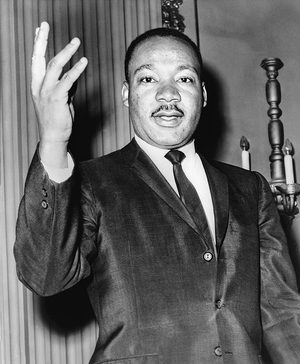

Martin Luther King Jr. was a Baptist minister, the son and grandson of pastors of Ebenezer Baptist Church in Atlanta, who led the Montgomery bus boycott (1955–56) and the Southern Christian Leadership Conference and became the best-known voice of the American civil rights movement. He was killed at Memphis on 4 April 1968. Baptists, Catholics, Orthodox, Lutherans, Anglicans and Methodists have each named him in a papal address, a calendar, a convention resolution or a statue; Reformed bodies have no common act, and some evangelicals dispute his theology.
| Lived | 15 January 1929, Atlanta, to 4 April 1968, Memphis; buried at Atlanta, 9 April 1968 |
|---|---|
| Church | Baptist; ordained 25 February 1948 at Ebenezer Baptist Church, Atlanta; first in the National Baptist Convention, then with the Progressive National Baptist Convention (formed 1961) |
| Role | Pastor of Dexter Avenue Baptist Church, Montgomery (from 1 September 1954); assistant pastor at Ebenezer from February 1960; chairman of the conference that became the Southern Christian Leadership Conference (January 1957); Nobel Peace Prize (Oslo, 10 December 1964) |
| Influenced by | Walter Rauschenbusch; Reinhold Niebuhr; Mohandas Gandhi; the personalist philosophers Edgar Brightman and L. Harold DeWolf at Boston University |
| Influenced | The Southern Christian Leadership Conference and the nonviolent campaigns at Birmingham, the March on Washington and Selma |
| Writings | Stride Toward Freedom (1958); "Letter from Birmingham Jail" (16 April 1963); Why We Can't Wait (1964); Where Do We Go from Here (1967); doctoral dissertation on Paul Tillich and Henry Nelson Wieman (1955) |
| Honored | 4 April in the Episcopal Church calendar; 15 January in the Evangelical Lutheran Church in America (ELCA) calendar; declared a "modern-day martyr" by The United Methodist Church (2012); statue at Westminster Abbey (1998) |
Life
King graduated from Morehouse College with a bachelor's degree in sociology on 8 June 1948, having been ordained that February as assistant pastor of his father's church. He took a bachelor of divinity at Crozer Theological Seminary (May 1951) and a doctorate in systematic theology at Boston University (5 June 1955). On 1 September 1954 he became pastor of Dexter Avenue Baptist Church in Montgomery, Alabama.
After Rosa Parks was arrested on 1 December 1955, the Montgomery Improvement Association was formed on 5 December and the bus boycott began, with King as its leading figure. It lasted until the Supreme Court affirmed Browder v. Gayle (13 November 1956) and the buses were integrated on 21 December. In January 1957 he was named chairman of the Southern leaders' conference that became the SCLC, and in February 1960 he moved to Atlanta to serve beside his father at Ebenezer. In 1961 the National Baptist Convention divided over its presidency, King removed from a convention post and a walkout led to the Progressive National Baptist Convention; the National Baptist Convention tells its side on its own page.
King was arrested at Birmingham on 12 April 1963, wrote his letter from the jail on 16 April and was released on 19 April. He spoke at the March on Washington on 28 August 1963 and received the Nobel Peace Prize at Oslo on 10 December 1964. After "Bloody Sunday" at Selma (7 March 1965), the march from Selma to Montgomery ended on 25 March. On 4 April 1967 he spoke against the Vietnam War at Riverside Church in New York ("Beyond Vietnam"). Exactly a year later he was shot in Memphis.
What he taught
King described his own sources in "Pilgrimage to Nonviolence" (Christian Century, 13 April 1960). He wrote that Rauschenbusch's Christianity and the Social Crisis left "an indelible imprint" on him, that Niebuhr made him aware of "the reality of sin," and that the life of Gandhi turned him from doubt about the power of love. At Boston University he studied personalism under Brightman and DeWolf; his dissertation compared the conceptions of God in Tillich and Wieman.
His teaching in the movement was that unjust laws and customs should be met by organized, nonviolent direct action, accepting arrest, and that this was a Christian duty and not only a tactic. The Birmingham letter answered eight white Alabama clergymen who had published a statement on 12 April 1963 urging an end to the demonstrations. In it he wrote that "Injustice anywhere is a threat to justice everywhere," and said he was "gravely disappointed with the white moderate." In his Riverside Church address he extended the same principle to the war in Vietnam.
The PNBC says he addressed every one of its annual sessions until 1968 (PNBC, History of the PNBC).
What historians say
The standard biographies are David Garrow's Bearing the Cross (1986; Pulitzer Prize, 1987) and Taylor Branch's three volumes, Parting the Waters (1988), Pillar of Fire (1998) and At Canaan's Edge (2006). Clayborne Carson and the Martin Luther King Jr. Papers Project at Stanford have published his papers.
Two matters are criticized. In 1988 the Papers Project editors found passages in King's 1955 dissertation copied closely from another Boston University student's dissertation (Jack Boozer, 1952) without quotation marks. In 1991 a Boston University committee concluded that he had plagiarized passages, but the university did not revoke the degree and noted the dissertation's original contribution (EBSCO Research Starters). Carson's own view, reported by EBSCO, was that King probably did not regard his copying as wrongdoing, since he gave his papers to the university's archive.
The FBI under J. Edgar Hoover watched King closely. Garrow reports that wiretaps on King's home and on the SCLC office in Atlanta began on 8 November 1963 with Attorney General Robert F. Kennedy's written approval, after the FBI told Kennedy that King's adviser Stanley Levison was a suspected communist.
Baptist Christians remember a second wrong: King and other Black Baptist pastors were opposed by many white Baptist churches and leaders (segregation and the Baptists; the Baptist record).
How the churches see King
- Catholic:
The sources consulted show no Catholic canonical or liturgical act concerning King, a Baptist minister. Pope Francis, addressing the United States Congress on 24 September 2015, named four Americans: Abraham Lincoln, King, Dorothy Day and Thomas Merton. Of the Selma-to-Montgomery march fifty years before, he said King led it to fulfill his "dream" of full civil and political rights for African Americans, and that the dream "continues to inspire us all."
- Orthodox:
The sources consulted record no statement about King by the Ecumenical Patriarchate or another Orthodox synod. In March 1965 Archbishop Iakovos, primate of the Greek Orthodox Archdiocese of North and South America, marched with King at Selma; Life put the two on its cover of 26 March 1965. He said he had come from Turkey, where he was a "third category citizen," and that he would stand for civil and human rights as long as he lived (Order of St. Andrew the Apostle, "Archbishop Iakovos and Civil Rights"). His stand is described as his own action, and it drew criticism.
- Lutheran:
The ELCA's calendar of commemorations lists "Martin Luther King Jr., renewer of society, martyr, 1968" on 15 January, as in the January 2016 post of Women of the ELCA, an ELCA organization. Bishop emeritus Abraham Allende of the Northeastern Ohio Synod likewise writes that the ELCA recognizes King in its calendar of Lesser Festivals and Commemorations. The sources consulted show no Missouri Synod or Wisconsin Synod act concerning King.
- Reformed:
No Reformed confession, synod or calendar names King. The Presbyterian Church (U.S.A.), in its Confession of 1967 (General Assembly, Portland), calls the church to advocate "the abolition of all racial discrimination"; a 2016 PC(USA) Mission article cites King's remark about Sunday morning as "the most segregated hour." Among Reformed-leaning evangelicals assessments divide. The Gospel Coalition held a conference, MLK50, in 2018 to mark the fiftieth anniversary of his death; in February 2024 the Calvinist pastor John MacArthur called King "not a Christian at all" and criticized the Coalition for honoring him, and the lawyer and minister Justin Giboney answered in Christianity Today that King's activism grew from his faith and that his early seminary papers do not show his mature theology.
- Anglican:
The Episcopal Church's calendar lists "Martin Luther King, Jr., Civil Rights Leader, 1968" on 4 April. At Westminster Abbey, a Church of England royal peculiar, a statue of King stands among ten modern martyrs above the Great West Door; the Archbishop of Canterbury unveiled the ten on 9 July 1998, in the presence of the Queen. The sources consulted show no King entry in the Church of England's Common Worship calendar.
- Methodist:
At the 2012 General Conference, on 1 May, The United Methodist Church declared King a "modern-day martyr"; the Book of Resolutions was to list him with Dietrich Bonhoeffer, whom the 2008 General Conference had named in the same words (United Methodist News Service). Its Book of Resolutions also contains a Martin Luther King Jr. Day resolution, adopted in 1992 and readopted in 2024, asking annual conferences to hold commemorative services.
- Baptist:
King was a Baptist pastor, and the PNBC says it gave him a denominational home and that he addressed each of its annual sessions until 1968. The Southern Baptist Convention, in its 1995 resolution on racial reconciliation, did not name King; it said that "in later years" Southern Baptists "failed, in many cases, to support, and in some cases opposed, legitimate initiatives to secure the civil rights of African-Americans," and apologized for "condoning and/or perpetuating individual and systemic racism." Its 2018 resolution on the doctrine of the curse of Ham notes the Ethics and Religious Liberty Commission's commemoration of the fiftieth anniversary of King's assassination. The National Baptist Convention, which King left in 1961, and the Southern Baptist Convention are separate bodies.
Sources
- Stanford King Institute, Major King Events Chronology, 1929–1968 dates of the life
- King, "Pilgrimage to Nonviolence," Christian Century 77 (13 April 1960), via the Stanford King Papers
- Stanford King Institute, "Personalism"
- King, "Letter from Birmingham Jail" (text, Bill of Rights Institute)
- EBSCO Research Starters, "Martin Luther King, Jr.'s Doctoral-Thesis Plagiarism Is Revealed"
- Pulitzer Prizes, 1987 Biography: Garrow, Bearing the Cross
- Garrow, The FBI and Martin Luther King, Jr. (Yale University Press, 2015 edition)
- Pope Francis, address to the United States Congress, 24 September 2015
- Order of St. Andrew the Apostle (Archons), Archbishop Iakovos and civil rights
- Women of the ELCA, "Honoring Vision" (15 January 2016)
- Allende, "Living out Martin Luther King's dream," Living Lutheran
- Presbyterian Mission Agency, "Providential coincidence" (Confession of 1967 and Belhar), 2016
- Giboney, "Why John MacArthur Is Wrong About MLK," Christianity Today (March 2024)
- Episcopal Church, Calendar of the Church Year
- Westminster Abbey, Martin Luther King Jr. and the Modern Martyrs
- United Methodist News Service, "United Methodists declare MLK Jr. a modern-day martyr" (2012)
- United Methodist Church, Book of Resolutions: Martin Luther King Jr. Day
- Progressive National Baptist Convention, History of the PNBC
- Southern Baptist Convention, Resolution on Racial Reconciliation on the 150th Anniversary (1995)
- Southern Baptist Convention, Resolution on Renouncing the Doctrine of the Curse of Ham (2018)
- Photograph by Dick DeMarsico (1964), Wikimedia Commons (public domain, Library of Congress)