Ignatius of Loyola 1491–1556
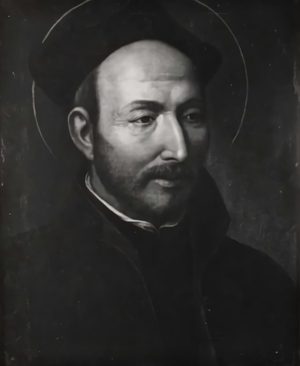

Ignatius of Loyola was a Basque soldier who became a priest, wrote the Spiritual Exercises and founded the Society of Jesus (the Jesuits), approved by Paul III in 1540. Catholics honor him as a saint. Other traditions have met his order in the history of the Reformation and his Exercises in the retreat houses of today, and each has answered in its own way.
| Lived | 1491 (day not known), castle of Loyola near Azpeitia, Guipúzcoa, to 31 July 1556, Rome |
|---|---|
| Church | Catholic; ordained priest at Venice, 24 June 1537; beatified 1609, canonized 12 March 1622 |
| Role | Founder and first Superior General of the Society of Jesus (elected April 1541) |
| Influenced by | The lives of Christ and of the saints, read while recovering at Loyola |
| Influenced | Francis Xavier, Peter Faber, James Laynez and the first Jesuits; the retreat movements that use the Exercises in many churches |
| Writings | Spiritual Exercises (begun at Manresa, approved by Paul III in 1548); Constitutions of the Society (drafted from 1547, adopted 1558) |
| Honored | 31 July: memorial in the Catholic General Roman Calendar; "Priest and Spiritual Writer" in the Episcopal Church's Lesser Feasts and Fasts |
Life
Born in 1491 at the castle of Loyola, Ignatius was a soldier. On 20 May 1521, in the French siege of the citadel of Pamplona, one leg was broken and the other torn. Confined at Loyola, he asked for romances of chivalry and was given lives of Christ and of the saints; from this reading he turned to a religious life. From 1522 he lived near Manresa, where the notes that became the Spiritual Exercises took shape. Franciscan authorities sent him back from a pilgrimage to Jerusalem, and he studied at Barcelona, Alcalá, Salamanca and, from June 1528, Paris. Suspicion followed him: a church inquisitor imprisoned him at Alcalá, and in Rome in 1538 the governor gave a sentence in his favor after slanders against him (Catholic Encyclopedia).
At Paris he gathered companions, among them Peter Faber, Francis Xavier, James Laynez, Alonso Salmerón, Nicolás Bobadilla and Simão Rodrigues. On 15 August 1534, at Montmartre, they vowed poverty and chastity and a journey to the Holy Land. Ignatius, Faber and Laynez came to Rome in the winter of 1537. Paul III approved the Society in the bull Regimini militantis Ecclesiae on 27 September 1540, and in April 1541 the companions elected Ignatius Superior General, despite his reluctance; they professed their vows on 22 April at St. Paul outside the Walls. Professed Jesuits take a fourth vow of obedience to the pope concerning missions (the papacy). Ignatius drafted the Constitutions from 1547; Julius III confirmed the Society's Formula in 1550. He founded the Roman College (1551) and the German College (1552), and the Society sent missionaries to India, the Congo and Brazil. He died in Rome on 31 July 1556; the Society then numbered about a thousand.
What he taught
The Spiritual Exercises are a manual for a director guiding another person through about thirty days of prayer, in four "weeks" (sin, the life of Christ, the passion, the resurrection). The "Principle and Foundation" opens them: "Man is created to praise, reverence, and serve God our Lord, and by this means to save his soul" (Mullan translation, 1914). The exercises teach the retreatant to picture scenes from the Gospels, to examine conscience daily, and to choose by noticing "consolation" and "desolation" and distinguishing good spirits from evil. They end with Rules for thinking with the Church. The thirteenth says that "the white which I see, is black, if the Hierarchical Church so decides it," because the same Spirit governs Christ and the Church. Rules 14 to 17 advise caution in speaking of predestination, faith and grace, lest hearers grow idle in works or doubt free will (compare justification and predestination).
The Society he founded was to go wherever the pope sent it, and worked in preaching, confession, catechism, schools and missions. Its 1540 Formula gave its aim as "the progress of souls in Christian life and doctrine and for the propagation of the faith"; the words "defence of the faith" were added in 1550 (O'Malley).
What historians say
Textbooks, John O'Malley writes, have depicted Ignatius and his companions as the "spearhead of the Catholic attack on the Reformation." O'Malley, a Jesuit historian, calls the claim that the Society was founded to fight the Reformation a "misapprehension": in its first years the Jesuits cared more for the conversion of unbelievers in Jerusalem than for Wittenberg, Protestantism is scarcely mentioned in Ignatius's Autobiography, and the "defence of the faith" wording came only in 1550. Critics, among them the Baptist publisher Way of Life Literature, read the thirteenth rule as a demand for submission to the hierarchy; Ignatius's own text grounds it in the belief that one Spirit guides Christ and the Church.
After Ignatius's death the Society's history became contested. Clement XIV suppressed it by the brief Dominus ac Redemptor (21 July 1773), saying that "scarcely or not at all" could the Church's peace be restored while it stood; Pius VII restored it in 1814 (Sollicitudo omnium ecclesiarum, 7 August). Jesuits also appear in the record chapters: the Jesuit Edmund Campion was executed in 1581 under Elizabeth I's laws (Elizabethan executions), and the Society apologized on 18 April 2017 for the 1838 sale of 272 enslaved people by Georgetown's Jesuits (the Church and slavery).
How the churches see Ignatius
- Catholic:
Paul V beatified Ignatius on 27 July 1609, and Gregory XV canonized him on 12 March 1622 with Francis Xavier, Teresa of Avila, Philip Neri and Isidore the Laborer, in the first collective canonization (Jesuits.global). His feast, 31 July, is a memorial on the General Roman Calendar. Paul III approved the Exercises in the brief Pastoralis officii (1548). The election of Pope Francis in 2013 made a Jesuit pope for the first time.
- Orthodox:
No Orthodox synod statement about Ignatius, and no Orthodox calendar entry for him, was found. The Orthodox record is mixed. Patriarch Jeremias II rejected the union project of the Jesuit Antonio Possevino in 1584 (Norman Russell). Yet St. Nikodemos the Hagiorite (canonized 1955), who regarded Latins as unbaptized heretics, adapted the Jesuit Giampietro Pinamonti's layman's version of the Exercises as Gymnasmata pneumatika (Venice, 1800), without naming its origin. The priest Sergei Sveshnikov writes that, unlike Roman Catholicism, "the Orthodox Tradition does not encourage the use of mental imagery" in prayer, and discusses Ignatius's method among his Western examples.
- Lutheran:
No Lutheran confession or synodical statement about Ignatius was found. A Reformation 500 page from Concordia Seminary in St. Louis presents him as a central figure of the Catholic Counter-Reformation. Jānis Vanags, Lutheran archbishop of Riga, found the Exercises in a samizdat copy in Soviet times and wrote in 2017: "I was amazed at how Lutheran the Spiritual Exercises are." He recalls that King Stefan's plan for Jesuit missions in Latvia was to uproot the Lutheran Church; the journal's editors add that Ignatius's name remains suspect among some in his church. Catholic and Lutheran retreat directors in Latvia now meet regularly.
- Reformed:
No Reformed confession or synod statement about Ignatius was found. Individual ministers have taken part in Ignatian training: the Methodist E. Adam Wells records that a Jesuit spiritual-direction course at Craighead, near Glasgow, in 1991–93 included members of the Church of Scotland.
- Anglican:
The Episcopal Church's Lesser Feasts and Fasts (2024) keeps 31 July for "Ignatius of Loyola, Priest and Spiritual Writer, 1556," with a collect asking for grace "to seek you in all things." Under Elizabeth I, when the Church of England was the established church, Parliament passed an Act against Jesuits and seminary priests (1585) ordering them to leave the realm. In 2017 Nicolas Stebbing, an Anglican priest of the Community of the Resurrection, wrote that he had wondered whether Jesuits would be "steely-eyed fanatics," and that he now gives the Exercises himself.
- Methodist:
No official Methodist statement about Ignatius was found. The Methodist Retreat Group joined the UK Retreat Association in 1979, and Wells reports that British Methodists, lay and ordained, use and direct Ignatian retreats, and that some recognize Ignatian direction in John Wesley's ministry. Hugh Jenkins, a South African Methodist, finds in the Wesleyan quadrilateral a framework for Ignatian discernment. The United Methodist pastor Justin Coleman wrote in 2025 that "this centuries-old Catholic practice has much to offer Protestant clergy today."
- Baptist:
No Baptist confession or convention statement about Ignatius was found. The Baptist historian Glenn Hinson argues, as summarized by Baptist News Global (2020), that early Baptists practiced exercises that "looked remarkably like Saint Ignatius of Loyola's daily examen." The fundamental Baptist ministry Way of Life Literature calls visualization prayer disobedient and dangerous, and objects to the Exercises' Marian devotion and obedience to the hierarchy. Baptists are one of four member groups of the UK Retreat Association, which lists Ignatian retreats.
Sources
- Catholic Encyclopedia (1913), "St. Ignatius of Loyola" life, dates, Manresa, Paris, Montmartre, inquiries, Society, death, beatification
- Catholic Encyclopedia (1913), "Society of Jesus" fourth vow; Constitutions; bulls of 1540 and 1814
- Jesuits.global, "Sainthood and canonization" (2022) canonization on 12 March 1622
- Concordia Seminary, Reformation 500 page on Ignatius of Loyola ordination at Venice, 24 June 1537; missions
- Mullan translation of the Spiritual Exercises (1914, public domain) Principle and Foundation; Rules for thinking with the Church
- O'Malley, "Attitudes of the Early Jesuits towards Misbelievers," The Way Supplement 68 (1990)
- Dominus ac Redemptor (1773), Jesuit Online Library, Boston College
- The Way 56/4 (October 2017), "The Reformation: A Gift from God?" (Vanags, Russell, Wells, Stebbing, Jenkins) also the source for Pope Francis as the first Jesuit pope
- Sveshnikov, "Mental Imagery in Eastern Orthodox Private Devotion"
- Episcopal Church, Lesser Feasts and Fasts 2024
- Liturgy Office of England and Wales, Calendar for July 2026
- Act Against Jesuits and Seminarists (1585), from Gee and Hardy
- Coleman, "Rooted in Christ," Faith & Leadership (2025)
- Baptist News Global, "In spiritual direction I learned how Jesus could be my friend" (2020)
- Way of Life Literature, "Ignatius of Loyola"
- Portrait attributed to Jacopino del Conte, Wikimedia Commons (public domain)