Phoebe Palmer 1807–1874
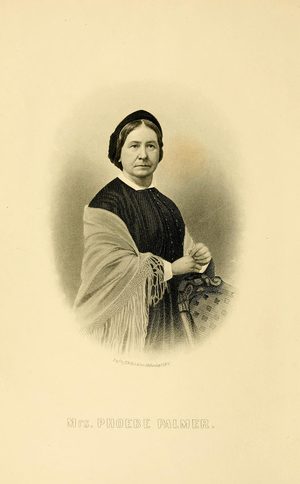

Phoebe Palmer was a New York Methodist laywoman who spread the teaching that entire sanctification, John Wesley's "Christian perfection," can be received at once by faith. Through a weekly meeting in her home, books and revival tours in North America and Britain she became known as the "mother of the Holiness movement." Her teaching, and her defense of women's preaching, have been answered, welcomed or refused in every tradition.
| Lived | 18 December 1807, New York City, to 2 November 1874, New York City |
|---|---|
| Church | Methodist (Allen Street Church, New York); a layperson, never ordained |
| Role | Leader of the Tuesday Meeting for the Promotion of Holiness; revival preacher in the United States, Canada and Britain; author; editor of Guide to Holiness (from 1864) |
| Influenced by | John Wesley and John Fletcher; her sister Sarah Lankford; Timothy Merritt, founder of the Guide to Christian Perfection |
| Influenced | Catherine Booth (indirectly); Frances Willard (often cited); the Holiness churches, including the Church of the Nazarene and the Wesleyan Church; Pentecostalism |
| Writings | The Way of Holiness (1843); Entire Devotion to God (1845); Faith and Its Effects (1848); The Promise of the Father (1859); Four Years in the Old World |
| Honored | No commemoration day found; called the "mother of the Holiness movement" in histories |
Life
Phoebe Worrall was born in New York City to Henry Worrall, who had been converted under Wesley's preaching in England, and Dorothea Wade Worrall. In 1827 she married Walter Clarke Palmer, a physician and fellow Methodist. Of their six children three lived to adulthood. The first two died in infancy, and a daughter, Eliza, died in a fire accidentally started by a household maid. According to the biography by Charles White, Palmer concluded God had taken her sons because she had made idols of them; she was determined not to make that mistake again (as summarized by Jennifer Wojciechowski, Word & World, 2020).
Her sister Sarah Lankford had received the experience of entire sanctification in 1835 and began a weekly meeting of Methodist women for Bible reading, prayer and testimony (sources date its start to 1835 or 1836). On 26 July 1837 Palmer, after a day of prayer in which Sarah fasted for her, gave up everything to God, including her husband and children, and trusted that she was sanctified though she felt no great emotion; she kept the anniversary every year. She became the leader of the Tuesday Meeting for the Promotion of Holiness (sources date this from 1837 to 1840). From about 1839 men, among them ministers of several denominations, attended; the group, which averaged about two hundred, outgrew the Palmers' parlor, and the meeting lasted more than fifty years.
Palmer wrote letters on her experience in 1839 and from 1842 serialized The Way of Holiness in the Christian Advocate and Journal; it appeared as a book in 1843 and reached fifty printings by 1867. She and Walter preached at revivals and camp meetings: in Canada from 1853 (a revival at Hamilton, Ontario, in 1857) and in Britain from 1859 to 1863, including Newcastle in 1859. Meanwhile she pressed the Methodist Ladies' Home Missionary Society to open the Five Points Mission in a New York slum (1850). The Palmers bought the Guide to Holiness in 1864, and she edited it until her death. She was never ordained or salaried by a church. She died in New York on 2 November 1874.
What she taught
Palmer took from Wesley the teaching that entire sanctification, a heart made perfect in love, is attainable in this life. Her own contribution was a method, which she called "the shorter way," in three steps: entire consecration, faith, and testimony. In her "altar theology" the altar is Christ, and whatever is laid on it becomes God's: she read Matthew 23:19 (KJV), "the altar that sanctifieth the gift," as a promise that the person who consecrates all is sanctified. The second step is to believe that promise now, whatever one feels; to doubt it is itself sin (see assurance). "God requires present holiness," she wrote in The Way of Holiness. The third step is to testify, since a blessing kept private will be lost.
In The Promise of the Father (Boston, 1859; more than four hundred pages) she argued that the Pentecostal promise of the Spirit (Joel 2:28; Acts 2:17-18, KJV: "your sons and your daughters shall prophesy") belongs to women as well as men, and that every sanctified believer must testify. She also dealt with 1 Corinthians 14:34, the verse bidding women "keep silence in the churches." She began by saying she did not intend to discuss "Women's rights" or "Women's Preaching, technically so called," and she did not seek ordination for herself or for others. Pneuma Review credits her with popularizing the idea of Spirit baptism, though she never spoke in tongues (tongues).
She was also active in temperance and in opposing slavery, and she viewed the Civil War as God's judgment on the South (Wojciechowski, citing White).
What historians say
Critics in her own time, and some since, have judged her teaching a thin or distorted version of Wesley's. Charles Edwin Jones (Methodist History, 1997) names the editor Nathan Bangs and other friends who were uneasy about her "naked faith," which they saw as implicitly denying prevenient grace and the witness of the Spirit; the minister A. A. Rees attacked her at Newcastle in 1859 and Catherine Booth replied; Bishop Matthew Simpson said that the "altar" of the communion rail had no sacrificial sense. An Encyclopedia.com entry calls her altar terminology controversial and her exegesis weak. Defenders point to her originality: Wojciechowski finds it in both the altar theology and the shorter way, and Elaine Heath (Naked Faith, 2010) reads her as independently recovering an ascetic and mystical theology within Methodism, against an older view of her as minor and derivative.
White's 1986 biography presents her as theologian, revivalist, feminist and humanitarian; Wojciechowski says "feminist" is not exact in the modern sense, since Palmer did not argue for ordination or suffrage, and that she could be inflexible and intolerant of those who disagreed. After her death the Holiness teaching was largely pushed out of the Methodist churches, and separate Holiness bodies took shape, among them the Church of the Nazarene (1895), the Church of God (Anderson, Indiana) and the Wesleyan Church (Wesleyan Church). Donald Dayton, Vinson Synan and Steven Land trace a line from the Holiness movement to Pentecostalism; Land writes that without it "there would have been no twentieth century Pentecostalism" (Pentecostal churches). Wojciechowski notes that Palmer's was not the first such defense: Margaret Fell had written one in 1666 and Sarah Grimké in 1837 (women in ministry).
How the churches see Palmer
- Catholic:
The Catholic Church has made no statement about Palmer. Its teaching on perfection is set out in the Council of Trent, Session 6: canon 23 anathematizes the view that a justified person can avoid all sins, even venial ones, throughout life except by a special privilege, as the Church holds for the Blessed Virgin, and canon 18 the view that God's commandments are impossible for the justified to keep. The Catechism (para. 2013) says all Christians are called to "the fullness of Christian life and to the perfection of charity." On women, John Paul II's Ordinatio Sacerdotalis (22 May 1994) states that "the Church has no authority whatsoever to confer priestly ordination on women" (women's ordination).
- Orthodox:
The Orthodox Church has made no statement about Palmer or the Holiness movement. Fr. Steven Kostoff, writing for the Orthodox Church in America (2015), describes salvation as "a synergistic process combining divine grace and human freedom" that involves ascetic struggle; Orthodox writers commonly speak of this as theosis.
- Lutheran:
No Lutheran church body has made a statement about Palmer. The Augsburg Confession (Art. XII), a Lutheran confessional text, condemns "those who contend that some may attain to such perfection in this life that they cannot sin." Jennifer Wojciechowski of Luther Seminary, whose 2020 Word & World study of Palmer is a source for this page, calls her an important American Methodist leader.
- Reformed:
The Westminster Confession (13.2) says of sanctification, "This sanctification is throughout, in the whole man; yet imperfect in this life." No Reformed church body has made a statement about Palmer in the sources checked.
- Anglican:
The Church of England and the Episcopal Church have made no statement about Palmer in the sources checked. Article IX of the Thirty-Nine Articles holds that "this infection of nature doth remain, yea in them that are regenerated," and Article XV that "if we say we have no sin, we deceive ourselves." Episcopal clergy were among those who attended her Tuesday Meeting (Wojciechowski), and she preached in Britain from 1859.
- Methodist:
The Holiness churches that grew from her movement state the teaching in their law: the Wesleyan Church's Discipline (para. 6655, art. 14) says "The crisis of entire sanctification perfects the believer in love and empowers that person for effective service." The United Methodist Church explains Wesley's perfection as a heart "habitually filled with the love of God and neighbor" and growth throughout life, without freedom from mistakes or temptation; its explanation does not mention Palmer. Within Methodism her method was disputed in her lifetime (see above). In 1956 the Methodist Church granted women full clergy rights (United Methodist Church).
- Baptist:
The Southern Baptist Convention's Baptist Faith and Message (2000, Art. IV) teaches that "Growth in grace should continue throughout the regenerate person's life," and says nothing of a second work. Article VI limits "the office of pastor/elder/overseer" to men "as qualified by Scripture" while affirming that "both men and women are gifted for service in the church." Other Baptist bodies, among them American Baptist Churches USA, ordain women. No Baptist body has made a statement about Palmer.
Sources
- Wojciechowski, "Phoebe Palmer and the Holy Life," Word & World 40:4 (Fall 2020), Luther Seminary life, 1837 sanctification, shorter way, Tuesday Meeting, Promise of the Father, British tour
- Phoebe Palmer timeline, Wesleyan Holiness Women Clergy (wrldrels.org) birth and death dates, books, travel, Five Points
- Encyclopedia.com, "Palmer, Phoebe Worrall" Tuesday Meeting origin, Guide to Holiness, altar theology
- Christian History Institute, "Holiness Fire-Starter"
- General Commission on Archives and History, UMC: Phoebe Palmer
- Charles Edwin Jones, on Phoebe Palmer and her critics (Methodist History, 1997)
- Charles Edward White, The Beauty of Holiness: Phoebe Palmer as Theologian, Revivalist, Feminist, and Humanitarian (Zondervan/Francis Asbury Press, 1986)
- Palmer, The Promise of the Father (Boston, 1859)
- Pneuma Review, "Wesley and the Pentecostals"
- Council of Trent, Session 6 (Waterworth translation)
- Catechism of the Catholic Church, para. 2013
- John Paul II, Ordinatio Sacerdotalis (22 May 1994)
- Kostoff, "Baptism: When all is said and done," Orthodox Church in America (2015)
- Augsburg Confession, Art. XII (Book of Concord)
- Westminster Confession of Faith, ch. 13 (Orthodox Presbyterian Church)
- Church of England, Articles of Religion
- The Wesleyan Church, Discipline (2016), para. 6655
- United Methodist Church, "What did John Wesley mean by moving on to perfection?"
- United Methodist Church, "When did the church first ordain women?"
- Baptist Faith and Message (2000), Arts. IV and VI
- Phoebe Palmer engraving, Wikimedia Commons (public domain)