Holy Fire Annual; first recorded c. 870
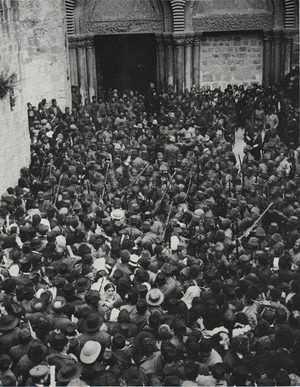

Every year on Holy Saturday, the day before Orthodox Easter by the Julian calendar, the Greek Orthodox Patriarch of Jerusalem enters the tomb of Christ in the Church of the Holy Sepulchre and comes out with lit candles, from which the flame is passed to the crowd. The Orthodox churches that take part receive it as the Light of Christ's resurrection, and many believers hold that it is kindled by God. Catholic, Protestant and some Orthodox writers have disputed that for centuries.
| Date | Holy Saturday each year, by the Julian reckoning of the Jerusalem Patriarchate; first reported in the 9th century |
|---|---|
| Place | Church of the Holy Sepulchre (Church of the Resurrection), Jerusalem; the Edicule over the tomb |
| Claimed by | Greek Orthodox Patriarchate of Jerusalem, with the Armenian Apostolic Patriarchate also taking part |
| Type | Recurring phenomenon: light or fire said to appear at the tomb |
| Official status | Observed by the Jerusalem Patriarchate as the Light of Christ's Resurrection; Pope Gregory IX is reported to have denounced it in 1238 (Britannica) |
| Investigations | None by a church commission or independent body found; doubts rest on travelers' reports from 1697 and clergy statements published in 2019 |
What is claimed
According to the Patriarchate of Jerusalem and Orthodox writers, the lamps in the Edicule are put out and the tomb is checked and sealed. On Holy Saturday the Patriarch, wearing only a white undergarment, prays alone inside, and the Fire appears. The Patriarchate's own report of the ceremony calls it "the Light of Christ's Resurrection," which the Patriarch, after praying in the tomb, passes out of the Edicule; representatives of the Armenian, Coptic and Syrian churches come to him to receive it. In an interview reprinted by the Orthodox Christian Information Center, Patriarch Diodorus I described a light, blue or indefinable, that rises from the stone, and said that in sixteen years his beard had never been burned; pilgrims report that the flame does not burn. He also called the event "almost like a sacrament."
Orthodox believers link it to the light of the angel at the tomb (Matthew 28:3, KJV: "His countenance was like lightning"). This is the account of its witnesses and clergy; the sections below give the history and the doubts.
History and devotion
The first witness in this form is Bernard, a pilgrim monk from the Latin West whose itinerary is dated c. 870. He says that on Holy Saturday the office was begun early in the church, "until by the coming of an angel" the light was kindled in the lamps above the sepulchre, after which the patriarch gave the fire to the bishops and people (Itinerary §11, Palestine Pilgrims' Text Society translation). The Russian abbot Daniel, in his pilgrimage of 1106–07, describes the lamps being cleaned, filled and sealed on Good Friday evening, and the bishop looking through the grille on Holy Saturday and seeing no light at first (Wilson's translation, 1888). The church was destroyed under the Fatimid caliph al-Hakim in 1009 (the 1913 Catholic Encyclopedia gives 1010) and rebuilt in the eleventh century.
While Latin clergy held the church after the First Crusade, the Fire did not appear on Holy Saturday in 1101, according to a 2017 scholarly article that calls Fulcher of Chartres the fullest account. In 1834 a crush in the packed church during the ceremony killed pilgrims: the English traveler Robert Curzon, who was there, described it, press summaries put the dead at several hundred, and Simon Sebag Montefiore gives about 400. Today the Patriarchate of Jerusalem presides. Armenian, Coptic and Syrian representatives receive the light from the Patriarch, and the Armenian Patriarchate's statement of 2008 described its dispute with the Greek Orthodox over the ceremony as "unresolved since 2002." The Patriarchate's report names the Church of Greece, the Greek government and other churches (Poland is named) among those who receive the light for their countries.
Investigations
No examination of the Edicule during the ceremony by a church commission or an independent body was found. Doubt is old. According to Britannica, Pope Gregory IX issued a bull in 1238 denouncing the ceremony as a fraud and forbidding Roman Catholic clergy to take part; the text of the bull was not located for this page. The English chaplain Henry Maundrell, at Jerusalem at Easter 1697, wrote that the Latins called it "a most shameful imposture," and that when the fire was handed out and tried on faces and beards, no one could bear it long (Journey from Aleppo to Jerusalem); he also reports a Latin claim that the Greeks released a dove to suggest the descent of the Spirit.
Orthodox defenders point to the officials' tomb checks and to witnesses such as Diodorus; Archbishop Alexios of Tiberias is quoted in the same interview as saying that "miracles cannot be proved" and need faith to bear fruit. The sharpest recent challenge came in 2019, when the Greek journalist Dimitris Alikakos published a book with recorded testimony in which sacristans and archbishops allegedly said the flame is lit by hand, with a lighter or matches. Asked why the word "miracle" had disappeared from its website, the Patriarchate said its "position on the Holy Light remains the known" one and accused him of trying to scandalize the faithful in Lent. The Patriarchate and Archbishops Isidore and Aristarchus sued him; the charges were defamation, breach of the confidentiality of conversation and misuse of personal data, not the question of the miracle itself, and he was acquitted of all charges on 29 March 2024. Petros Panagiotopoulos of Aristotle University of Thessaloniki told Balkan Insight that the "question of truth is quite a debatable subject."
Official status
For the Patriarchate of Jerusalem the Fire is part of the Holy Saturday liturgy, and it hands the light to other Orthodox churches. No council or synod defining belief in it as a dogma was found. Pope Gregory IX is reported to have forbidden Latin clergy to take part, and no later Catholic statement was found. The Protestant traditions have made no statement about it; their general teaching on miracles is given with each tradition below.
Where each church stands
- Catholic:
According to Britannica, Gregory IX's bull of 1238 denounced the ceremony as a fraud and barred Roman Catholic clergy from it; Maundrell reported in 1697 that the Latins in Jerusalem still called it an imposture. The 1913 Catholic Encyclopedia article "Holy Sepulchre" mentions only the oval openings used by the Greeks on Holy Saturday for distributing the Holy Fire, without comment. The Custody of the Holy Land (Franciscans) shares the church under the Status Quo. No present-day Catholic statement on it was found.
- Orthodox:
The Greek Orthodox Patriarchate of Jerusalem reports the ceremony each year as "the Light of Christ's Resurrection," and in 2019 said its position on the Holy Light is unchanged. Patriarch Diodorus I called it "almost like a sacrament." The Armenian Apostolic Patriarchate takes part and in 2008 described a dispute with the Greek Patriarchate over the ceremony as unresolved since 2002. Some Orthodox clergy, as quoted by Alikakos, are said to deny that it is a miracle; the Patriarchate rejects the book.
- Lutheran:
No Lutheran church body has made a statement about the Holy Fire. The Lutheran Confessions rest doctrine on Scripture alone (Scripture alone), so no reported phenomenon is binding. The Lutheran writer Larry Beane, in Gottesdienst (2024), calls it a centuries-old fraud, cites the Smalcald Articles' criticism of relics, and says the real miracle is the resurrection; that is one writer's view, not an official statement.
- Reformed:
No Reformed church has made a statement about the Holy Fire. The Westminster Confession (1.1) says God's "former ways" of revealing his will are "now ceased"; cessationist Reformed writers apply this to miracles claimed after the apostles (Scripture alone).
- Anglican:
The Church of England and the Anglican Communion have made no statement about the Holy Fire. The best-known early Anglican witness is Henry Maundrell, a Church of England clergyman, who described the ceremony in 1697, reported what Latins said of it, and wrote that no one who tried the fire on his face could bear it long.
- Methodist:
No Methodist body has made a statement about the Holy Fire. John Wesley, unlike many Reformed writers, held that the gifts of the Spirit were not withdrawn because they were no longer needed but because "the love of many" had "waxed cold" (Sermon 89, The More Excellent Way), so Methodist teaching does not rule out miracles in later ages; it says nothing about this one.
- Baptist:
No Baptist body has made a statement about the Holy Fire. The Second London Confession (1689, 1.1) says the "former ways" of God's revealing his will are "now ceased"; it says nothing of this ceremony.
Sources
- The Itinerary of Bernard the Wise, §11 (Palestine Pilgrims' Text Society, 1893)
- Pilgrimage of the Russian Abbot Daniel in the Holy Land, 1106-1107, tr. C. W. Wilson (Palestine Pilgrims' Text Society, 1888)
- Jerusalem Patriarchate, "The Ceremony of the Holy Fire" (report of the 2026 ceremony)
- Niels Christian Hvidt, interview with Patriarch Diodorus I and others, Berlingske Tidende, 15 September 1998 (Orthodox Christian Information Center)
- Britannica, "Holy Fire" (the 1238 bull)
- "Greek liturgy in crusader Jerusalem: witnesses of liturgical life at the Holy Sepulchre and St Sabas Lavra," Journal of Medieval History (2017)
- Catholic Encyclopedia (1913), "Holy Sepulchre"
- Henry Maundrell, A Journey from Aleppo to Jerusalem at Easter, A.D. 1697 (in Thomas Wright, Early Travels in Palestine, Project Gutenberg)
- Robert Curzon, Visits to Monasteries in the Levant (1849), ch. XVI, on 1834
- Balkan Insight, "Greek Journalist on Trial for Debunking Holy Fire Ritual," 20 March 2024
- Keep Talking Greece, "Holy Fire: No divine miracle but a human hand holding a lighter?" 21 March 2019 (the Patriarchate's reply)
- Religion News Service, "Five years after challenging miracle of Holy Fire, Greek journalist is acquitted," 29 March 2024
- Armenian Patriarchate statement on the Status Quo, 22 April 2008 (Armenian News Network)
- Larry Beane, "The Holy Fire," Gottesdienst, 2024
- Westminster Confession of Faith, ch. 1 (Orthodox Presbyterian Church)
- Second London Baptist Confession (1689), ch. 1
- John Wesley, Sermon 89, The More Excellent Way
- Ceremony of the Holy Fire at the Holy Sepulchre (1905), Wikimedia Commons (public domain)
- Times of Israel, report on the Holy Fire ritual (summarizing Curzon on 1834)
- The National Herald, "What's behind the Visually Stunning 'Holy Fire' Ceremony in Jerusalem?" (citing Montefiore)