Our Lady of Akita 1973–1981
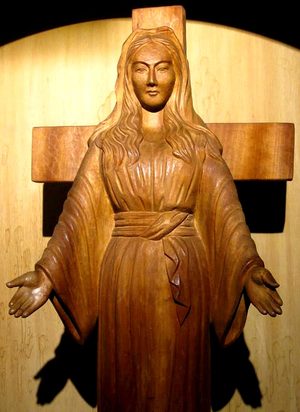

At Yuzawadai, near the city of Akita in northern Japan, Sister Agnes Katsuko Sasagawa reported messages in 1973 from a voice she took to be the Virgin Mary, and the sisters of her community reported that a wooden statue of Mary in their chapel bled and then wept 101 times (1975–1981). Bishop John Shojiro Ito of Niigata authorized devotion to Mary under this title in his diocese in 1984; the Holy See has issued no judgment of its own, and the Protestant traditions hold that nothing is to be added to Scripture by new revelation.
| Date | 12 June 1973 (first reported signs) to 15 September 1981 (last reported tears) |
|---|---|
| Place | Convent chapel of the Institute of the Handmaids of the Holy Eucharist (Seitai Hoshikai), Yuzawadai, Akita, Japan |
| Claimed by | Sister Agnes Katsuko Sasagawa and the sisters of her community (Roman Catholic) |
| Type | Marian apparition (messages heard from a statue); weeping and bleeding wooden statue; a stigmatic wound |
| Official status | Veneration of the "Holy Mother of Akita" authorized by the local bishop, John Shojiro Ito of Niigata, 22 April 1984, pending a judgment of the Holy See; no such judgment has been issued |
| Investigations | First diocesan commission (1976): could not prove a supernatural origin; Holy See unfavorable letter (1981); bishop's own inquiry of eight years; laboratory tests of the liquids at Akita and Gifu universities |
What is claimed
According to Sister Agnes, a member of the Handmaids of the Holy Eucharist, rays of light came from the tabernacle in the convent chapel on 12 June 1973 and on the two days after; on 28 June a cross-shaped wound appeared on her left hand and bled heavily (EWTN). On 6 July, she says, she heard a voice from the chapel's wooden statue of Mary, a figure three feet tall carved from a single block of katsura wood. The same day the sisters saw blood on the statue's right hand, which they report happened four times; on 29 September the wound disappeared and the statue began to sweat (EWTN). The statue was carved in 1963 by Saburo Wakasa, a sculptor of Akita city (convent website).
Three messages are dated 6 July, 3 August and 13 October 1973. In the first, the voice asks whether her deafness is painful and says it will be healed. The last, in EWTN's account, warns of a punishment in which fire falls from the sky and names Bishop Ito as the community's director. Catholic Culture quotes the messages as warning of the devil's work entering the Church, with "cardinals opposing cardinals, bishops against bishops."
The convent states that on the morning of 4 January 1975 tears began to flow from the statue and recurred 101 times, until 15 September 1981, the feast of Our Lady of Sorrows. Miracle Hunter, following Teiji Yasuda's book on Akita, adds that Sister Agnes's hearing returned for a time on 13 October 1974, that Akita Municipal Hospital found her incurably deaf in 1975, and that it was restored on 30 May 1982, which the site connects with the promise of 6 July 1973.
History and devotion
The convent's website names Bishop Ito as founder of the institute in 1970. Sister Agnes died on 15 August 2024, aged 93 (Catholic News Agency).
Ito began consulting the Congregation for the Doctrine of the Faith in 1975. According to Ito's own account as quoted by the Catholic commentator Mike Lewis, the Archbishop of Tokyo set up a commission in 1976 that "was not in a position to prove the supernatural events of Akita"; in 1979 Ito asked the Congregation for a second commission; in 1981 it sent the nunciature in Tokyo a letter "unfavorable to the events," which Ito held "contained some misunderstandings"; and in 1982–83 he sent a new dossier, which three Congregation officials decided in October 1983 "should remain under examination." On 22 April 1984 he issued his pastoral letter.
Investigations
Laboratory tests. The convent says swabs of the liquid were sent to the forensic laboratories of Akita University and Gifu University and certified to be "bodily fluid." Miracle Hunter reports that samples of tears, sweat and blood were sent for analysis in January 1975; that Eiji Okuhara, a Catholic physician in the biochemistry department at Akita University who had himself seen the weeping, ran the first tests and passed samples to a non-Christian forensic specialist, Kaoru Sagisaka; and that the samples were human, the blood type B and the sweat and tears type AB.
Church inquiries. Ito wrote of his eight years of inquiry (EWTN), and Lewis quotes him as saying of the tears, "It was salty and seemed to me truly human tears." The 1976 commission and the 1981 letter of the Congregation (above) did not confirm the events.
Critics. Lewis argues that Ito approved the events in 1984 without the Holy See's agreement, and reports that the statue is modeled on an image of "The Lady of All Nations." Peter Seiichi Shirayanagi, president of the Japanese bishops' conference, told the magazine 30 Days in July 1990: "The events of Akita are no longer to be taken seriously" (Miracle Hunter; Lewis). EWTN answers that the bishop's judgment, as the local authority's, has not been repudiated.
Official status
In his letter of 22 April 1984 Ito recognized "the supernatural character of a series of mysterious events concerning the statue of the Holy Mother Mary" and authorized veneration of the "Holy Mother of Akita" in his diocese while awaiting the Holy See's definitive judgment (EWTN; Miracle Hunter). He found the messages contained "nothing contrary to Catholic doctrine or morals" and stressed that even a favorable judgment would concern only private revelation (Catholic News Agency). In 1978 the Congregation's norms had made the local bishop the competent authority for such claims (EWTN).
In June 1988 Ito took the letter to Cardinal Joseph Ratzinger, who allowed it to stand. Ito said Ratzinger's remarks "only indicated that he did not object" to it (UCA News, 1988, as quoted by Lewis). The nuncio, William Carew, said in 1990 that Ratzinger "did not give any judgment on the reliability or credibility" of the messages, and a later nuncio, Ambrose de Paoli, wrote in 1999: "The Holy See has never given any kind of approval to either the events or messages of Akita" (Lewis). The former Philippine ambassador to the Holy See, Howard Dee, said in 1998 that Ratzinger privately told him the Fatima and Akita messages are "essentially the same" (Inside the Vatican, as reported by Catholic Culture). EWTN notes that no decree exists, but concludes that the 1984 approval remains because no later authority has repudiated it.
The Holy See's norms of 17 May 2024 replaced those of 1978 and set six verdicts, the mildest being nihil obstat, which authorizes the faithful to follow a devotion prudently "without expressing any certainty" about its supernatural origin. The norms add that "the faithful are not obliged to give an assent of faith" to such phenomena (Dicastery for the Doctrine of the Faith).
Where each church stands
- Catholic:
The Catechism (para. 67) teaches that so-called "private" revelations "do not belong" to the deposit of faith, and that their role is not to complete Christ's revelation but to help believers live by it in a period of history. Ito's 1984 letter is an act of the local bishop, and the Holy See has issued no verdict of its own. Under the 2024 norms no Catholic is required to accept Akita.
- Orthodox:
The Orthodox Church has made no statement about Akita. Orthodox teaching on visions is cautious: the Orthodox theologian Alexei Osipov writes that the Fathers warn of prelest, spiritual self-delusion, and advise neither accepting visions readily nor condemning those who report them, quoting St. Isaac the Syrian: "Let no one deceive himself and be given over to the deception of visions."
- Lutheran:
No Lutheran body has made a statement about Akita. The Smalcald Articles (III.8.10) state that "God does not wish to deal with us otherwise than through the spoken Word and the Sacraments," and warn against the spirit that boasts of the Spirit without the Word. The Wisconsin Synod's This We Believe adds that since salvation is fully revealed in Scripture, believers "need and expect no other revelations" (WELS).
- Reformed:
No Reformed church has made a statement about Akita. The Westminster Confession (1.1, 1.6) holds that God's former ways of revealing his will are "now ceased," and that nothing is to be added to Scripture "by new revelations of the Spirit, or traditions of men."
- Anglican:
The Church of England has made no statement about Akita. Article VI of the Thirty-Nine Articles holds that whatever is not read in Scripture or proved by it is not to be required as an article of faith, and Article XXII calls the Romish doctrine of the invocation of saints "a fond thing vainly invented" and "repugnant to the Word of God."
- Methodist:
No Methodist body has made a statement about Akita. The Articles of Religion retained in the United Methodist Book of Discipline (Article XIV) call the "Romish doctrine" of invocation of saints "a fond thing, vainly invented" and "repugnant to the Word of God."
- Baptist:
Baptists have made no statement about Akita. The Second London Confession (1677; reissued 1689) says in 1.1 that God's former ways of revealing his will are "now ceased" and in 1.6 that nothing is to be added to Scripture "by new Revelation of the Spirit." Some Baptists hold that the Spirit's gifts continue.
Sources
- EWTN, "A Message From Our Lady: Akita, Japan" (revised 2011) events of 1973, messages, 1984 letter, 1978 norms
- Seitai Hoshikai (Handmaids of the Holy Eucharist), convent website statue, weeping 4 January 1975 to 15 September 1981, laboratory certification
- Miracle Hunter, Akita laboratory tests, 1976 commission, 1988 and 1990 statements, hearing
- Mike Lewis, "What to make of Akita" Ito's account of the inquiries; UCA News 1988; Carew, de Paoli; criticisms
- Catholic News Agency, "Sister Agnes Sasagawa, Our Lady of Akita visionary, dies at 93" (2024)
- Catholic Culture, on Akita and Fatima (Howard Dee, Inside the Vatican, 1998)
- Dicastery for the Doctrine of the Faith, Norms for proceeding in the discernment of alleged supernatural phenomena (17 May 2024)
- Catechism of the Catholic Church, para. 67
- Osipov, "Individual Revelation and Its Indications" (OrthoChristian)
- Smalcald Articles, Part III, Article VIII (Book of Concord)
- WELS, "Private revelations"
- Westminster Confession of Faith, ch. 1 (Orthodox Presbyterian Church)
- Church of England, Articles of Religion
- United Methodist Church, Articles of Religion
- Second London Baptist Confession (1689), ch. 1
- Photograph of the statue, Wikimedia Commons (CC BY-SA 4.0)