King James Version 1611
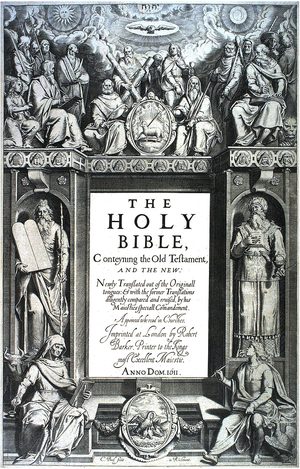

The King James Version (called the Authorized Version in Britain) is the English Bible made by a body of 47 scholars for King James I and published in London in 1611. By the 1660s it was known simply as "the bible" in England, and it remains the only English Bible some churches will use. This site quotes it, together with the Douay-Rheims, whenever it quotes Scripture.
| Published | 1611, London, by Robert Barker, the King's Printer; the standard text is the Oxford edition of 1769 |
|---|---|
| Commissioned by | King James I, after the Hampton Court Conference (January 1604); overseen by Richard Bancroft, bishop of London and then archbishop of Canterbury |
| Translators | 47 scholars (54 were first approved), all members of the Church of England, in six companies at Westminster, Oxford and Cambridge |
| Language | Early Modern English |
| Old Testament from | The Hebrew (Masoretic) text, revised from the Bishops' Bible |
| New Testament from | The Greek Textus Receptus (the "Received Text" tradition of printed Greek editions) |
| Books | 66 books of the Protestant canon; in 1611 fourteen Apocrypha books were printed between the Testaments, and most later printings omit them |
| Approach | Word-for-word (formal), with words supplied for English sense in italic type |
| Copyright | Public domain in the United States; in the United Kingdom the rights are vested in the Crown, with Cambridge University Press as the Crown's patentee |
| Used by | Church of England Prayer Book services; Independent Baptist and other KJV-only churches |
How it was made
The translation came out of the Hampton Court Conference of January 1604, where James I heard Puritan complaints against the Church of England. On Monday 16 January the Puritan John Rainolds asked for a new translation; the request was unexpected, and the king agreed. According to the historian Kenneth Fincham, James had called the Geneva Bible "the worst of all" translations and condemned some of its marginal notes as seditious (see the Geneva Bible). He formally appointed the translators and helped shape the fifteen rules they were to follow, which Bancroft drafted.
Fifty-four scholars were first approved and 47 are recorded as having worked. All belonged to the Church of England and all but Sir Henry Savile were clergy. Lancelot Andrewes was first named, in the First Westminster company, which took Genesis to 2 Kings. Two companies each met at Westminster, Oxford and Cambridge; the Second Oxford company took the Gospels, Acts and Revelation, and the Second Cambridge company the Apocrypha. Each company's work was sent to the others for review, and a panel in London reviewed the whole from 1609 to early 1611. Fincham reports that Bancroft held the right to print the translation and sold it to Barker for £4,000.
The book was published sometime between March 1611 and February 1612. Its title page says it was "Appointed to be read in Churches."
How it translates
The rules set the method. Rule 1 made the Bishops' Bible (1568) the base text, "as little altered as the truth of the original will permit." Rule 14 allowed the translations of Tyndale, Matthew, Coverdale, Whitchurch (the Great Bible) and Geneva wherever they agreed better with the original; much of the New Testament's wording is Tyndale's (William Tyndale). Rule 3 kept traditional church vocabulary: "the Word Church not to be translated Congregation." Rule 6 allowed marginal notes only "for the explanation of the Hebrew or Greek Words" that could not be put briefly in the text.
The Old Testament follows the Hebrew Masoretic text, and the Apocrypha the Greek, or the Latin where no Greek was available. The New Testament follows the printed Greek Textus Receptus. Later critical editions of the Greek New Testament rest on a wider body of manuscripts, and where they differ from the Received Text, modern versions differ from the KJV; this is the textual ground of the KJV-only debate below.
One often-cited choice is "bishoprick" at Acts 1:20, a change attributed to Bancroft.
Reception and revisions
Authorization. The KJV was never formally authorized by a proclamation requiring its use or an order to parishes to buy it; the University of Glasgow's special collections say its reputation as the "authorized" version dates from the standardized edition of 1769, and Fincham finds the phrase "authorised version" only from the 1820s. F. F. Bruce thought an order in council likely, but the Privy Council records for 1600 to 1613 burned in 1618 or 1619. Fincham argues that many bishops treated the royal commission as authority: Bishop Miles Smith of Gloucester, a translator, called it "lately set forth by his maiesties authority." Its acceptance grew over the following decades.
Text. Cambridge editions of 1629 and 1638 revised the 1611 text. The Oxford edition of 1769, edited by Benjamin Blayney, modernized spelling and punctuation and became the standard text most printings follow. The Apocrypha stood between the Testaments in 1611 (What is the Apocrypha?); by the nineteenth century printings nearly always omitted it.
Crown copyright. In the United Kingdom the text is not free of rights: the Church of England says its extracts are reproduced by permission of the Crown's patentee, Cambridge University Press. The privilege rests on letters patent held by the King's (later Queen's) Printer. In the United States the 1611 text is in the public domain.
The KJV-only movement. Some churches, chiefly Independent Baptist, hold that the KJV alone should be used. James White's survey (The King James Only Controversy, 1995) distinguishes five positions, from a simple preference, through the claim that its Hebrew and Greek base texts are better, to the claim that the KJV itself is inspired. Peter Ruckman (1921–2016), an Independent Baptist pastor in Pensacola, taught that the KJV was "advanced revelation" with authority above the Hebrew and Greek; other KJV defenders, including Roy Beacham and Kevin Bauder, reject that claim. D. A. Waite, president of the Dean Burgon Society since 1978, argues for the KJV from the Hebrew and Greek texts, the translators, their method and its theology. Within Independent Baptist circles John R. Rice held that the KJV is not perfect.
Where each church stands on the the KJV
- Catholic:
No Catholic document consulted for this page names the KJV. Canon law (c. 825 §1) says books of sacred Scripture "cannot be published" unless the Apostolic See or a conference of bishops has approved them, and requires approved vernacular translations to carry annotations; §2 allows Catholics, with a conference's permission, to prepare translations in collaboration with "separated brothers and sisters." Dei Verbum 22 (1965) likewise allows such joint translations with Church approval. The English Catholic Bible of the KJV's era was the Douay-Rheims.
- Orthodox:
The Orthodox churches have no official English Bible. The Orthodox Study Bible (New Testament and Psalms, 1993; whole Bible, 2008), produced by St. Athanasius Academy and blessed by bishops of the Standing Conference of Canonical Orthodox Bishops in America, prints the New King James Version (a 1982 revision of the KJV) for the New Testament and the Academy's own translation of the Septuagint for the Old; it is not an official text. An Antiochian parish guide (St. Michael, Texas) groups the KJV with Protestant Bibles whose Old Testament follows the Hebrew Masoretic text, not the Septuagint.
- Lutheran:
The Lutheran confessions, written in German and Latin in the 1500s, name no English translation. The Missouri Synod's Lutheran Service Book (2006) takes its Scripture readings from the English Standard Version unless otherwise indicated.
- Reformed:
The Westminster Confession (1.8) holds that the Scriptures "are to be translated into the vulgar language of every nation unto which they come," with the Hebrew and Greek originals as the final appeal. The Westminster Directory for Public Worship (1645) orders the canonical books to be read "out of the best allowed translation," excluding the Apocrypha. Neither names an English version; both were written while the KJV was still new.
- Anglican:
The Book of Common Prayer (1662) prints the Epistles and Gospels in the KJV and the Psalter in Coverdale's translation. The Church of England says that for Prayer Book services that reproduce the reading, "the Authorized Version of the Bible and the Psalter in The Book of Common Prayer are to be used"; the Prayer Book (Versions of the Bible) Measure 1965 allows other versions, and Common Worship uses the New Revised Standard Version, though any version not prohibited by lawful authority may be used. Article VI says the Church reads the Apocrypha "for example of life and instruction of manners" but does not use it "to establish any doctrine."
- Methodist:
John Wesley's Explanatory Notes upon the New Testament (preface dated 4 January 1754) print the text mostly in "the common English translation," which he judged "abundantly the best that I have seen," with occasional small changes. The United Methodist Church has no official translation; for its publishing house's teaching resources the preferred texts are the Common English Bible and the New Revised Standard Version.
- Baptist:
Baptist positions divide. Independent Baptist KJV-only teachers such as Ruckman and Waite (above) hold that the KJV alone should be used. The Southern Baptist Convention's Baptist Faith and Message (2000) says the Bible was "written by men divinely inspired" and names no translation; the convention's publisher, LifeWay, issued its own translation, the Holman Christian Standard Bible (2004), revised as the Christian Standard Bible (2017).
Sources
- Fincham, "The King James Bible: Crown, Church and People" (University of Kent, 2020) Hampton Court, Rainolds, the rules, Bancroft, Barker, authorization, spread
- University of Glasgow, "The King James Bible" (Divine Write) never formally authorized; 1769 edition
- Gibson, "The King James Bible 1611: History and Provenance" (Anglicanism.org) translators, companies, Bancroft's alterations
- Pollard, Records of the English Bible (1911): the fifteen rules, as quoted by Mathetes.ai wording of rules 1, 3, 6, 14
- Text & Canon Institute, "Seven Common Misconceptions about the King James Bible" Bishops' Bible base; editions of 1629, 1638 and 1769
- King James Version (reference article on companies, texts, Blayney's 1769 edition, Apocrypha) pointer to Bruce and Daniell; Privy Council fire
- British Bible monopolies campaigns letters patent; King's Printer; university presses
- Church of England, Liturgical copyright Crown rights; Cambridge University Press as patentee
- Church of England, Versions of the Bible and of the Psalms
- Church of England, Articles of Religion (Article VI)
- Book of Common Prayer (1662): Epistles, Gospels and Psalter pointer to Maude
- King James Only movement (reference article: White's five positions, Ruckman, Burgon, Rice, Cloud) pointer to White (1995), Beacham and Bauder (2001)
- Peter Ruckman (reference article) dates; Independent Baptist; advanced revelation
- Dean Burgon Society Waite president since 1978
- Waite, Defending the King James Bible (Old Paths Publications) the four-fold argument
- Code of Canon Law, canon 825 (Vatican)
- Second Vatican Council, Dei Verbum (1965), para. 22
- The Orthodox Study Bible, Thomas Nelson (2008): title-page verso, via Open Library NKJV New Testament; St. Athanasius Academy Septuagint
- Orthodox Study Bible (reference article: 1993 and 2008 editions, episcopal blessing)
- St. Michael Antiochian Orthodox Church, "What Bible translation should Orthodox Christians use?"
- Lutheran Service Book (Concordia Publishing House), front matter on Scripture text
- Westminster Confession of Faith, ch. 1 (OPC)
- Westminster Directory for Publick Worship (1645), "Of Publick Reading of the Holy Scriptures"
- Wesley, Explanatory Notes upon the New Testament, Preface (CCEL)
- United Methodist Church, "Does the UMC have an official Bible translation?"
- Southern Baptist Convention, Baptist Faith and Message 2000, Article I
- Illinois Baptist, "A new Bible: LifeWay's Christian Standard Bible and its purpose"
- 1611 title page, Wikimedia Commons (public domain)