Symeon the New Theologian 949–1022
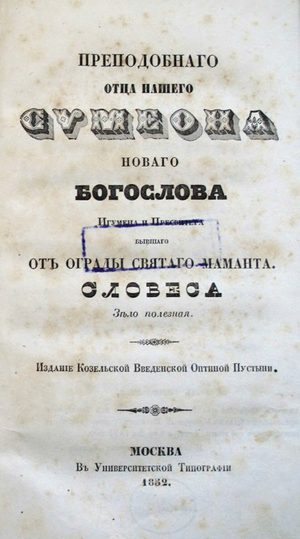
Symeon the New Theologian was a Byzantine monk and abbot of St Mamas in Constantinople who taught that Christians are meant to know God by direct, conscious experience, above all as divine light, and who wrote down his own visions in sermons and hymns. His claims brought a trial before the patriarch's synod and exile (1009). The Orthodox Church counts him a saint, and Benedict XVI gave a general audience to him in 2009.
| Lived | 949, Galate in Paphlagonia, to 12 March 1022, at the oratory of St Marina across the Bosphorus from Constantinople (the year of birth is disputed: see below) |
|---|---|
| Church | Church of Constantinople; monk and priest |
| Role | Monk of the Studios (976 or 977); abbot of St Mamas, Constantinople (980 to c. 1005) |
| Influenced by | Symeon the Studite (Eulabes), his spiritual father; Mark the Monk; the monastic tradition of Gregory of Nazianzus and John Climacus |
| Influenced | His disciples Arsenios, his successor at St Mamas, and Niketas Stethatos, later abbot of the Studios, who edited his works |
| Writings | Catecheses (discourses to his monks); Hymns of Divine Love (58 hymns); Theological, Gnostic and Practical Chapters; ethical treatises; letters |
| Honored | 12 March in the Orthodox calendar, kept on 12 October when March 12 falls in Great Lent; one of three saints called "the Theologian" |
Life
Symeon was born in 949 at Galate in Paphlagonia, to Basil and Theophano, a provincial family of standing. His uncle took him to court at Constantinople as a boy, and he was expected to enter imperial service. At about fourteen he sought out Symeon the Studite, called Eulabes ("the devout"), a monk of the Studios monastery, who became his spiritual father. According to Kallistos Ware, his first vision of light came about the age of twenty, while he prayed as a layman. In 976 or 977 he entered the Studios as a postulant; his devotion to the elder troubled the abbot, and he moved to the neighboring monastery of St Mamas, where the Studite had him tonsured. In 980 he became its hegumen and was ordained priest, rebuilt the house and tightened its discipline. About thirty monks rebelled in the later 990s; the patriarch sided with Symeon, who asked that they be spared.
The Studite died in 986 or 987, and Symeon kept an annual festival in his honor. After some sixteen years Stephen, the former metropolitan of Nicomedia and now the patriarch's syncellus, led an attack on this veneration of a man not officially recognized as a saint. Symeon resigned as hegumen about 1005 in favor of Arsenios, and in January 1009 the synod condemned him to exile. Accounts of the end of the affair differ. H. J. M. Turner reports that the sentence was revoked and Symeon was allowed to return to St Mamas if he kept the Studite's festival more modestly, which he refused; others say the patriarch offered him an archbishopric and he declined. Benedict XVI says Patriarch Sergius II rehabilitated him. He spent his last years at St Marina, a small monastery he restored near Chrysopolis, where he wrote much of his work, and died there on 12 March 1022. His disciple Niketas Stethatos edited his writings and, after 1052, wrote his Life.
What he taught
Symeon taught that true knowledge of God comes through purification and spiritual experience, not from books alone (Benedict XVI, 2009). He described visions of divine light, which he took to be God himself and not a created light; in it he was changed yet kept his own identity, and his mysticism centered on Christ (Ware). It begins in repentance: his first vision came as he prayed "God be merciful to me a sinner" (Luke 18:13, KJV), and his tears expressed both penitence and joy. John McGuckin argues that in the Hymns repentance is not a beginner's stage: "repentance is one of the highest spiritual states, not the lowest." He speaks of union with Christ in the language of deification (theosis).
He held that Christians should consciously feel the indwelling of the Spirit, a "sensation of the heart," and that the Spirit's gifts have not ceased (Ware). Benedict XVI reports that for Symeon this grace was "the fruit of Baptism in the life of every seriously committed believer," not a gift for a few mystics. He also urged submission to a spiritual father. In his letter on confession he held that the authority to bind and loose had passed from apostles to bishops to priests and then to God's elect, the monks; on his view conscious awareness of the Spirit is the essential qualification of a confessor, so a lay monk who had it could hear confession and a bishop who lacked it could not (Ware; Barkley). Ware adds that most Orthodox hesitate to follow him here, since they distinguish spiritual direction from the sacrament.
What historians say
Only two eleventh-century sources describe his life: Niketas's Life and Symeon's own writings. Stephen Barkley notes that hagiography tends to exaggerate a saint's sanctity, while Symeon's own works exaggerate his unworthiness. Dates are uncertain: Barkley, following Alfeyev, lists 949 (Irénée Hausherr), 956 (Christou) and 963–69 (Holl) for his birth. The Orthodox Church in America gives his death as 1021; Turner, Benedict XVI and most others give 1022.
Historians differ on the title. Benedict XVI notes that tradition reserved "Theologian" for John the Evangelist and Gregory of Nazianzus. Alexander Golitzin, quoted by Barkley, observes that "Newness or innovation in Byzantine theology was an attribute normally associated with heretics," so the epithet may have been given first by his enemies; Encyclopedia.com suggests it distinguished him from those two. Golitzin also calls his theology "thoroughly traditional" (as cited by Barkley), and Hilarion Alfeyev's St Symeon the New Theologian and Orthodox Tradition (Oxford, 2000) places his life in the setting of Byzantine monasticism and the Studite tradition. Basil Krivocheine, an Orthodox archbishop, published a full study, In the Light of Christ: Saint Symeon the New Theologian (949–1022): Life, Spirituality, Doctrine (St Vladimir's Seminary Press, 1986). McGuckin (2020) holds that English-language scholarship has fixed on the visions of light and neglected the Hymns' main teaching, radical repentance. Ware reports that critics objected to his veneration of the Studite without approval and to his views on priesthood and confession, yet the Byzantine Church canonized him.
Pentecostal writers have compared him to their own movement. Christianity Today's "Timeline of the Spirit-gifted" (2002) calls him "perhaps the most famous Eastern [Orthodox] charismatic Christian," while its editor Chris Armstrong adds that calling such figures "Pentecostal" or "charismatic" would be "a misleading anachronism." Gene Mills, writing as a Pentecostal, sets Symeon's second baptism of tears beside Spirit baptism and notes the difference in the sign: tears for Symeon, tongues for classical Pentecostals.
How the churches see Symeon
- Catholic:
Benedict XVI gave his general audience of 16 September 2009 to Symeon, calling him a "holy Eastern monk" whose works have had "an important place in the Eastern monastic tradition to our day," and used his teaching to recommend spiritual direction. The Jesuit scholar Irénée Hausherr proposed the chronology that is generally accepted (Barkley), and Paulist Press, a Catholic publisher, issued the Discourses in English in its Classics of Western Spirituality. On confession, Catholic teaching (Catechism 1422–1498) is that sins are confessed to a priest who absolves in Christ's name.
- Orthodox:
The Orthodox Church honors him as Venerable Symeon the New Theologian, on 12 March, a feast moved to 12 October when March 12 falls in Great Lent (Orthodox Church in America). With John the Evangelist and Gregory of Nazianzus he is one of three saints called "the Theologian." The date of his canonization is unknown, but veneration began soon after his death (Turner), and Ware says the Byzantine Church, after controversy, canonized him. Ware adds that most Orthodox would hesitate to accept his teaching that a lay monk with the Spirit may hear confession.
- Lutheran:
Lutheran churches have made no statement about Symeon. Their confessions say the Holy Spirit is given "through the Word and Sacraments, as through instruments" (Augsburg Confession V), condemn those who think the Spirit comes without the outward Word, and keep private absolution (XI). Tuomo Mannermaa and the Helsinki school of Lutheran scholars find a doctrine close to theosis in Luther; other Lutheran scholars dispute this.
- Reformed:
The Reformed churches have made no statement about Symeon. The Westminster Confession (1646) says the believer may be assured by "the testimony of the Spirit of adoption witnessing with our spirits that we are the children of God" (18.2), and also that God's former ways of revealing his will are "now ceased" (1.1), a clause cessationists apply to the sign gifts (spiritual gifts).
- Anglican:
The Anglican churches have made no statement about Symeon. Their formularies speak of assurance and of falling from grace in the terms of Article XVI of the Thirty-Nine Articles, which allows that believers "may depart from grace given" (assurance).
- Methodist:
The Methodist churches have made no statement about Symeon. John Wesley recorded in his Journal (24 May 1738) that at Aldersgate Street his heart was "strangely warmed," and taught that the Spirit witnesses directly to the believer's adoption (Romans 8:16). Gene Mills, a Pentecostal writer, observes that Wesley shares Symeon's view that infant baptism is effective but can be lost.
- Baptist:
Baptist bodies have made no statement about Symeon. The Baptist Faith and Message (2000, art. II.C) says only that the Spirit "bestows the spiritual gifts," and Baptists are divided between those who hold that the sign gifts ended with the apostles and those who do not (spiritual gifts). Baptists have no sacramental confession and no priestly absolution (confession).
Sources
- Benedict XVI, General Audience of 16 September 2009: Symeon the New Theologian
- Turner (ed.), The Epistles of St Symeon the New Theologian, Oxford Early Christian Texts (2009), introduction dates, Stephen, exile, rehabilitation terms
- Kallistos Ware, "Symeon the New Theologian" (excerpt)
- Stephen D. Barkley, "Symeon the New Theologian: A Saint of and for His Times" (2016) cites Alfeyev, Golitzin, Hunt, Maloney
- Encyclopedia.com, "Symeon the New Theologian, Monk of the Studion"
- Orthodox Church in America, "Venerable Simeon the New Theologian"
- McGuckin, "Repentance as Divine Communion in St. Symeon the New Theologian's Hymns of Divine Love," International Journal of Orthodox Theology 11:1 (2020)
- Alfeyev, St Symeon the New Theologian and Orthodox Tradition (Oxford University Press, 2000)
- Krivocheine, In the Light of Christ (St Vladimir's Seminary Press, 1986)
- Armstrong, "Timeline of the Spirit-gifted," Christianity Today (1 October 2002)
- Mills, "The Baptism of Tears," Quodlibet Journal 3:3 (2001), reprinted in the Pneuma Review
- Paulist Press, Symeon the New Theologian: Discourses (Classics of Western Spirituality)
- Augsburg Confession, arts. V and XI (Book of Concord)
- Westminster Confession of Faith, ch. 18 (Orthodox Presbyterian Church)
- Wesley, Journal, 24 May 1738 (quoted by Discipleship Ministries)
- Title page of the 1852 Moscow edition, Wikimedia Commons (public domain)