Incorrupt bodies
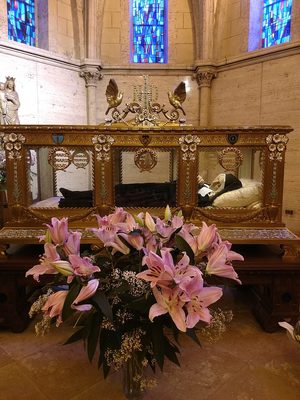

Incorruptibility is the claim that a dead person's body has not decayed as bodies normally do, and that this is a sign from God. It is made for many Catholic and Orthodox saints, and each tradition has had to say what such a claim shows. Catholic and Orthodox sources both treat it as a possible sign, not a requirement for sainthood, while the Reformation churches reject the veneration of relics.
| Date | Examples below: saints who died between 1833 and 1879, with bodies examined between 1903 and 1933 |
|---|---|
| Place | Nevers, Paris (rue du Bac), Ars, Diveyevo, Corfu, Kyiv |
| Claimed by | The Catholic Church (religious communities and dioceses) and Orthodox churches (Russian, Greek, Ukrainian) |
| Type | Relic: the claim that a body has not decayed, or has kept a lifelike state |
| Official status | Catholic Church: not a requirement for canonization; counted as a sign only if neither embalming nor natural preservation explains it. Orthodox: not a requirement; accepted by some writers as a divine sign, with caution |
| Investigations | Medical examinations at Nevers (1909, 1919, 1925); Synod commission at Sarov (1903); Italian scientists' study of Margaret of Cortona and Zita (1980s); Soviet-era exhibit at the Kyiv Caves (1934) |
What is claimed
The Catholic writer Joan Carroll Cruz, in The Incorruptibles (1977), listed 102 saints and blesseds she counted as incorrupt and said that about 1% had received some intervention. In her summary, Prospero Lambertini (later Benedict XIV), writing between 1708 and 1728, held that bodies found intact but decaying within a few years do not count; he would accept only bodies that keep "lifelike flexibility, color and freshness, without deliberate intervention" for many years (EWTN News).
According to the Nevers community and its doctors, Bernadette Soubirous (died 16 April 1879) was exhumed in 1909, 1919 and 1925. The 1909 witnesses noted no smell and skin clinging to the muscles. Dr. Comte's report of 3 April 1919 says that "the body of the Venerable Bernadette is intact, the skeleton is complete"; in 1925 he found the liver unexpectedly soft and wrote that this "did not seem to be a natural phenomenon" (as reported in the National Catholic Register). Catherine Labouré (died 31 December 1876) was found incorrupt in 1933, according to the Vincentians, and lies in a glass coffin at the rue du Bac in Paris. For John Vianney (died 4 August 1859), the Catholic site Hozana says the body was found uncorrupted when the tomb was opened for his cause and is displayed at Ars with a wax mask; the Marian priest Chris Alar says that in his case it is the heart that has not decayed.
Among the Orthodox, the writer Patrick Comerford reports that Spyridon of Trimythous "was said" to have been found incorrupt; his relics were brought to Corfu after 1453 and lie in a double sarcophagus whose inner part has a removable bottom "to facilitate changing the slippers of the saint." In the Kyiv Caves, where the monastery was founded in the 11th century, many burial niches still hold mummified remains of monks and saints (Encyclopedia of Ukraine).
History and devotion
The Council of Trent (Session 25, 3–4 December 1563) taught that "the holy bodies of holy martyrs, and of others now living with Christ" are "to be venerated by the faithful," and ruled that no new miracles are to be acknowledged, or new relics recognized, unless the bishop has examined and approved them. Bernadette was beatified on 14 June 1925 and canonized by Pius XI on 8 December 1933; Vianney was canonized on 31 May 1925; Catherine Labouré was beatified on 28 May 1933 and canonized by Pius XII on 27 July 1947. The Catechism (1674) names the veneration of relics among forms of popular piety.
Orthodox practice rests on the Second Council of Nicaea (787), whose canon 7 requires relics in every consecrated church. The relics of monks of the Kyiv Caves were canonized by Metropolitan Petro Mohyla in 1643. At Corfu the relics of Spyridon are carried in procession on Palm Sunday, Holy Saturday, 11 August (for the Ottoman siege of 1716) and the first Sunday of November (Orthodox Christianity). Soviet authorities confiscated relics in 1921–22; in 1934 an exhibit on the Lavra grounds showed "samples of artificial and natural mummification" and, in the Lavra's own account, called some remains "fabricated" relics. For Seraphim of Sarov, whose glorification came in 1903, see his entry.
Investigations
The sceptic Joe Nickell argues in Looking for a Miracle (1993) that Bernadette's face and hands are wax, added because her face was emaciated at the first exhumation (as summarized by the Skeptic's Dictionary). The Catholic account in the Register says that in 1925, as she was to lie in a glass coffin, casts were made and a wax covering applied to the face and hands, which had darkened; her nose had thinned, and Comte removed two ribs as relics. The same account says that in 1919 he had removed ribs, kneecaps, part of the liver and muscle, and attributes her skin's discoloring to the washing in 1909.
In the 1980s Italian scientists, in a Church-sanctioned study reported by Heather Pringle (Discover, 2001), found that Margaret of Cortona had been extensively embalmed at her devotees' request, but found "not a trace of human intervention" on Zita. Cruz noted that many saints lay in earth or wooden coffins unsuited to natural mummification. Forensic literature describes adipocere, a fatty substance that forms in some graves and is regarded as inhibiting decomposition (Fiedler and Graw, Naturwissenschaften, 2003); the Skeptic's Dictionary cites adipocere, alkaline or dry soil, and careful burial as explanations. When the body of Carlo Acutis was examined, Bishop Domenico Sorrentino said it "was found in the normal state of transformation typical of the cadaveric condition."
A commission sent to Sarov in January 1903 found only bones, according to the Pravoslavie.ru chronology, and Metropolitan Anthony (Vadkovsky) wrote that incorruption "is by no means considered a sign" of sanctity; the Synod glorified Seraphim nonetheless.
Official status
The Catholic Church has no fixed definition of the condition a body must be in to be called incorrupt, and does not require incorruption for canonization; it is regarded as miraculous only when neither deliberate preservation nor natural preservation explains it (EWTN News). Canonization declares a person's holiness, not the state of the body. In Orthodox teaching, Pomazansky writes that the uncovering of relics was not an essential condition of glorification, and that incorruption of the dead is no guarantee of sanctity.
Where each church stands
- Catholic:
Trent (1563) taught the veneration of saints' bodies and required a bishop's approval for new relics and miracles; the Catechism (1674) lists veneration of relics among forms of popular piety. Incorruption is not required for canonization, and Cruz's list, though widely read, is one author's compilation and not an official one. Bernadette (1933), Vianney (1925) and Catherine Labouré (1947) were canonized for their holiness, not for the state of their bodies.
- Orthodox:
Canon 7 of Nicaea II (787) requires relics in every consecrated church. The theologian Mikhail Pomazansky (Orthodox Dogmatic Theology, "The Veneration of Holy Relics") accepts the incorruption of the righteous as one of God's signs of their sanctity but says it is no guarantee of sanctity. According to the Pravoslavie.ru chronology, Metropolitan Anthony wrote in 1903 that it "is by no means considered a sign." Meduza reports that Russian Orthodoxy often expects incorrupt relics as a tradition, not a rule, while in Greek practice preserved flesh is sometimes seen as a bad sign.
- Lutheran:
The Smalcald Articles (II.2.22–23) call relics, with "falsehoods and tomfooleries concerning the bones of dogs and horses," a thing that should long ago have been condemned, since they were made to work indulgence and the forgiveness of sins. The Lutheran confessions make no statement about incorrupt bodies as such.
- Reformed:
Calvin's treatise on relics (French, 1543; in English, An Admonition showing the Advantages which Christendom might derive from an Inventory of Relics) argues that relics are often fraudulent: "every Apostle has more than four bodies, and every Saint two or three." He says the world should have sought Christ "in his Word, sacraments, and spiritual influences" and not in his garments. Reformed churches have made no confessional statement on incorruption itself; see John Calvin.
- Anglican:
Article XXII (1563) calls the "Romish Doctrine" of the worshipping and adoration of images and relics "a fond thing vainly invented" and grounded on no warrant of Scripture. The Church of England has made no statement on incorrupt bodies; Anglo-Catholic parishes use relics as aids to devotion, while Evangelical parishes keep churches plain.
- Methodist:
Wesley's Article XIV (1784) repeats the Anglican wording: the "Romish doctrine" of worshipping and adoring images and relics is "a fond thing, vainly invented." The Methodist churches have made no statement about incorrupt bodies.
- Baptist:
No Baptist convention or confession mentions incorrupt bodies. The Second London Confession (1689), chapter 22, paragraph 1, gives religious worship to God alone and "not to angels, saints, or any other creatures." This site's chapter on images and relics lists Baptists with the Reformed as holding that venerating relics is superstition.
Sources
- EWTN News (CNA): Carlo Acutis raises the question: what does it mean if a saint's body is incorrupt?
- National Catholic Register: The Marvelous Preservation of St. Bernadette
- National Catholic Register: The Incorruptibles: who are these mysterious saints?
- Vincentian Family wiki: Catherine Labouré
- Hozana: The Holy Parish Priest of Ars
- Council of Trent, Session 25 (1563)
- Skeptic's Dictionary: Incorruptibility (citing Nickell, Looking for a Miracle, 1993)
- Fiedler and Graw, Decomposition of buried corpses, with special reference to the formation of adipocere, Naturwissenschaften 90 (2003)
- Patrick Comerford: The Church of Saint Spyridon, Corfu (2019)
- Orthodox Christianity: procession honors St. Spyridon saving Corfu (11 August)
- Encyclopedia of Ukraine: Kyivan Cave Monastery
- Kyiv-Pechersk Lavra: Interesting stories (1934 exhibit)
- Pomazansky, Orthodox Dogmatic Theology, The Veneration of Holy Relics
- Pravoslavie.ru, chronology of the canonization of Seraphim of Sarov (2013, in Russian)
- Meduza: why do people venerate relics
- Smalcald Articles, Part II, Article II (Book of Concord)
- Calvin, Admonition on relics (Christian History Institute excerpt)
- Church of England, Articles of Religion (Article XXII)
- United Methodist Church, Articles of Religion (Article XIV)
- Second London Baptist Confession (1689), chapter 22