John William Fletcher 1729–1785
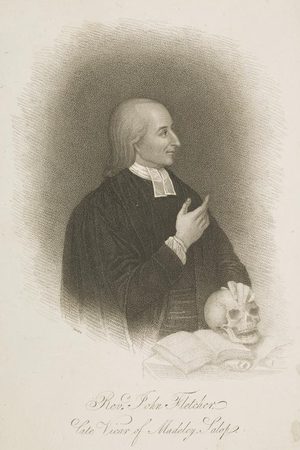

John Fletcher (Jean Guillaume de la Fléchère) was a Swiss-born priest of the Church of England who spent twenty-five years as vicar of Madeley in Shropshire. When the Methodist Conference of 1770 stirred a quarrel with the Calvinists over justification, works and predestination, he wrote the Checks to Antinomianism in Wesley's defense, and Wesley hoped he would lead the movement after him.
| Lived | 12 September 1729, Nyon, Switzerland, to 14 August 1785, Madeley, Shropshire |
|---|---|
| Church | Priest of the Church of England (ordained deacon and priest 1757); a Methodist preacher in connection with John Wesley who never left the established church |
| Role | Vicar of Madeley (1760–1785); superintendent of the Countess of Huntingdon's college at Trevecca (1768–1771); Wesley's proposed successor (1773) |
| Influenced by | John Wesley and Charles Wesley, the latter his frequent correspondent |
| Influenced | Joseph Benson, his biographer; later Methodist and holiness writers on Christian perfection and the baptism of the Holy Spirit |
| Writings | Checks to Antinomianism (1771–1775); An Essay on Truth (1773); Scripture Scales (1774); A Polemical Essay on the Twin Doctrines of Christian Imperfection and a Death Purgatory (1775); The Reconciliation (1776); The Portrait of St. Paul (published 1790) |
| Honored | No day in the Episcopal Church's calendar (which lists the Wesleys on 3 March); buried at St. Michael's, Madeley; subject of Wesley's Sermon 133 |
Life
Fletcher was educated at Nyon and the University of Geneva. Intending a military career, he went to Lisbon to take a commission, was prevented by an accident, and later visited England, where in 1752 he became tutor to the sons of Thomas Hill of Tern Hall in Shropshire. Hearing of the Methodists there, he joined their society; Wesley's Short Account prints a diary entry of January 1755 from his struggle toward assurance. On two successive Sundays in 1757 the bishop of Bangor ordained him deacon and priest at the Chapel Royal. In 1760 he accepted the living of Madeley, in Hill's gift, in preference to a richer one, and stayed there for the rest of his life. He founded societies at Madeley Wood and Coalbrookdale, and preferred parish work to Wesley's itinerant preaching.
In 1768 the Countess of Huntingdon invited him to oversee her college at Trevecca in Wales. After the Methodist Conference of 7 August 1770 issued Minutes saying that Methodists had "leaned too much toward Calvinism" and that people are "every hour and every moment pleasing or displeasing to God, according to our works," Walter Shirley circulated a letter inviting clergy and laity to protest. Fletcher answered with the first Check (1771) and resigned from Trevecca that year, and Joseph Benson was dismissed as headmaster there for taking the same side; the controversy ran until the late 1770s. On 15 January 1773 Wesley wrote to him, "Thou art the man," proposing that he lead the connection after Wesley. Fletcher did not accept, and he died first. Poor health took him from Madeley from 1776 to 1781 (he spent part of it at Nyon); on 12 November 1781 he married Mary Bosanquet at Batley, and they returned to Madeley in January 1782. He died there on 14 August 1785, and Wesley published his Short Account of the Life and Death in 1786.
What he taught
Fletcher defended Wesley's Arminian teaching that Christ died for all; he wrote that he must hold it because "God is love." He held that his opponents' stress on imputed righteousness, with the denial that believers must do works, led to antinomianism, and the title of the Checks names the charge. In the Third Check he wrote that he had meant to oppose antinomianism alone, but that his opponents defended it on Calvinist ground and so he had to meet them there. In The Reconciliation (1776) he argued that the doctrines of grace and of justice are both essential, so that a candid Arminian and a candid Calvinist might each find the other's truth in Scripture.
Robert Mattke summarizes his scheme as an initial justification by faith alone and a final justification at judgment by the works of faith, held together as two "gospel axioms." The 1775 Polemical Essay defended Christian perfection, and his doctrine of "dispensations" is linked by some historians to later talk of a baptism of the Holy Spirit. He rejected the Calvinist doctrine of unconditional election (election and foreseen faith). In 1776 he defended Wesley's Calm Address to Our American Colonies against the Baptist minister Caleb Evans. In Madeley he taught the children himself every day and set up a large Sunday school.
What historians say
Methodist historians have rated the Checks highly. Abel Stevens wrote in 1859 that they were "more influential in the denomination than Wesley's own controversial writings" on the subject, and Wesley himself praised their language, argument and temper. A United Methodist writer, Philip Brooks (2023), says they helped establish the doctrine of Christian perfection, and speculates that Fletcher, a loyal Anglican, might have kept Methodism from separating from the Church of England had he outlived Wesley; Wesley named Thomas Coke a superintendent in 1784. Others dispute how far Fletcher's Spirit language led to Pentecostalism: Vinson Synan credits him with first calling a second work of grace the "baptism of the Holy Spirit," while others, citing Staples in the Wesleyan Theological Journal, read him as linking the two ideas without identifying them.
The opposing side was Calvinist. The controversy involved Shirley, Augustus Toplady (More Work for Mr. John Wesley, 1772; Historic Proof of the Doctrinal Calvinism of the Church of England, 1774), Sir Richard Hill (Review of Wesley's Doctrines, 1772) and Rowland Hill, and the Hills answered the Checks with pamphlets of their own (Richard Hill's Finishing Stroke replied to the Fourth Check). The Dictionary of National Biography judged that the Checks were so tangled in "the most feeble, bitter, and unprofitable controversy of the eighteenth century" that their intellectual merits went unrecognized. Fletcher himself wrote that he was "no party-man."
How the churches see Fletcher
- Catholic:
The Catholic Church has made no statement about Fletcher. On the matters he argued, the Council of Trent (Session 6, chapter 10 and canon 24) teaches an "increase of justification received," and anathematizes the view that justice received is not preserved and increased before God through good works. Catholic writers have not treated Fletcher's "second justification" as an official question.
- Orthodox:
The Orthodox Church has made no statement about Fletcher. Its general teaching on works is set out in the Confession of Dositheus (Synod of Jerusalem, 1672), which says, as Philip Schaff reports, that man is justified "not by faith alone, but also by works."
- Lutheran:
Lutheran churches have made no statement about Fletcher. The Formula of Concord (Epitome VI) rejects the teaching that the law is "not to be urged upon Christians and true believers," the antinomianism that Fletcher charged against his Calvinist opponents, and Lutherans in turn deny that election rests on foreseen faith while refusing to teach reprobation (election without reprobation).
- Reformed:
Reformed critics of Fletcher included Toplady and the Hills, who held that Wesley's 1770 Minutes taught justification by works and who defended the Calvinism of the Church of England. The Westminster Confession answers the charge of antinomianism in its own terms: faith is "the alone instrument of justification" (11.2), yet it is "never alone" in the justified person, and good works are "the fruits and evidences of a true and lively faith" (16.2). It teaches that some are predestinated to everlasting life (3.3), a doctrine Fletcher's Checks contested. No Reformed church has issued a statement on Fletcher himself.
- Anglican:
Fletcher was a priest of the Church of England from 1757 until his death, and as vicar of Madeley he did not itinerate as Wesley did. Article XVII of the Church of England says that "Predestination to Life is the everlasting purpose of God," and Article XII that good works "follow after Justification." Toplady's Historic Proof of the Doctrinal Calvinism of the Church of England (1774) argued that the Church's teaching was Calvinist, the position Fletcher's Arminian Checks opposed. The Episcopal Church's calendar commemorates John and Charles Wesley on 3 March and does not list Fletcher.
- Methodist:
John Wesley's Sermon 133 on his death takes as its text Psalm 37:37, and in it Wesley says of Fletcher, "one equal to him I have not known," and "I scarce expect to find another such on this side of eternity." A four-volume edition of Fletcher's works was issued by the Methodist Book Concern in New York, and United Methodist Communications includes him among its "Unsung Heroes of Methodism." His writings are not among the doctrinal standards of the United Methodist Church, which are Wesley's Standard Sermons and Notes and the Articles (how binding are the Standard Sermons).
- Baptist:
No Baptist body has made a statement about Fletcher. Caleb Evans, Baptist pastor at Broadmead, Bristol, and from 1779 principal of Bristol Baptist Academy, was the addressee of Fletcher's three letters in defense of Wesley's Calm Address (1776). The Second London Confession (1689), which many Baptists hold, devotes chapter 17 to the perseverance of the saints, a teaching on which Methodists differ (sheep who can perish).
Sources
- Overton, "Fletcher, John William," Dictionary of National Biography, vol. 19 (1889) dates, Madeley, Trevecca, Checks, works
- Wesley, A Short Account of the Life and Death of the Rev. John Fletcher (1786), Wesley Corpus birth date, 1755 diary, ordination, Madeley, Trevecca resignation, "no party-man"
- Wesley, Sermon 133, On the Death of the Rev. Mr. John Fletcher (CCEL)
- Wesley's letters 1773, Wesley Center Online (letter of 15 January 1773)
- Wesley Center Online, "Doctrinal Wars": the 1770 Minutes and the controversy
- Wesley Scholar, "The Minutes Controversy, 1770-1777" Shirley's circular, titles by Toplady and the Hills, after Gunter, The Limits of Love Divine
- Fletcher, Checks to Antinomianism, table of contents (Gospel Truth)
- Mattke, "John Fletcher's Methodology in the Antinomian Controversy of 1770-76," Wesleyan Theological Journal (1992) second justification; Stevens quotation (History of Methodism, 1859)
- Brooks, "Unsung Heroes of Methodism: John Fletcher," United Methodist Communications (2023)
- John William Fletcher (Wikipedia), for marriage at Batley (Brown 1983) and Mary's burial
- "Fletcher, John William (Fletcher of Madeley)," biographical entry (cblibrary.org) Methodist Book Concern edition; 1776 tracts
- Pneuma Review, "The Second Blessing of Spirit Baptism" (Synan on Fletcher)
- James Clarke extract on Fletcher's dispensations (Staples)
- Caleb Evans, Dissenting Studies biography
- Council of Trent, Session 6 (Waterworth translation)
- Schaff, Creeds of Christendom, on the Synod of Jerusalem (1672)
- Formula of Concord, Epitome, Article VI (Book of Concord)
- Westminster Confession of Faith, chs. 3, 11, 16 (OPC)
- Church of England, Articles of Religion, XII and XVII
- Episcopal Church, Calendar of the Church Year
- Second London Baptist Confession (1689), ch. 17
- Rev. John Fletcher, engraving by Thomas Blood, Wikimedia Commons (public domain)