C. F. W. Walther 1811–1887
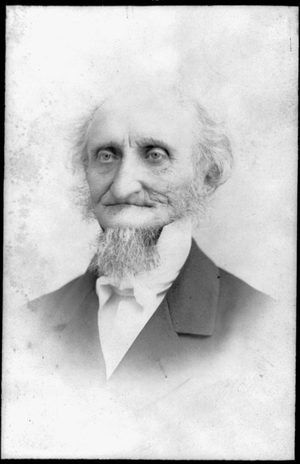

Carl Ferdinand Wilhelm Walther was a Saxon pastor who led a group of German Lutheran emigrants to Missouri and became the first president of the Lutheran Church–Missouri Synod (1847). He held that the church exists wherever the Word and sacraments are rightly given, and that a congregation's constitution must rest on the Bible and the Lutheran Confessions. Other Christians know him for his dispute over election and for his writing on slavery.
| Lived | 25 October 1811, Langenchursdorf, Saxony, to 7 May 1887, St. Louis, Missouri |
|---|---|
| Church | Lutheran pastor; ordained in Saxony (1837); the Lutheran Church–Missouri Synod |
| Role | Pastor of Trinity Church, St. Louis (from 1841); first president of the Missouri Synod (1847–50; again 1864–78); first professor and head of Concordia Seminary (from 1849); editor of Der Lutheraner (1844) and Lehre und Wehre (1855); first president of the Synodical Conference (1872) |
| Influenced by | Martin Stephan, whose letter comforted him as a student; Luther's writings; the Lutheran Confessions |
| Influenced | Wilhelm Sihler, F. C. D. Wyneken and F. A. Crämer, who joined him in forming the synod; the congregational constitutions of the Missouri Synod |
| Writings | Altenburg Theses (1841); Church and Ministry (1852); The Proper Distinction between Law and Gospel (lectures 1884–85; German edition 1897); articles on slavery in Lehre und Wehre (1863) |
| Honored | 7 May, as "C. F. W. Walther, Theologian," in Lutheran Service Book (Missouri Synod) |
Life
Walther was born in the parsonage of Langenchursdorf, the son and grandson of Saxon pastors. At Leipzig he fell into a strict Pietism that left him tormented about his salvation; he found relief in the letters of the Dresden pastor Martin Stephan and in his father's volumes of Luther. He was ordained on 15 January 1837 and served at Bräunsdorf. When charges of fraud and sexual misconduct against Stephan led to his suspension, Stephan's followers, including Walther and his brother Otto, resolved to emigrate. About seven hundred sailed from Bremerhaven in November 1838, electing Stephan their bishop on the voyage, and bought land in Perry County, Missouri.
On 5 May 1839 two women told a pastor in St. Louis that Stephan had seduced them. Walther, sent to Perry County with the news, took part in a council that by 30 May accused Stephan of sexual immorality, mismanagement and false doctrine, removed him from office and put him across the Mississippi into Illinois. The colonists were left asking whether they were a church at all. In the Altenburg Debate (15 and 21 April 1841) Walther answered the lawyer Franz Marbach that they were, and Marbach conceded. Walther then became pastor of Trinity Church, St. Louis. He began Der Lutheraner on 7 September 1844, and on 26 April 1847 at Chicago twelve pastors and twenty congregations formed the synod, with Walther as president. The seminary moved from the Altenburg log cabin to St. Louis in December 1849 with Walther as its head. He led the synod again in 1864–78 and was first president of the Synodical Conference in 1872. At his death the synod counted 459,376 baptized members, against 4,099 in 1847.
What he taught
In the Altenburg Theses Walther argued that the church consists of all believers in Christ, and that a local church is wherever God's Word is proclaimed and the sacraments administered, even if the body errs in doctrine; such a body has the right to call pastors and the duty to seek purity of doctrine. Church and Ministry (1852) set out nine theses on the church and ten on the pastoral office, and rested the office on the congregation's call. He thought true church unity must rest on agreement in doctrine, and the 1843 constitution of his congregation, which became the pattern for the synod's, rested on fidelity to the Bible and the Lutheran Confessions (see apostolic succession for how other churches ground the ministry).
His lectures on law and gospel (39 evening lectures to seminarians, 12 September 1884 to 6 November 1885, on 25 theses) teach that Scripture contains two kinds of word, the law that demands and accuses and the gospel that gives forgiveness, and that preaching fails when they are confused. Stenographic notes by Theodore Claus, edited by Ludwig Fürbringer, were printed in German in 1897, ten years after his death; W. H. T. Dau's English translation appeared in 1929.
In an 1877 essay on predestination Walther taught that God's election is based purely on grace and is not produced in any way by human beings. Opponents held that God elects in view of the faith he foresaw (intuitu fidei).
What historians say
Stephan. The Missouri Synod's publisher records that the charges in Saxony produced "few conclusive findings" and that at least one woman retracted her claims, but that in Missouri two women independently confessed, that Stephan refused to meet the council on the ground that it had no authority, and that the colonists then judged him unfit for office (Concordia Publishing House, introduction to Law and Gospel, 2010). Walther's part in the council is therefore both a founding act of the synod and, for the colonists, a break with the man to whom they had pledged obedience.
Election. In 1879 Professor F. A. Schmidt argued that Walther's doctrine was really Calvinism, and the dispute split the Synodical Conference: the Ohio Synod withdrew in 1881 and the Norwegian Synod in 1883, and some Missouri pastors, F. W. Stellhorn among them, left. Walther's essay, in the Missouri Synod's account, said only that election rests on grace and is produced in no way by human beings; Schmidt's side held that this amounted to Calvinism.
Slavery. In the foreword to volume 9 of Lehre und Wehre (1863) Walther asked whether slavery, "the relationship between slave and master," is in itself a sin or only through the sins attached to it. He held that abolitionism sprang from unbelief and humanism, listed the biblical commands on masters' treatment and the Old Testament slaveholders, and concluded that "slavery is not against Christian morals," while urging Christians to press for just and loving treatment. In a letter of 1869 to the Norwegian pastor A. C. Preus he wrote that what the apostles did not condemn in Roman slavery, "we dare not condemn" either, but that something can be "without sin in itself and yet connected with many sins" (Andrea Schultz, Historical Footnotes 57:1, Concordia Historical Institute). Concordia Theological Quarterly (2021) notes that no one in the synod is known to have owned slaves, that Walther and Wilhelm Sihler said God would punish abuse and that slaves should be treated with kindness, and concludes "neither man supported slavery"; it also names "major shortcomings" in their reasoning and a "cultural ignorance that failed to oppose" racism. Schultz writes that neither Walther nor the synod made an official statement, and that his views "were and remain unpopular." William Schumacher of Concordia Seminary said in 2011 that "Walther was wrong about slavery." On American Lutherans in general see Slavery and racism in American Lutheranism, which does not treat Walther.
How the churches see Walther
- Catholic:
The Catholic Church has made no statement about Walther. The Smalcald Articles, which Missouri Synod pastors accept with the rest of the Book of Concord, call the pope "the very Antichrist" (II.4.10). The Catholic Church answers that the Antichrist of John's letters is whoever denies that Christ came in the flesh (the pope and the Antichrist) and teaches papal primacy and infallibility (Vatican I, 1870; Peter and the papacy). The Missouri Synod is not a member of the Lutheran World Federation, which signed the 1999 Joint Declaration with Rome.
- Orthodox:
The Orthodox Church has made no statement about Walther. On the quarrel over election, the Confession of Dositheus (1672, decrees 3 and 14) ties God's choice to his foreknowledge of how each will use free will.
- Lutheran:
Lutheran Service Book commemorates "C. F. W. Walther, Theologian" on 7 May, and the Missouri Synod's publishing house keeps his Law and Gospel in print. The Missouri Synod requires its pastors to hold the whole Book of Concord to be a correct statement of Scripture, in the line of Walther's insistence on the Confessions. Other Lutherans differ: Ohio and Norwegian Lutherans rejected his doctrine of election in the 1880s. The ELCA's 2019 declaration to people of African descent apologizes for Lutheran complicity in slavery generally; the sources consulted do not show that it names Walther. Concordia Seminary's William Schumacher judges Walther wrong on slavery, and Concordia Theological Quarterly (Fort Wayne) says he did not support it.
- Reformed:
Reformed confessions teach election "without any foresight of faith, or good works" (Westminster Confession 3.5), and that God passed over the rest (3.7). Schmidt called Walther's doctrine Calvinism (1879). Reformed critics of Lutheran teaching argue that if election rests wholly on God's grace, the others were passed over; Lutherans answer from the Formula of Concord (art. XI) that damnation is wholly the sinner's fault. See Fifty questions for Lutherans. Presbyterians have their own record on slavery in American Presbyterians and slavery.
- Anglican:
The Church of England has made no statement about Walther. Article XVII defines predestination to life and says nothing of reprobation, and Anglicans have read it in both Calvinist and Arminian ways, so the Anglican communion holds no common verdict on the Lutheran election dispute.
- Methodist:
Methodists have made no statement about Walther. Wesley's sermon "Free Grace" (1740) rejected unconditional election, and Methodists teach that grace is "free in all, and free for all." The Methodist Articles of Religion (1784) contain no article on predestination.
- Baptist:
The Southern Baptist Convention has made no statement about Walther. Baptists are divided on election: Particular Baptists hold unconditional election, while most Southern Baptists hold that grace enables a free response (Baptist Faith and Message, art. V). Southern Baptists have their own history of defending slavery from Scripture, and the 1995 convention resolution called slavery a "deplorable sin" (Defending slavery from Scripture).
Sources
- Walther, Law and Gospel (Concordia Publishing House, 2010), "The Life of C. F. W. Walther" (sample pages) dates of the life, the Stephan affair, Altenburg Debate, the synod, the 1877 essay and the election controversy; the lectures and the 1897 German edition
- Schaum, "Walther and Sihler on Slavery," Concordia Theological Quarterly 85 (2021): 119–121
- Schultz, "C. F. W. Walther and the Civil War," Historical Footnotes 57:1 (Concordia Historical Institute) Walther's letter to Preus (1869); no official statement by the synod
- Walther, "Slavery, Humanism, & the Bible," selections from Lehre und Wehre (1863), tr. Erika Bullmann Flores
- Concordia Journal Currents, "C. F. W. Walther at 200" (2011), comment by William Schumacher
- Our Great Heritage: C. F. W. Walther, The Lutheran Witness (2024)
- Lutheran Service Book commemorations (Concordia Publishing House)
- 1517, "C. F. W. Walther: Preacher of the Gospel" the 1884–85 lectures on 25 theses
- Church and Ministry (Kirche und Amt), Concordia Publishing House
- Evangelical Lutheran Synodical Conference of North America (history, 1872 and the 1881 and 1883 withdrawals) citing the Christian Cyclopedia (2000)
- Smalcald Articles, Part II, Article IV (Book of Concord)
- Westminster Confession of Faith, ch. 3; Formula of Concord, art. XI; Confession of Dositheus; Thirty-Nine Articles, art. XVII; Wesley, Free Grace as quoted and cited in this site's chapter on predestination
- Southern Baptist Convention, Resolution on Racial Reconciliation (1995)
- Photograph of Walther, Library of Congress (public domain)