Our Lady of Zeitoun 1968–1971
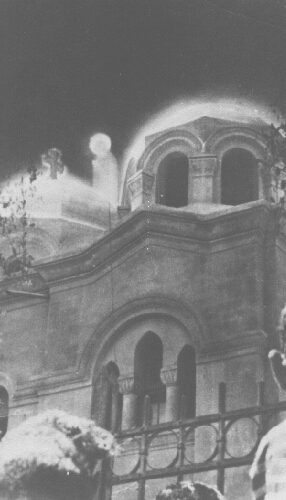

From 2 April 1968, crowds in the Zeitoun district of Cairo reported lights and a figure they took to be the Virgin Mary above the Coptic Orthodox church dedicated to her. The Coptic Patriarchate declared the appearances real within weeks; sceptical scholars, among them the anthropologist Cynthia Nelson, wrote of lights of unclear origin. The Coptic Church belongs to the Oriental Orthodox family, not to any of the seven traditions compared on this site, so the readings below give where each of the seven has spoken of Zeitoun and, where it has not, what it teaches in general.
| Date | Evening of 2 April 1968 until about 1971; the lights recurred on many nights, from minutes to hours at a time, according to witnesses |
|---|---|
| Place | Church of the Virgin Mary, Tomanbey Street, Zeitoun, Cairo, Egypt |
| Claimed by | The Coptic Orthodox Church of Alexandria (Oriental Orthodox), under Pope Kyrillos VI; the witnesses are reported to have included Copts, other Christians and Muslims |
| Type | Marian apparition: a figure and lights seen above the church's domes |
| Official status | Declared genuine by the Coptic Orthodox Papal Residence (statement of 4 May 1968); feast on 2 April in the Coptic Church. No Eastern Orthodox, Catholic or Protestant church judgment has been found |
| Investigations | Committees of Coptic clergy under Pope Kyrillos VI (1968); anthropologist Cynthia Nelson (1973); the geophysical proposal of Derr and Persinger (1989) |
What is claimed
According to the Coptic Patriarchate, the appearances began on the evening of Tuesday 2 April 1968 (24 Baramhat 1684 in the Coptic calendar). The church's own site says two women passing and workers at the garage across the street saw a figure above the central dome; the garage worker Farouk Mohamed Atwa shouted for the woman to come down, and a non-Christian woman is reported to have cried, "It's Our Lady Mary!" The figure, often described as a woman in white, and bright lights returned on many nights. Witnesses differ: some saw a clear figure, some only light, and some nothing. Crowds gathered nightly; Al-Ahram is quoted as reporting on 27 April 1968 that "thousands" came each night, and the garage was vacated to make room for visitors.
The Papal Residence's statement says that Mary "has indeed appeared repeatedly and clearly" over the church, and cites a revival of faith and "marvelous signs of miraculous healing in many individuals, verified both scientifically and through collective testimonies." Coptic accounts report healings of blindness, paralysis and cancer and say that the witnesses included Muslims and Jews as well as Copts, other Orthodox, Catholics and Protestants (OrthodoxWiki). Totals are given as hundreds of thousands (Skeptic's Dictionary) or millions (OrthodoxWiki); neither can be checked.
History and devotion
Tawfik Khalil Abraham, who had planned a hotel in 1920, built a church instead, completed about five years later (University of Dayton Marian Library). Nelson's article of 1973 opens by placing the appearances ten months after the Six-Day War. The land of the garage was later sold to the church, and a large Cathedral of the Virgin Mary was built beside the older church, which is known as the Church of the Apparitions. The Coptic Church keeps 2 April (24 Baramhat) as a feast of the apparition. Joe Nickell links the district to the legend of the Holy Family's flight into Egypt (Skeptic's Dictionary); see Mary and the saints.
Investigations
Church committees. Pope Kyrillos VI appointed a committee of senior priests and bishops, headed by Anba Gregorios (OrthodoxWiki); the Marian Library says twelve bishops, among them Athanasius of Beni Suef, who recorded his own sighting on 29 April 1968. The Patriarchate says that committees of clergy "investigated the truth and personally witnessed the apparition" and reported to the Pope, and that thousands of witnesses "have agreed in their descriptions." Bishop Athanasius read the statement at a press conference; it is dated 4 May 1968 in most accounts, and 5 May, the date of the Watani report, in others. A committee report quoted on the church's site says the apparition "is authentic and without deception." Sacred Heart sisters are reported to have sent a report to the Vatican, and an envoy came on 28 April (OrthodoxWiki; The Miracle Hunter; neither gives the report's content).
Sceptical findings. Cynthia Nelson, an anthropologist at the American University in Cairo, published "The Virgin of Zeitoun" in Worldview (September 1973). In published summaries of the article she visited several times and saw only intermittent flashes of light and an ambiguous glow, noted that the street lamps had been disconnected, and looked for the sightings' cause in the witnesses' intellectual and emotional concerns rather than in a visible figure. Michael P. Carroll (The Cult of the Virgin Mary, 1986) proposed that lights of uncertain origin were read as Mary because of the strains after the 1967 defeat and Mary's association with the district. John Derr and Michael Persinger (Perceptual and Motor Skills, 1989) proposed that tectonic strain produced luminous phenomena; Robert Todd Carroll adds that seismic activity near Zeitoun rose roughly tenfold in the period, says that he does not know what caused the lights, and holds that witnesses supplied the identification as Mary, since the lights said nothing. He ranks the Marian explanation last of the possibilities.
Defenders' reply. Travis Dumsday, a philosopher at Concordia University of Edmonton, argues in The Marian Apparitions at Zeitoun: An Evidential Inquiry (SVS Press, 2024) that every naturalistic explanation proposed so far has failed, so that the events are "powerful evidence for the reality of the supernatural" (the publisher's summary).
Official status
The Coptic Orthodox Papal Residence declared the appearances real in 1968, and the Coptic Church keeps a feast on 2 April; the sources consulted do not say whether belief in them is required of Copts. The Holy See sent an envoy but, according to the Marian Library, Pope Paul VI left the judgment to the Coptic community. Cardinal Stephanos I, the Coptic Catholic patriarch, is reported by The Miracle Hunter to have investigated in May 1968 and submitted findings to Paul VI, which that source does not summarize. The Catholic Church has issued no approval of its own, and no Eastern Orthodox or Protestant church has been found to have ruled on the matter.
Where each church stands
- Catholic:
The Catholic Church has made no judgment on Zeitoun, and the Holy See left the matter to the Coptic authorities. Its general teaching is that private revelations, even approved ones, do not belong to the deposit of faith and cannot "improve" or "complete" Christ's revelation (Catechism 67). Under the norms of the Dicastery for the Doctrine of the Faith (17 May 2024), the diocesan bishop examines an apparition within his territory, and a nihil obstat is given "without expressing any certainty about the supernatural authenticity" of the event; even then "the faithful are not obliged to give an assent of faith to them."
- Orthodox:
The Eastern Orthodox (Chalcedonian) churches are a separate communion from the Coptic Church, and no official Eastern Orthodox statement on Zeitoun has been found. The Orthodox Church in America teaches that the Church honors miracles in its saints, several of whom it calls wonderworkers. The two families held a joint dialogue on Christology (1989, 1990, 1993). SVS Press, the press of St Vladimir's Orthodox Theological Seminary, published Dumsday's book on Zeitoun (2024), which speaks for its author, not for the church.
- Lutheran:
No Lutheran church has made a statement about Zeitoun. The Lutheran Church-Missouri Synod's Commission on Theology and Church Relations does not deny that God gives gifts "according to His good pleasure and the needs of the church," and holds that "the Word and the sacraments are the only means of grace" (The Charismatic Movement and Lutheran Theology, 1972; see Spiritual gifts, tongues and healing).
- Reformed:
No Reformed church has made a statement about Zeitoun. The Westminster Confession says that God's "former ways" of revealing his will are "now ceased" (1.1), and Calvin held that apostles and prophets were "not instituted in the Church to be perpetual" (Institutes 4.3.4); cessationism is common among Presbyterians. The Christian Reformed Church (1973) holds that Christ gives "whatever gifts he judges necessary" in every age. See Scripture alone.
- Anglican:
No statement by the Church of England or the Anglican Communion on Zeitoun has been found. Article VI of the Thirty-Nine Articles holds that what is not read in Scripture or proved by it is not "to be required of any man, that it should be believed as an article of the Faith."
- Methodist:
No Methodist church has made a statement about Zeitoun. John Wesley held that the extraordinary gifts were not "common in the church for more than two or three centuries," and blamed their decline on love having "waxed cold," not on God's withdrawing them (Sermon 89, The More Excellent Way, 1787).
- Baptist:
No Baptist body has made a statement about Zeitoun. Baptists are divided between cessationists, who follow the Second London Confession (1677/1689, 1.1) in holding that God's "former ways" of revealing his will have ceased, and continuationists; the Baptist Faith and Message (2000) does not mention apparitions. Most Baptist churches pray for the sick, following James 5:14–15, without claiming a gift of healing.
Sources
- Our Lady of Zeitoun (ourladyofzeitoun.com): home page, reports and documents first witnesses, Al-Ahram report, feast on 2 April
- Watani, 5 May 1968: Papal Residence statement (ourladyofzeitoun.com)
- OrthodoxWiki, "Zeitun" committee under Anba Gregorios; envoy and nuns' report
- University of Dayton Marian Library, "Mary in Zeitoun" (2024) church c. 1925; twelve bishops; Vatican left judgment to the Coptic community
- The Miracle Hunter, "Zeitun" Cardinal Stephanos; Catholic reports
- Nelson, "The Virgin of Zeitoun," Worldview 16:9 (1973), pp. 5-11 only the opening extract was read; Nelson's observations are taken from published summaries
- Carroll, Robert Todd, "Zeitoun," The Skeptic's Dictionary
- Derr and Persinger, Perceptual and Motor Skills 68(1), 1989, pp. 123-128
- Carroll, Michael P., The Cult of the Virgin Mary: Psychological Origins (Princeton, 1986)
- Dumsday, The Marian Apparitions at Zeitoun: An Evidential Inquiry (SVS Press, 2024)
- Dicastery for the Doctrine of the Faith, Norms for proceeding in the Discernment of alleged Supernatural Phenomena (17 May 2024)
- Joint Commission of the Orthodox and Oriental Orthodox Churches, agreed statements 1989, 1990, 1993 (Pro Unione)
- Church of England, Articles of Religion
- Image: File:Our Lady of Zeitun.jpg, Wikimedia Commons