Philaret of Moscow 1782–1867
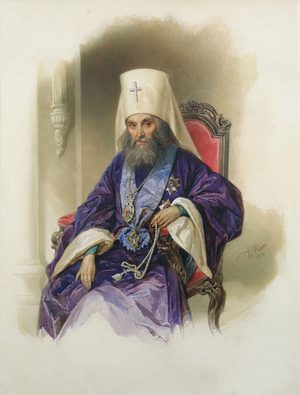

Philaret (Drozdov) was Metropolitan of Moscow for more than forty years and the leading Russian churchman of the nineteenth century. His Longer Catechism, approved by the Holy Synod in 1830, became a standard statement of Russian Orthodox teaching, and this site quotes it as an Orthodox source throughout. Other churches have met him as the voice of the Russian Church, as the force behind the Russian Bible, and as the metropolitan who refused William Palmer communion.
| Lived | 26 December 1782 (Old Style; 6 January 1783), Kolomna, to 19 November (1 December) 1867, Moscow |
|---|---|
| Church | Russian Orthodox Church |
| Role | Rector of the St. Petersburg Theological Academy (1812); bishop from 1817; member of the Holy Synod from 1819; Archbishop of Moscow from 1821; Metropolitan of Moscow from 1826 until his death |
| Influenced by | The Greek Fathers, whom he cites throughout his Catechism; his spiritual elder, Archimandrite Anthony (Medvedev) of the Trinity Lavra |
| Influenced | Theological teaching in Russian instead of Latin; the Synodal Russian Bible (1876); Orthodox instruction in Russia and abroad through the Catechism |
| Writings | Christian Catechism (1823); Longer Catechism (approved by the Synod, 1830); sermons (collected 1820 and 1830–36); Russian translations of the Psalms (1822) and the Gospel of John |
| Honored | 19 November (Old Style) in the Russian Orthodox calendar; glorified as a saint in 1994 |
Life
Vasily Drozdov was born at Kolomna, the son of a deacon who later became a priest. He studied at the Kolomna seminary and the Trinity Lavra near Moscow, taught at the Lavra from 1803, and was tonsured Philaret in 1808. In 1809 he went to teach at the Theological Academy in St. Petersburg, becoming its rector in 1812, and he worked to have classes taught in Russian and not in Latin. He was consecrated bishop in 1817 as vicar of the St. Petersburg diocese, became Archbishop of Tver in 1819 and Archbishop of Moscow in 1821, and was made Metropolitan in 1826.
From 1814 to 1826 he took part in the Russian Bible Society, believing that Scripture in modern Russian would revive the Church. When the Society was closed at the start of Nicholas I's reign, its leaders, he among them, were accused of being freemasons seeking to destroy Orthodoxy. In the 1840s he was forced out of the Synod by the chief procurator, Count Protasov, and he attended no meetings from the early 1840s until 1855. Under Alexander II the Bible translation resumed under the Synod, and Britannica says he directed it; the complete Bible appeared in 1876, nine years after his death. He is credited with the text of the Emancipation Manifesto, issued on 3 March 1861 (19 February Old Style). He died at Moscow and was buried at the Trinity Lavra of St. Sergius.
What he taught
The Longer Catechism is his main work. Its three parts treat faith (the Creed and the sacraments), hope (prayer, the Lord's Prayer and the Beatitudes) and love (the commandments). It teaches that salvation needs both faith and works: "Faith without works is dead" (Q 5, quoting James 2:20, KJV). Revelation reaches men by two channels, holy tradition and holy Scripture (Q 16), and Scripture is to be understood in the sense that agrees with "the interpretation of the orthodox Church and the holy Fathers" (Q 56; Scripture alone). For the Old Testament it follows the twenty-two books of the Hebrew list and says that other books, such as Sirach, were appointed by the Fathers to be read by those preparing for admission to the Church (Q 31–35; the canon).
On the Church it says that the Church "can not sin, nor err, nor utter falsehood in place of truth" (Q 271), and that all who obtain salvation obtain it "only in the one Catholic Church" (Q 272), which it identifies with the ancient churches of the East, among them the Church of Russia (Q 273; outside the Church). It holds that the Creed's teaching on the Holy Spirit admits no supplement, citing canon 7 of the Council of Ephesus against any new creed (Q 242; the Filioque). It teaches baptism by threefold immersion, which cannot be repeated (Q 288, 303–304; baptism); that the bread and wine "are changed, or transubstantiated" into Christ's body and blood, without defining how (Q 339–340; transubstantiation); and that the prayers of the Church and the Liturgy help the departed (Q 377; purgatory).
Philaret held that Church and State are two separate bodies working in harmony. He sponsored the Writings of the Holy Fathers in Russian Translation (1843–1893) and defended the elders of Optina Monastery when others attacked them.
What historians say
Britannica reports that the 1823 Catechism was revised several times to remove Lutheran influences, and that after 1839 it shaped nineteenth-century Russian theology. Encyclopedia.com adds that critics in church and government read his reforms as signs that Orthodoxy was growing dependent on Protestantism, and that he answered by grounding his theology more openly in the Fathers. The Orthodox Church in America's life of him says that he supported the Bible Society at first "without realizing how dangerous some of its ideas were," and that his elder Anthony criticized its "unorthodox ethos." In 1842 he judged the work of Gerasim Pavsky, a Hebrew scholar,"not sufficiently Orthodox," and copies were burned (Orthodox History).
On the Emancipation, Encyclopedia.com calls him the government's natural choice to compose the manifesto, and the New Schaff-Herzog Encyclopedia says he is "said to have prepared" it, while EBSCO names him and Yuri Samarin as co-authors, so the extent of his hand is a matter of dispute. On Scripture, the Christian History Institute says he "articulated the accepted understanding" that the Church alone may translate and publish it. The treatment of the Old Believers under the tsars is set out in the Orthodox record; the sources used for this page do not tie Philaret to particular acts against them.
How the churches see Philaret
- Catholic:
The Catholic Church has made no statement about Philaret. Pius IX's 1848 letter In suprema Petri apostoli sede to the Eastern churches drew the reply of the Eastern Patriarchs, which Philaret "fully endorsed" (Orthodox Church in America); it rejects the Filioque and papal claims, and the Catholic teaching on both is set out in the Filioque and the papacy. The Second Vatican Council's Unitatis Redintegratio (15) says the Eastern churches "possess true sacraments, above all by apostolic succession."
- Orthodox:
The Russian Orthodox Church glorified Philaret as a saint in 1994 (the OCA's life gives 1995) and keeps his memory on 19 November (Old Style). Philip Schaff, who published the Catechism in English, called it "the most authoritative doctrinal standard" of the Orthodox Graeco-Russian Church, one that "practically superseded" Peter Mogila's Orthodox Confession. It stands as a catechism approved by the Holy Synod (1830), not as a council's definition; this site cites it with the Confession of Dositheus and the 1848 Encyclical. See the Russian Orthodox Church.
- Lutheran:
The Lutheran churches have made no statement about Philaret. Britannica says the Catechism of 1823 was revised to remove its Lutheran influences. On the point where the Catechism and the Lutheran Confessions most differ, the Catechism sets holy tradition beside Scripture (Q 16–24), while the Formula of Concord names the prophetic and apostolic Scriptures as the "rule and norm" of all teaching (Scripture alone).
- Reformed:
The Reformed churches have made no formal statement about Philaret. Philip Schaff, a Reformed church historian, compared Blackmore's English translation with the Greek and German versions in Creeds of Christendom, vol. 2, and found it "faithful and idiomatic," and printed the whole Catechism. The Westminster Confession (1.10) names the Holy Spirit speaking in Scripture as the supreme judge of religious controversies, a different account of authority from the Catechism's two channels.
- Anglican:
The Anglican churches have issued no formal statement about Philaret. In 1840 William Palmer of Magdalen College, Oxford, went to Russia to seek recognition of the Anglican claim to intercommunion; after nearly a year the claim was "at length decisively rejected by the metropolitan of Moscow" (Dictionary of National Biography), and the Synod would admit him only if he acknowledged the Thirty-nine Articles. In July 1846 Palmer told Alexei Khomiakov that a parcel of his Harmony of Anglican Doctrine with the Doctrine of the Catholic and Apostolic Church of the East was being sent for Philaret. Palmer entered the Roman Church in 1855, and Newman later arranged his Notes of a Visit to the Russian Church (1882). The English Longer Catechism is by the Rev. R. W. Blackmore, formerly chaplain to the Russia Company at Kronstadt, in The Doctrine of the Russian Church (Aberdeen, 1845).
- Methodist:
The Methodist churches have made no statement about Philaret. Their Articles of Religion (Article V) hold that "The Holy Scripture containeth all things necessary to salvation," a different account of Scripture and tradition from the Catechism's (Q 16–24; sola scriptura).
- Baptist:
Baptist bodies have made no statement about Philaret. The Baptist Faith and Message (2000), art. I, calls Scripture "the supreme standard by which all human conduct, creeds, and religious opinions should be tried," which sets the standard against which Baptists would weigh the Catechism's appeal to tradition and the Fathers (Q 16–24, 56; holy tradition).
Sources
- Britannica, "Philaret" (Russian Orthodox theologian) dates, Moscow 1821, Catechism revisions, Bible
- Orthodox Church in America, "Repose of Saint Philaret (Drozdov), Metropolitan of Moscow" life, 1826, Bible Society, death and burial
- Encyclopedia of Eastern Orthodox Christianity, "St. Filaret (Philaret) Drozdov" career, Bible Society, Synod, canonization 1994
- Encyclopedia.com, "Filaret Drozdov, Metropolitan"
- New Schaff-Herzog Encyclopedia, "Philaret" works; emancipation
- EBSCO Research Starters, "Emancipation of the Russian Serfs"
- Christian History Institute, "Which text? Whose job? What language?"
- Orthodox History, "The Unholy Side of Holy Russia" Pavsky; Protasov
- The Longer Catechism of the Orthodox, Catholic, Eastern Church (Blackmore translation, as printed by Schaff)
- Schaff, Creeds of Christendom, vol. 2, "The Longer Catechism of the Russian Church"
- Orthodox Church in America, "Relations between the Churches East and West" (1848 Encyclical; Palmer)
- Dictionary of National Biography, "Palmer, William (1811–1879)"
- Palmer to Khomiakov, 1 July 1846, in Russia and the English Church (Project Canterbury)
- Palmer's Notes of a Visit to the Russian Church, selected and arranged by Newman (1882)
- Second Vatican Council, Unitatis Redintegratio (1964), 15
- Solid Declaration of the Formula of Concord (Book of Concord)
- Westminster Confession of Faith, ch. 1
- Articles of Religion of the Methodist Church (UMC)
- Baptist Faith and Message 2000, art. I
- Watercolor portrait by Vladimir Hau, 1854, Wikimedia Commons (public domain)