The Septuagint 3rd century BC onward
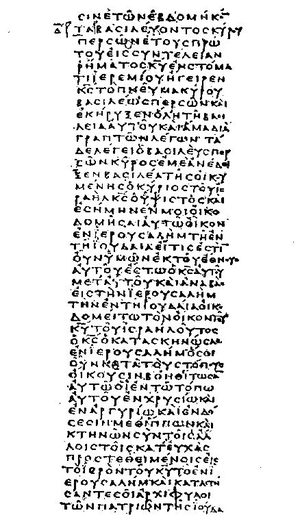

The Septuagint (LXX) is the Greek translation of the Hebrew Scriptures made by Jews in Alexandria, beginning in the 3rd century BC. It was the Bible of Greek-speaking Jews and of the early Church, and it contains books that are not in the Hebrew canon (the Apocrypha). Every tradition has a position on it: it is the Orthodox Church's Old Testament, a source of the Latin Bible of the West, and for Protestants a witness to be weighed against the Hebrew text.
| Published | The Pentateuch probably in the mid-3rd century BC; the other books over the following generations; Alexandria, Egypt |
|---|---|
| Translators | Unnamed Jewish translators; the Letter of Aristeas says seventy-two elders were sent from Jerusalem under Ptolemy II Philadelphus |
| Language | Koine Greek |
| Old Testament from | Hebrew (and some Aramaic) texts of its time, which differ in places from the later Masoretic Text |
| New Testament from | Not applicable: the Septuagint is the Old Testament only, though the great Greek codices bind it with the New Testament |
| Books | The Old Testament including the books Catholics call deuterocanonical (Tobit, Judith, 1 and 2 Maccabees, Wisdom, Sirach, Baruch, longer Esther and Daniel); Orthodox editions add 3 Maccabees and the Prayer of Manasseh |
| Approach | Made by different hands over generations, so method varies from book to book |
| Copyright | The ancient text is in the public domain; the modern critical editions are copyrighted (Rahlfs-Hanhart: Deutsche Bibelgesellschaft) |
| Used by | Greek-speaking Jews and the early Church; the Orthodox Church as its Old Testament; all traditions in scholarship |
How it was made
The Letter of Aristeas, presented as a letter from "Aristeas" to his brother Philocrates, tells how Ptolemy II Philadelphus, advised by his librarian Demetrius of Phalerum, asked the high priest Eleazar in Jerusalem for scholars to translate the Jewish Law for the royal library. Seventy-two elders, six from each tribe, were sent, and on the island of Pharos they finished in seventy-two days (Jewish Encyclopedia). The name "Septuagint," Latin for "seventy," comes from this number. The Catholic Encyclopedia judges the letter "certainly apocryphal" and its writer a Jew, not the Greek he claims to be, yet holds that the Pentateuch was probably translated at Alexandria in the mid-3rd century BC and that the Law, the Prophets and part of the Writings were in Greek before about 130 BC. The Jewish Encyclopedia reports a date of about 200 BC for the letter (Schürer) and itself argues for a Maccabean date.
Later writers embellished the story. Irenaeus (Against Heresies 3.21.2) says that when the elders' versions were compared before Ptolemy, "the Scriptures were acknowledged as truly divine." Augustine (City of God 18.42-43) held that the Seventy were moved by the same Spirit as the prophets, so that no single later translator should be preferred to them. Jerome wrote in his preface to the Pentateuch that he did not know who invented the tale of the seventy cells, that neither Aristeas nor Josephus tells it, and that to be a prophet is one thing and to be a translator another.
In the third century Origen set the Septuagint beside the Hebrew and other Greek versions (Aquila, Symmachus, Theodotion) in his Hexapla, marking where it added to or lacked the Hebrew. Three great codices carry the text: Vaticanus (B) and Sinaiticus (Aleph) of the 4th century, and Alexandrinus (A) of the 5th. The Catholic Encyclopedia calls Vaticanus the purest text and says Alexandrinus was altered toward the Hebrew.
How it translates
Besides the books of the Hebrew Bible it contains further books and longer forms of Esther and Daniel. Whether these belong to the Old Testament is the question treated in the canon chapter and on the Apocrypha page.
The New Testament writers, the Catholic Encyclopedia says, took most of their Old Testament citations from it. Fr. Lawrence Barriger gives as an example Matthew's quotation of Isaiah 7:14 in the Greek form "A virgin shall be with child," where the Hebrew has a word he renders "young woman." Another case is Psalm 40:6, which the KJV renders "mine ears hast thou opened"; Hebrews 10:5 cites it in the Greek form, "a body hast thou prepared me."
The two sides read the differences from the Hebrew differently. The translators of the King James Version said that the Septuagint "dissenteth from the Originall in many places." Orthodox writers answer that it reflects the Hebrew text as it stood in the 3rd and 2nd centuries BC (Hilarion Alfeyev, Orthodox Christianity II, 2012, p. 34), before the Masoretes fixed the standard Hebrew text between the sixth and ninth centuries AD, and Barriger adds that the Dead Sea Scrolls support the existence of differing Hebrew sources.
Reception and editions
Greek versions by Aquila, Symmachus and Theodotion appeared beside it, but the 1611 translators note that "the Edition of the Seuentie went away with the credit." The Old Latin Bibles were made from it (Catholic Encyclopedia). Jerome's turn to the Hebrew for the Latin Old Testament brought him into dispute with defenders of the Septuagint such as Augustine; see the Vulgate.
Alfred Rahlfs's Septuaginta (Stuttgart, 1935) is an eclectic text built mainly on Vaticanus, Sinaiticus and Alexandrinus; Robert Hanhart issued a corrected edition in 2006 (Rahlfs-Hanhart). The Göttingen Septuaginta-Unternehmen, founded in 1908 under Rahlfs, presents a critical text of each book from all accessible witnesses. The New Revised Standard Version took Rahlfs's edition, with Göttingen volumes, as the Greek basis for the deuterocanonical books. On which Septuagint books count as Scripture, see the Orthodox debate over the Old Testament.
Where each church stands on the the Septuagint
- Catholic:
The Church used the Septuagint from the start, and Vatican II's Dei Verbum (22) says she "accepted as her own that very ancient Greek translation" while giving "a place of honor" to the Vulgate. The Council of Trent (8 April 1546) declared the Vulgate authentic for public readings. Jerome's Vulgate Old Testament follows the Hebrew except for the Psalter (the Gallican Psalter, revised from the fifth column of Origen's Hexapla) and books he did not revise, such as Wisdom, Sirach, Baruch and 1 and 2 Maccabees, which come from the Old Latin, itself based on the Septuagint (Catholic Encyclopedia). John Paul II's Scripturarum thesaurus (25 April 1979) promulgated the Nova Vulgata, the Vulgate revised against the original texts, as the typical edition.
- Orthodox:
The Catholic Encyclopedia (1913) calls the Septuagint "the official text in the Greek Church," and Fr. Lawrence Barriger of the American Carpatho-Russian Orthodox Diocese (ACROD) writes that it is the "official version of the Old Testament used by the Orthodox Church," though he cites no formal decision. The Synod of Jerusalem (1672) called Wisdom, Judith, Tobit, Maccabees and Sirach "genuine parts of Scripture." Metropolitan Hilarion (Alfeyev) reports that Philaret of Moscow held it necessary to attribute "a dogmatic merit to the Translation of the Seventy." Fr. John Whiteford would read the Hebrew alongside the Septuagint and note the differences, while he reports that Fr. Stephen De Young holds the Masoretic Text equally authoritative.
- Lutheran:
Luther's complete Bible (1534) translated the Old Testament from the Hebrew, using a Masoretic Bible printed at Soncino in 1494, with the help of Matthäus Aurogallus. It set the books found only in the Septuagint apart as Apocrypha, "not held to be equal to Holy Scripture, but useful and good to read." The Lutheran Confessions name the prophetic and apostolic Scriptures as the norm but give no list of books, and in practice Lutherans use the 66-book canon.
- Reformed:
The Westminster Confession (1.8, 1647) holds that the Old Testament "in Hebrew" and the New Testament in Greek, "being immediately inspired by God, and by his singular care and providence kept pure in all ages," are authentic and the final appeal in religious controversies. It declares the books "commonly called Apocrypha" to be "no part of the canon of the Scripture" (1.3), so the Septuagint carries no authority of its own for Reformed churches.
- Anglican:
The translators of the King James Version, Church of England clergy, wrote in 1611 that the Seventy "were Interpreters, they were not Prophets," that their work "needed in many places correction," yet that the apostles used it; they translated from the Hebrew and Greek originals. This is the translators' statement, not an act of the Church. Article VI of the Thirty-Nine Articles lists the Hebrew canon as Scripture and says the Church reads the other books "for example of life and instruction of manners" but not to establish doctrine.
- Methodist:
Article V of the Methodist Articles of Religion (1784) receives the Old Testament books "of whose authority was never any doubt in the church." The United Methodist Church "does not have an 'official' version or translation of the Bible"; Discipleship Ministries prefers the Common English Bible and the New Revised Standard Version for curriculum. The NRSV's Old Testament rests on the Hebrew Biblia Hebraica Stuttgartensia, with the Septuagint followed only occasionally.
- Baptist:
The Second London Confession (1689, 1.8) names the Old Testament "in Hebrew" and the New Testament in Greek as the texts to which the church must appeal, and says the books commonly called Apocrypha, "not being of divine inspiration," are no part of the canon (1.3). On that basis Baptists treat the Septuagint as a translation and a witness to the Hebrew, not as a source of Scripture beyond it.
Sources
- Jewish Encyclopedia, "Aristeas, Letter of" the story; dating
- Catholic Encyclopedia, "Septuagint Version" (1913) origin, recensions, codices, editions, Greek Church use
- Irenaeus, Against Heresies 3.21.2 (New Advent)
- Augustine, City of God, Book 18 (New Advent)
- Jerome, Preface to the Pentateuch (Fourth Century Christianity)
- Translators to the Reader, King James Version (1611)
- Barriger, "The Septuagint," ACROD
- Whiteford, "Is the Septuagint the Authoritative Version of the Old Testament for the Orthodox Church?"
- OrthoChristian, "The Septuagint vs. the Masoretic Text" (quoting Hilarion Alfeyev, Orthodox Christianity II, p. 34)
- Deutsche Bibelgesellschaft, Septuaginta (Rahlfs-Hanhart)
- Göttingen Septuaginta-Unternehmen: Septuaginta, Vetus Testamentum Graecum (NYPL catalog record)
- New Revised Standard Version, "To the Reader"
- Dei Verbum (1965), para. 22
- John Paul II, Scripturarum thesaurus (1979)
- Catholic Encyclopedia, "The Vulgate" (via Catholic Culture) Gallican Psalter; Old Latin books; Trent decree
- Visser, The Luther Bible (Utrecht University)
- Musée protestant, "Martin Luther, translator of the Bible"
- Westminster Confession of Faith, ch. 1 (OPC)
- Second London Baptist Confession (1689), ch. 1
- Thirty-Nine Articles, Article VI (Church of England)
- United Methodist Church, official translation of the Bible (Interpreter, 2015)
- Codex Vaticanus plate, Wikimedia Commons (public domain)