The Geneva Bible 1560–1644
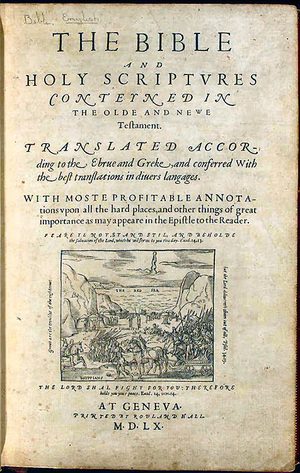

The Geneva Bible is the English Bible that Protestant exiles from the reign of Mary I made at Geneva: the New Testament in 1557, the whole Bible in 1560. It was the first complete English Bible with numbered verses, set in Roman type, and its marginal notes explained the text from a Calvinist point of view. It was the Bible of English and Scottish households for more than half a century, until James I, who objected to some of its notes, called for the translation that became the King James Version.
| Published | New Testament: Geneva, 1557. Whole Bible: Geneva, 1560, printed by Rowland Hall. First printed in England in 1576. Printed until 1644, in well over 100 editions |
|---|---|
| Translators | English Protestant exiles in Geneva, led by William Whittingham; Anthony Gilby is named for the Old Testament; Coverdale, Christopher Goodman, Thomas Sampson and William Cole are counted probable members. Laurence Tomson revised the New Testament in 1576 |
| Language | Early Modern English |
| Old Testament from | Hebrew and Aramaic, as a thorough revision of the Great Bible (Charles Ryrie) |
| New Testament from | Tyndale's latest text revised against the Greek (Estienne's edition of 1550) and Beza's Latin version and commentary; Tomson's 1576 revision follows Beza's Greek text |
| Books | The 66 books of the Protestant canon. The Apocrypha stand in a separate section between the Testaments, under a preface that denies them authority for doctrine |
| Approach | Close to the Hebrew and Greek, with words supplied for English sense set in italic, numbered verses, chapter summaries and marginal notes |
| Copyright | Public domain |
| Used by | English and Scottish Puritans and Presbyterians, and the Pilgrims of Plymouth, until the King James Version replaced it; no church is known to use it as its official Bible today |
How it was made
When Mary I restored Catholicism in England in 1553, Protestant scholars fled to the Continent, and a group settled at Geneva. William Whittingham, who had married a sister-in-law of John Calvin, prepared a New Testament that was printed there in 1557 by Conrad Badius. The Catholic Encyclopedia (1913) says it came with an introduction by Calvin and was the first English Bible with its text divided into verses. The whole Bible followed in 1560, printed by Rowland Hall and dedicated to Elizabeth I, who had succeeded in 1558. Its title page promised "moste profitable annotations upon all the hard places." Whittingham probably did most of the New Testament; the identity of all the translators is not certain.
The 1560 edition was printed abroad. English printing began in 1576, and some 140 editions are counted by 1644 (Ligonier Ministries; Dunham Bible Museum). The first Bible printed in Scotland, in 1579, was a Geneva Bible, and Parliament required each householder worth 300 marks of yearly rent to own a Bible (Dunham Bible Museum). In 1576 Laurence Tomson, Sir Francis Walsingham's secretary, revised the New Testament with Beza's Greek text and notes; from 1587 most Geneva Bibles carried his version.
How it translates
The Old Testament was made from the Hebrew as a thorough revision of the Great Bible, and the New Testament revised Tyndale's text against the Greek and Beza's Latin (Ryrie; bible-researcher.com). Its title says it was translated "according to the Ebrue and Greke" and conferred with the best translations in other languages. Whittingham's 1557 New Testament set words supplied for English sense in italic and took its verse numbers from Estienne's edition of 1551. The 1560 Bible was printed in Roman type instead of black letter, and each book and chapter carried a summary of its contents, so that it was designed, as David McKitterick puts it, "to be read, as well as to be heard" (Furniss). One rendering gave it a nickname: Adam and Eve "made themselves breeches" (Genesis 3:7), whence the "Breeches Bible".
The notes make it a study Bible. They give cross-references, alternative renderings and explanations, and set out Reformation teaching on justification and on predestination; Matthew Barrett (Founders Journal) adds that they identify the pope with the Antichrist. Ryrie compared the notes with those of the Bishops' Bible and found little difference on salvation or the sinfulness of man; the principal difference lay in the greater emphasis on predestination and election in the Geneva notes. Some notes bore on rulers. The note at Exodus 1:19 says of the Hebrew midwives who disobeyed Pharaoh, "Their disobedience herein was lawful, but their dissembling evil." The preface to the Apocrypha says the books were not received by common consent to be read publicly in the church and do not prove doctrine, though they may be read as the work of godly men for history and conduct.
Reception and revisions
The Geneva Bible far outsold the Bishops' Bible of 1568 and became the common household Bible of English Protestants. Shakespeare, Bunyan and Milton used it (Dunham Bible Museum), and Pilgrim Hall Museum holds William Bradford's 1592 Geneva Bible. At the Hampton Court Conference in January 1604, James I said, according to William Barlow's account, that some notes were "very partiall, untrue, seditious, and savouring too much, of daungerous, and trayterous conceites," and gave two examples: the note at Exodus 1:19, which "alloweth Disobedience unto Kings," and the note at 2 Chronicles 15:16, which "taxeth Asa for deposing his Mother, only, and not killing her" (quoted by Furniss and Fincham). The Puritan John Rainolds then asked for a new translation, and the king agreed. The 1611 translators were told to add no marginal notes beyond the explanation of Hebrew and Greek words, and to consult the Geneva Bible among others where the Bishops' text was faulty. Barrett cites estimates that about 20 percent of the King James Version came directly from the Geneva Bible.
Kenneth Fincham notes that the king's printers went on printing the Geneva Bible until 1616. Thomas Fuller reported in the 1650s that some Puritans regretted the loss of "the spectacles of those Geneva annotations." The usual last date for the Geneva Bible is 1644; the Dunham Bible Museum lists a London printing of 1778.
Where each church stands on the the Geneva Bible
- Catholic:
The Catholic Church has made no official statement about the Geneva Bible. The Rheims New Testament (1582), whose notes the Catholic Encyclopedia says were written chiefly by Bristow, Allen and Worthington, announced on its title page the exposing of "the corruptions of divers late translations"; the title page does not name Geneva. The Protestant William Fulke printed the Rheims text and notes beside the Bishops' Bible in 1589 to show the Rheims text inferior. Catholics count the books that the Geneva Bible sets apart as Apocrypha as Scripture. Dei Verbum 22 (1965) says the Church "sees to it that suitable and correct translations are made," and that translations made "in cooperation with the separated brethren" may be used by all Christians.
- Orthodox:
The Orthodox Church has made no statement about the Geneva Bible. The Synod of Jerusalem (1672, Confession of Dositheus, Question 3) judges Wisdom, Judith, Tobit, Susanna, the Maccabees and Sirach to be "Canonical Books," which the Geneva Bible places in a separate section under a preface denying them authority for doctrine. Its Decree 2 says Scripture is to be read "not otherwise than as the Catholic Church has interpreted and delivered the same."
- Lutheran:
No Lutheran confession or synod is known to have made a statement about the Geneva Bible. The Missouri Synod's Reformation site (Betsy Karkan, 2017) calls it "the most outstanding English translation of the Reformation" and notes Coverdale's part in it.
- Reformed:
The Geneva Bible was the Reformed Bible of the English-speaking world. The Scottish church used it throughout the reign of James VI, and an edition with Tomson's and Junius's notes was printed at Edinburgh in 1610 apparently with the consent of the Kirk (Fincham). Ligonier Ministries (2026) calls it "the Bible of Shakespeare" and says Puritans, the Plymouth Pilgrims and the Jamestown settlers carried it. The Westminster Confession (1.8) says Scripture is to be "translated into the vulgar language of every nation," and (1.3) that the Apocrypha are "not being of divine inspiration." No Reformed confession names the Geneva Bible.
- Anglican:
The Church of England never officially authorized the Geneva Bible, as Barrett notes. Archbishop Matthew Parker's Bishops' Bible of 1568 was the church's own version, and the Convocation of Canterbury in 1571 ordered it placed in every bishop's house, every cathedral and, as far as possible, every church (Gruber collection). At Hampton Court in 1604 James I objected to the Geneva notes (see above), and the translators of the King James Version were told to add none. Article VI of the Thirty-Nine Articles says the Church reads the Apocrypha "for example of life and instruction of manners"; the Geneva preface to them is similar in aim.
- Methodist:
No Methodist body has made a statement about the Geneva Bible, and the United Methodist Church has no official Bible translation (UMC). John Wesley's Explanatory Notes upon the New Testament (1754) were written on the King James Version, for "plain unlettered men."
- Baptist:
No Baptist body has made a statement about the Geneva Bible. An essay in Founders Journal by Matthew Barrett calls its marginal notes a distinctive feature and regrets that the King James translators dropped them. The Second London Confession (1689, 1.8) says Scripture is to be "translated into the vulgar language of every nation," and (1.3) that the Apocrypha are "no part of the canon or rule of the Scripture."
Sources
- Catholic Encyclopedia (1913), "Versions of the Bible" 1557 New Testament, Whittingham, Bishops' Bible, Rheims notes
- Bible-researcher.com, "The Geneva Bible" 1557 and 1560 texts, Roman type, italic, Estienne verses, Tomson, Junius
- Ryrie, "Calvinistic Emphases in the Geneva and Bishops' Bibles," Bibliotheca Sacra, January 1965 translators, sources, comparison of the notes
- Furniss, "Reading the Geneva Bible: Notes Toward an English Revolution?" (University of Strathclyde) numbered verses, summaries, Barlow's report of James I's two examples, the Exodus 1:19 note
- Fincham, "The King James Bible: Crown, Church and People" (University of Kent, 2020) James I's words at Hampton Court, printing until 1616, Edinburgh edition of 1610, Fuller, Dutch printings
- Dunham Bible Museum, "From Geneva: The First English Study Bible" 1560 printing, Scotland 1579, editions, 1778 printing, Breeches Bible, writers
- Ligonier Ministries, "The Original Geneva Bible" translators, editions, Shakespeare, Puritans, Pilgrims
- Barrett, "The Geneva Bible and Its Influence on the King James Bible," Founders Journal 86 notes, never authorized, 20 percent of the KJV
- Pilgrim Hall Museum, "Religion and Worship" William Bradford's 1592 Geneva Bible
- Wikimedia Commons, 1560 Geneva Bible facsimile preface to the Apocrypha (described in secondary transcriptions; facsimile not read)
- Wikipedia, "Bishops' Bible" Parker, 1568, aim of replacing the Geneva Bible; used only to find sources
- Gruber Rare Books Collection, "Bishop's Bible" (Lutheran School of Theology at Chicago) Convocation of 1571
- Wikipedia, "Hampton Court Conference" Rainolds's proposal; used only to find sources
- Wikipedia, "King James Version" instructions to the translators; used only to find sources
- Wikipedia, "Douay-Rheims Bible" Fulke's edition of 1589; used only to find sources
- Karkan, "The Cradle of Christ in Every Home: Reformation Translations of the Bible," lutheranreformation.org (2017)
- Vatican II, Dei Verbum 22
- Synod of Jerusalem (Confession of Dositheus) 1672
- Westminster Confession of Faith 1.3, 1.8 (OPC)
- Church of England, Articles of Religion
- UMC, "Does the UMC have an official Bible translation?"
- Wesley, Preface to Explanatory Notes upon the New Testament (1754)
- Second London (Baptist) Confession of 1689, chapter 1